Irrawaddy Dolphin
Orcaella brevirostris
A blunt-headed dolphin of Asian coasts and rivers that, in Myanmar, herds fish toward fishermen's cast nets.
Photo: Bernard Dupont / CC BY-SA 2.0
3 things to know
- In Myanmar's Ayeyarwady River, Irrawaddy dolphins drive fish toward fishermen's cast nets.
- Cast nets thrown with dolphins helping came up empty far less often than nets thrown without them.
- Cambodia's government put the Mekong population at 113 in February 2026, along about 180 km (112 miles) of river.
- Scientific name
- Orcaella brevirostris
- Depth
- 0 m – 10 m
0 – 33 ft - Size
- About 1.8–2.7 m (5.9–9 ft) long
- Weight
- About 90–200 kg (198–440 lb)
- Lifespan
- Estimated at 30 to 50 years
- Diet
- Fish, shrimp and probably other crustaceans
- Where
- Coasts, estuaries and lagoons of South and Southeast Asia, plus the Ayeyarwady, Mekong and Mahakam rivers
- IUCN status
- Endangered
- Depth zones
- Sunlight
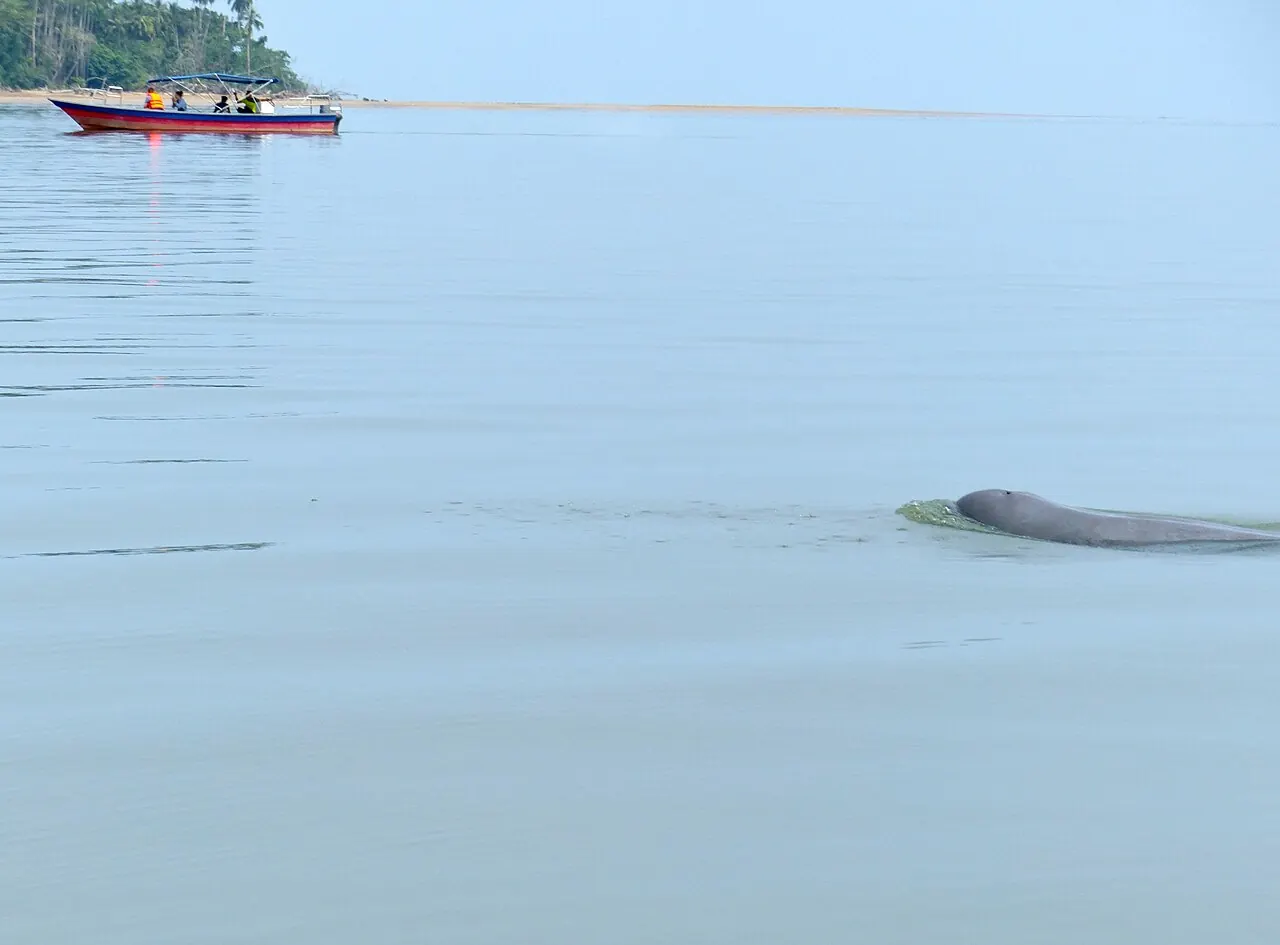
An Irrawaddy dolphin has a bulging, rounded forehead and only a short beak, and it is gray all over, a little paler on the belly. It surfaces with a slow roll and often lifts its tail clear of the water before a deep dive, and it has been seen spitting jets of water. WWF gives a length of 1.8 to 2.7 meters (5.9 to 9 feet) and a weight of about 90 to 200 kilograms (198 to 440 pounds). The only other member of its genus is the Australian snubfin dolphin, described as a separate species in 2005.
It lives in coastal waters, estuaries and lagoons of South and Southeast Asia, which SeaLifeBase says it usually uses at depths of 1 to 10 meters (3 to 33 feet), and in three big rivers: the Ayeyarwady in Myanmar, the Mekong in Cambodia and Laos, and the Mahakam in Indonesian Borneo. Groups are small, usually 2 to 7 dolphins. They eat fish and shrimp, finding them by echolocation in murky water.
In Myanmar's Ayeyarwady River, dolphins and cast-net fishermen fish together. Using calls and signals on both sides, the dolphins drive schools of fish toward the boats and the fishermen throw their nets as the fish come close. Brian Smith and colleagues measured what this is worth in November and December of 2006 and 2007 near Myay Zun. With dolphins cooperating, the catch per cast was about double in 2006 and about triple in 2007. Most of the difference came from empty nets: 68 to 71 percent of casts without dolphins came up empty, compared with 14 to 32 percent of cooperative casts. The fishermen also blamed illegal electric fishing for shrinking catches, and Myanmar had set up the 74-kilometer (46-mile) Ayeyawady Dolphin Protected Area in December 2005.
In the Mekong, the last published census by Cambodia's Fisheries Administration and WWF estimated 89 dolphins in 2020, along about 180 kilometers (112 miles) of river between Kratie and Khone Falls on the border with Laos. After a run of newborn calves, Cambodia's agriculture ministry put the count at 113 in February 2026. That river population is listed as Critically Endangered. Gillnets, dams upstream, overfishing and electrofishing are the main dangers there.
The IUCN's 2017 assessment lists the species as a whole as Endangered. Bycatch in fishing gear is its main threat, and in 2004 CITES banned international trade in live Irrawaddy dolphins.
Sources
- iucnredlist.org/species/15419/123790805
- worldwildlife.org/species/dolphin-and-porpoise/irrawaddy-dolphin
- worldwildlife.org/news/press-releases/numbers-of-critically-endangered-mekong-river-dol…
- wwfasia.awsassets.panda.org/downloads/dolphin-conservation-debrief--5-.pdf
- akp.gov.kh/post/detail/362459
- programs.wcs.org/myanmar/Wildlife/Dolphin.aspx
- Study: doi:10.1016/j.biocon.2009.01.015
- agris.fao.org/search/en/records/65de62786eef00c2cea07ed8
- sealifebase.se/summary/Orcaella-brevirostris.html
- marinemammalscience.org/science-and-publications/list-marine-mammal-species-subspecies



