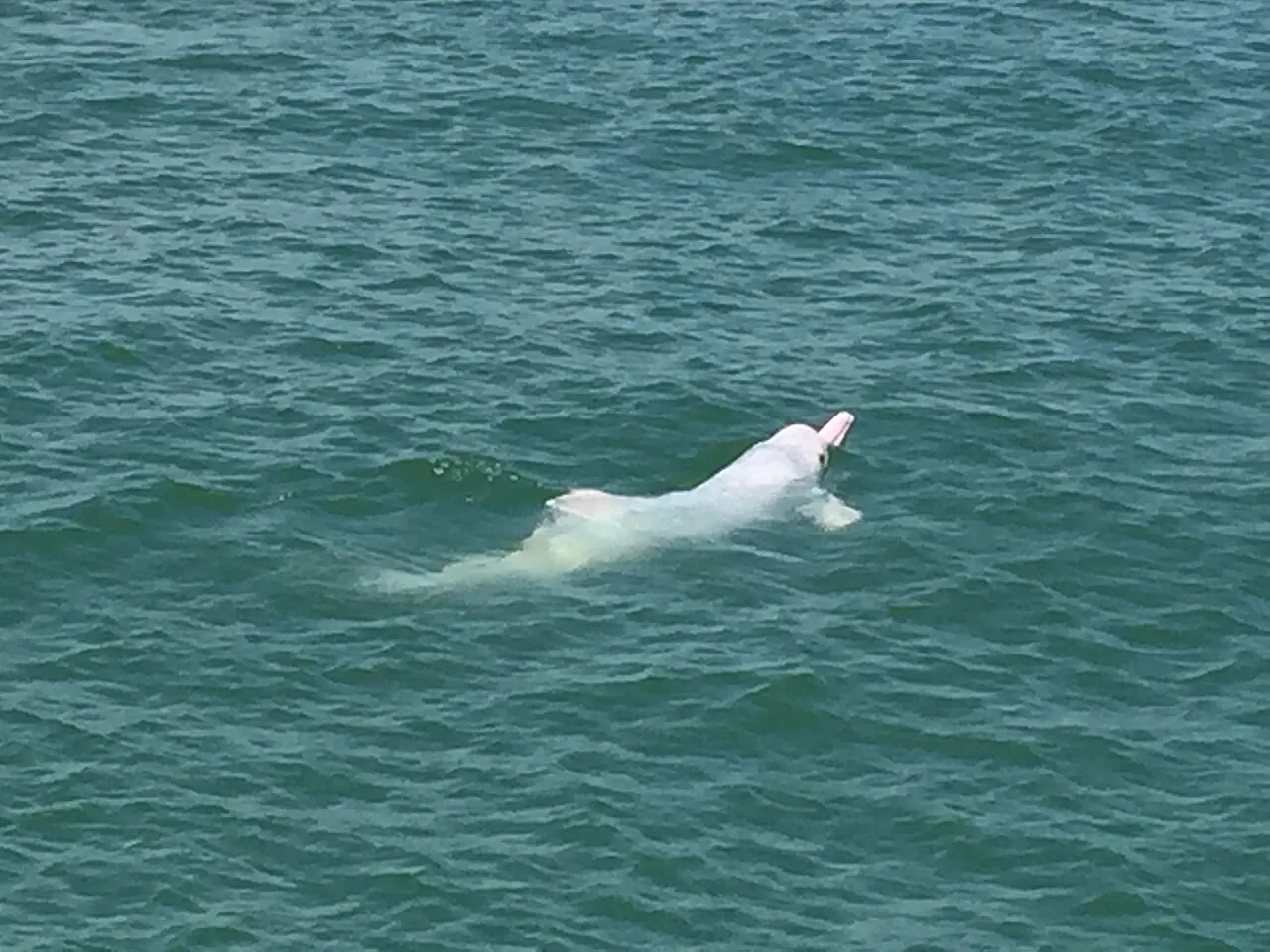
Indo-Pacific Humpback Dolphin
Sousa chinensis
A shallow-water dolphin that turns from dark gray to pinkish white as it ages, now scarce in Hong Kong waters.
Photo: Leonard Reback / CC BY-SA 4.0
3 things to know
- Calves are dark gray, but adults around China and Southeast Asia are white, often tinged pink.
- It rarely goes into water deeper than about 25 m (82 ft).
- Surveys estimated only 38 in Hong Kong's main dolphin areas in 2024.
- Scientific name
- Sousa chinensis
- Depth
- 0 m – 25 m
0 – 82 ft - Size
- About 1.8–3 m (5.9–9.8 ft) long, in an account that predates the split of the Indian Ocean humpback dolphin
- Weight
- About 250–285 kg (550–630 lb) when fully grown, in the same pre-split account
- Lifespan
- 40 years or more
- Diet
- Mainly estuarine fish, sometimes cephalopods and crustaceans
- Where
- Coastal waters from central China south through Southeast Asia to Borneo and west to eastern India
- IUCN status
- Vulnerable
- Depth zones
- Sunlight
Color is the giveaway with this dolphin, and it changes with age. Calves are dark gray, young animals turn a mottled grayish pink, and adults around China and Southeast Asia are white, often with a pink tint and a speckling of dark flecks. In Hong Kong it goes by Chinese white dolphin. The body is robust, with a long beak and a dorsal fin that rises from a hump on the back. Adults are about 1.8 to 3 meters (5.9 to 9.8 feet) long and weigh 250 to 285 kilograms (550 to 630 pounds), according to an Animal Diversity Web account written before the Indian Ocean humpback dolphin was split off.
This is a shallow-water animal. It ranges from central China near the mouth of the Yangtze River south through Southeast Asia to Borneo and west to the Orissa coast of India, keeping to bays, estuaries, mangroves and river mouths, usually in water about 20 meters (66 feet) deep and rarely deeper than 25 meters (82 feet). Humpback dolphins farther west in the Indian Ocean and off northern Australia were once included in this species and are now treated as separate species.
The Pearl River Estuary in southern China holds more than 2,000, one of the largest populations anywhere, and Hong Kong's western waters sit at its eastern edge. Samuel Hung and John Wang of the Hong Kong Cetacean Research Project, surveying for the Hong Kong government, estimated 38 dolphins in Hong Kong's four main dolphin areas in 2024; the lowest recent estimate was 32, in 2018. They report large declines over the past two decades in the waters north of Lantau Island, although numbers off west Lantau have held fairly steady in recent years. Photographs still identified at least 99 individuals using Hong Kong waters in 2023–24.
Off central western Taiwan lives a subspecies of its own, the Taiwanese humpback dolphin, described in 2015 (NOAA dates its formal recognition to 2016). Fewer than 100 remain, in a narrow strip of estuarine water mostly less than 20 meters (65 feet) deep. Entanglement in fishing gear and coastal development, including land reclamation, are the main threats, and NOAA Fisheries listed it as endangered under the US Endangered Species Act in 2018.
The IUCN lists the species as Vulnerable, in an assessment made in 2015 and published in 2017, with a decreasing population trend.
Sources
- iucnredlist.org/species/82031425/123794774
- animaldiversity.org/accounts/Sousa_chinensis
- afcd.gov.hk/english/conservation/con_mar/con_mar_chi/con_mar_chi_chi/con_mar_chi_chi_di…
- afcd.gov.hk/english/conservation/con_mar/con_mar_chi/con_mar_chi_chi/con_mar_chi_chi_ab…
- afcd.gov.hk/english/conservation/con_mar/con_mar_chi/con_mar_chi_chi/files/FinalReport_…
- afcd.gov.hk/english/conservation/con_mar/con_mar_chi/con_mar_chi_chi/files/FinalReport2…
- fisheries.noaa.gov/species/taiwanese-humpback-dolphin
- marinemammalscience.org/science-and-publications/list-marine-mammal-species-subspecies



