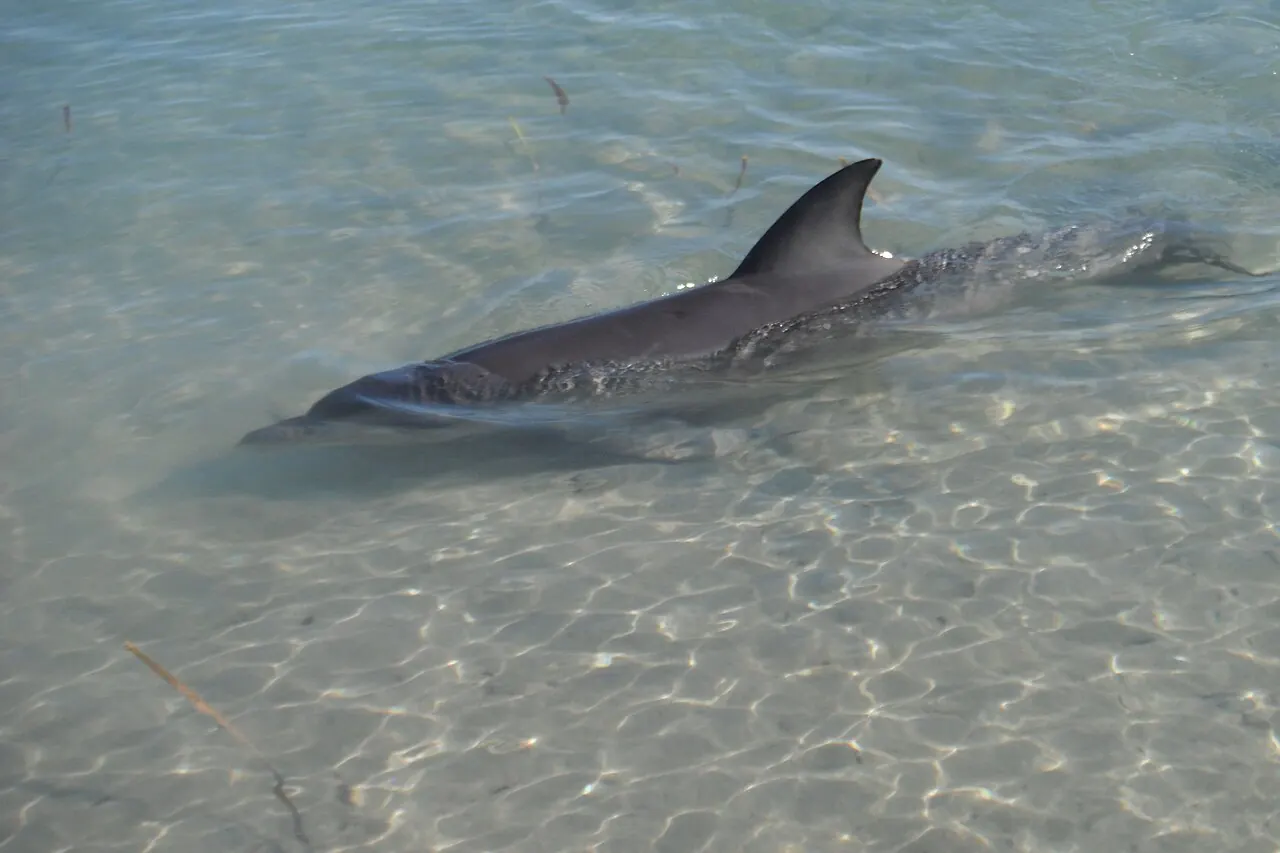
Indo-Pacific Bottlenose Dolphin
Tursiops aduncus
A slender, long-beaked bottlenose dolphin of warm coasts, known for the Shark Bay dolphins that hunt wearing sea sponges.
Photo: Dinkum / CC0
3 things to know
- Its pale belly is often marked with gray spots.
- Some dolphins in Shark Bay, Australia, wear marine sponges on their beaks while searching the seafloor for food.
- Sponging passes almost only from mothers to daughters within a single maternal line.
- Scientific name
- Tursiops aduncus
- Depth
- 0 m – 50 m
0 – 164 ft - Size
- Up to about 2.6 m (8.5 ft) long
- Weight
- Up to about 230 kg (510 lb)
- Lifespan
- More than 40 years
- Diet
- Mainly bony fish, also squid and other cephalopods
- Where
- Warm coastal waters of the Indian Ocean and western Pacific, from East Africa and the Red Sea to China and Australia
- IUCN status
- Near Threatened
- Depth zones
- Sunlight
Indo-Pacific bottlenose dolphins look a lot like common bottlenose dolphins, but they are more slender, with a longer, thinner beak. Adults grow to about 2.6 meters (8.5 feet) long and up to about 230 kilograms (510 pounds). The back is dark gray and the belly lighter gray or nearly white, often marked with gray spots.
The species lives along warm coasts of the Indian Ocean and western Pacific, from East Africa and the Red Sea to India, China and Australia. It is mostly a shallow-water dolphin: SeaLifeBase gives its usual depth as 1 to 50 meters (3 to 164 feet), and Animal Diversity Web describes it living near shore in water less than 300 meters (about 980 feet) deep. It eats mainly bony fish and, to a lesser degree, squid and other cephalopods. Groups of 5 to 15 are most common, though some gatherings number in the hundreds.
Pregnancy lasts about 12 months, and females give birth every three to six years, by different estimates. Wild dolphins can live more than 40 years, and the Shark Bay research project in Western Australia reports animals living into their early fifties. The IUCN lists the species as Near Threatened. Hunting and shark nets have threatened bottlenose dolphins in parts of the range, and tiger sharks prey on them, especially calves.
In Shark Bay, a few dolphins hunt with tools. They tear marine sponges off the seafloor and wear them over their beaks while probing the bottom for fish. In 2005, Michael Krützen and colleagues showed that this sponging passes almost entirely from mothers to daughters within one maternal line, and that all the adult spongers are so closely related that they likely descend from one recent "Sponging Eve." They called it the first known case of material culture in a marine mammal. Janet Mann's team later found that spongers are more solitary, spend more time in deep channels and dive longer than other females, yet raise calves about as successfully.
The Shark Bay dolphins were reclassified from common to Indo-Pacific bottlenose dolphins in 1999. The Shark Bay Dolphin Project notes that they carry mitochondrial types typical of both species, and the 2005 sponging paper calls them simply Tursiops sp.
Sources
- sealifebase.se/summary/Tursiops-aduncus.html
- animaldiversity.org/accounts/Tursiops_aduncus
- en.wikipedia.org/wiki/Indo-Pacific_bottlenose_dolphin
- monkeymiadolphins.org
- Study: doi:10.1073/pnas.0500232102
- Study: doi:10.1371/journal.pone.0003868
- Study: doi:10.2305/IUCN.UK.2019-3.RLTS.T41714A50381127.en
- iucn-csg.org/red-list-status-of-cetaceans



