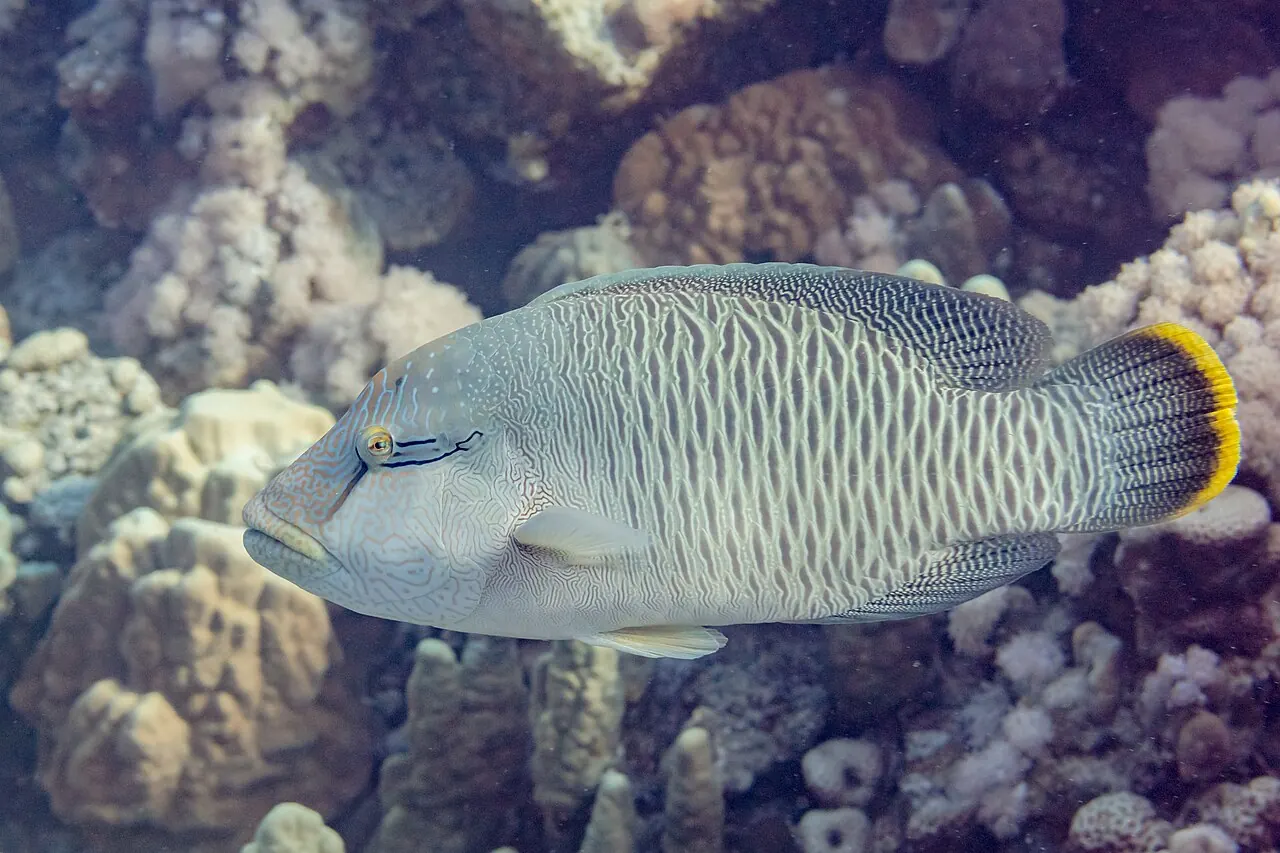
Humphead Wrasse
Cheilinus undulatus
A giant Indo-Pacific reef fish with a bulging forehead that eats toxic prey, changes sex, and is prized in the live reef food fish trade.
Photo: Diego Delso / CC BY-SA 4.0
3 things to know
- Both females and males grow the bulging forehead hump once they are large enough.
- It is one of the few predators of crown-of-thorns starfish, boxfishes and sea hares.
- Many start life as females and change to males at around 9 years old.
- Scientific name
- Cheilinus undulatus
- Depth
- 0 m – 100 m
0 – 328 ft - Size
- Reported up to 229 cm (7.5 ft) long, but no confirmed record over 150 cm (5 ft) fork length
- Weight
- Reported up to about 190 kg (420 lb)
- Lifespan
- Estimated maximum about 30 years for females and 25 for males (NOAA Fisheries); FishBase gives a maximum reported age of 32 years
- Diet
- Mollusks, small fishes, sea urchins, crustaceans, brittle stars and sea stars, including toxic boxfishes, sea hares and crown-of-thorns starfish
- Where
- Indo-Pacific reefs from the Red Sea and South Africa to the Tuamotu Islands, including Guam, the Northern Mariana Islands and American Samoa
- IUCN status
- Endangered
- Depth zones
- Sunlight
A bulging hump on the forehead gives the humphead wrasse its name, and it is not a mark of either sex. According to a 2014 NOAA Fisheries review, the hump starts to show at about 37 centimeters (15 inches), and every fish longer than about 75 centimeters (30 inches) has one. Adults are olive to green, with a blue-green head traced with wavy yellowish lines, thick fleshy lips and two dark lines running back from each eye. The species is often listed at 229 centimeters (7.5 feet) and 190 kilograms (420 pounds), but there are no confirmed records longer than 150 centimeters (5 feet) in fork length.
It lives across the Indo-Pacific, from the Red Sea and South Africa to the Tuamotu Islands. In US waters it is found around American Samoa, Guam and the Northern Mariana Islands, and at Wake Atoll and several Line and Phoenix islands, but it is absent from Hawaii except for occasional strays. Juveniles shelter in seagrass beds, coral-rich lagoons and mangroves. Adults patrol steep outer reef slopes, channels and drop-offs to at least 100 meters (330 feet) by day and rest in caves and under ledges at night.
The wrasse turns over and crushes rocks and rubble to reach hidden prey. Its thick lips appear to absorb the spines of sea urchins, and teeth in its throat crack heavy-shelled snails. It is one of the few predators of toxic animals such as boxfishes, sea hares and crown-of-thorns starfish. In some islands that diet can make its flesh carry ciguatera toxin.
Many humphead wrasse begin adult life as females and change to males at around 9 years old. NOAA Fisheries puts the maximum age at about 30 years for females and 25 for males, while FishBase lists a maximum reported age of 32 years.
For about three decades the fish has been one of the highest-valued luxury items in the live reef food fish trade, with Indonesia, Malaysia and the Philippines the main exporters. The IUCN moved it from Vulnerable to Endangered in 2004, the same year it was added to CITES Appendix II, which regulates trade. In 2014 NOAA Fisheries decided that it did not warrant listing under the US Endangered Species Act, finding that many populations, especially those in US waters, were stable, showed no clear trend or might be increasing. Its most recent IUCN assessment, in 2024, kept it at Endangered.



