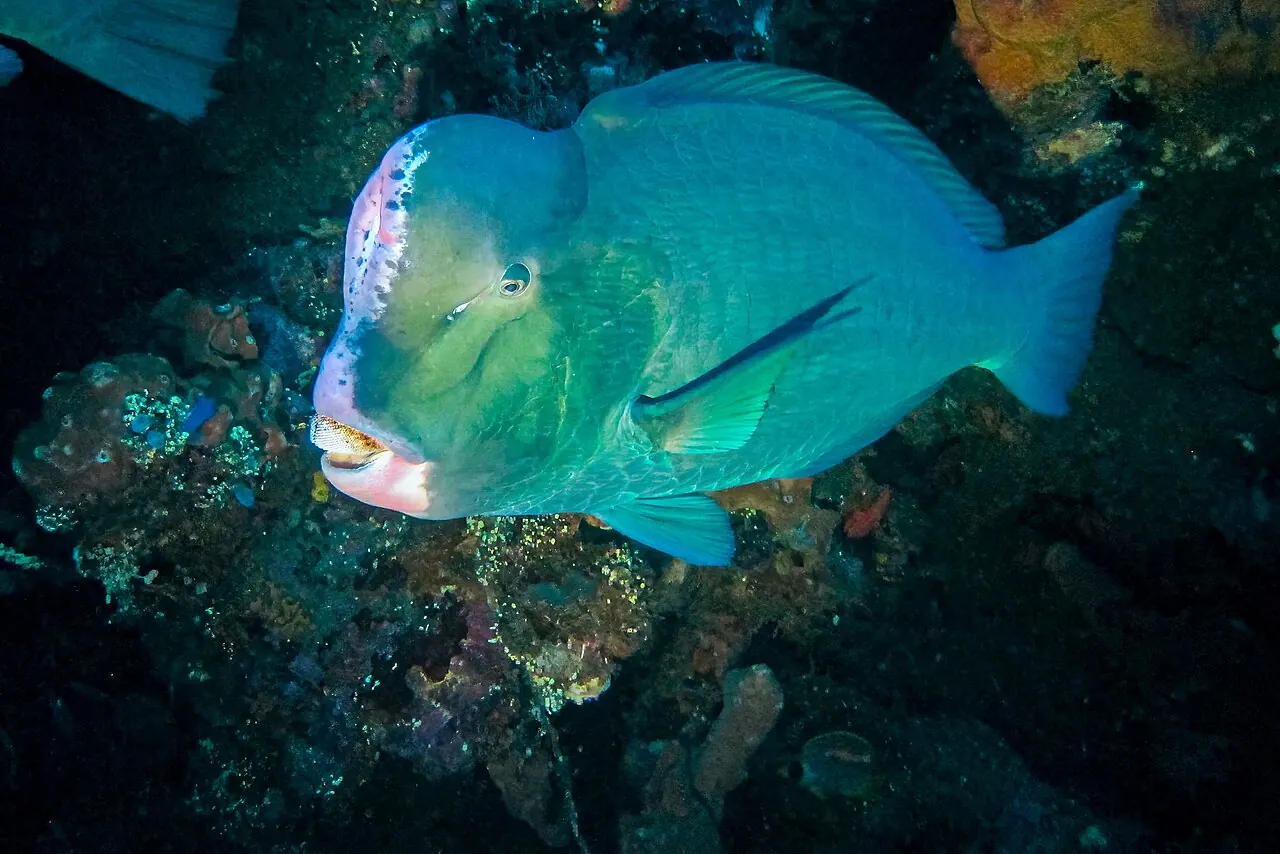
Humphead Parrotfish
Bolbometopon muricatum
The largest parrotfish, a reef giant that eats live coral by the ton and whose males settle rivalries by ramming heads.
Photo: Dirk Froebel / CC BY 4.0
3 things to know
- Each adult can swallow more than 5 metric tons of reef rock a year, almost half of it living coral.
- At Wake Atoll, rival males were filmed charging and ramming each other head-on.
- Groups sleep together in shallow water, which made them easy targets for night spearfishers.
- Scientific name
- Bolbometopon muricatum
- Depth
- 1 m – 40 m
3 – 131 ft - Size
- Up to 130 cm (4.3 ft)
- Weight
- Up to 46 kg (101 lb)
- Lifespan
- Up to about 40 years, the approximate maximum age used in a 2012 NOAA Fisheries status review
- Diet
- Algae, live coral and shellfish bitten from the reef
- Where
- Indo-Pacific reefs from the Red Sea and East Africa to Samoa and the Line Islands, including Guam, American Samoa, the Northern Mariana Islands and Wake Atoll
- IUCN status
- Vulnerable
- Depth zones
- Sunlight
A steep, bulging forehead marks the humphead parrotfish, also called the bumphead, the largest of all the parrotfishes. FishBase gives it a maximum of 130 centimeters (4.3 feet) and 46 kilograms (101 pounds). The bump shows on fish of at least 25 centimeters (10 inches), and young fish are brownish to green with rows of white spots, slowly turning a uniform dark green as adults. Small knobs on its teeth set it apart from other parrotfishes.
It lives across the Indo-Pacific, from the Red Sea and East Africa to Samoa and the Line Islands, including the US territories of Guam and American Samoa. Juveniles stay in lagoons. Adults move along clear outer lagoons and seaward reefs to at least 30 meters (98 feet), usually in small groups, eating algae, live coral and shellfish, and at night they sleep in caves and often in shipwrecks. FishBase says they sometimes ram corals with their heads to help them feed.
Their appetite reshapes reefs. On the Great Barrier Reef, David Bellwood, Andrew Hoey and Howard Choat calculated in 2003 that each fish swallows more than 5 metric tons of reef rock a year, almost half of it living coral. On relatively unexploited oceanic reefs, they found, the fish eat reef rock about as fast as the reef grows.
In August 2011, Roldan Muñoz of NOAA Fisheries and colleagues spent 100 hours watching the protected population at Wake Atoll, where one photograph of part of a spawning group showed 246 fish, and they found another use for the hump. In about 7 meters (23 feet) of water they heard loud cracks, then filmed rival males charging and smashing into each other forehead first, then circling to bite at each other's backs. They knew of no earlier scientific record of ritual headbutting in a marine fish.
Sleeping in groups in shallow water makes the species easy to catch. Muñoz's team describes how night spearfishing grew with the arrival of underwater flashlights in the 1970s, and how in the western Solomon Islands sleeping groups that had fed villages for generations disappeared. The IUCN lists the species as Vulnerable, with a decreasing population, in its 2024 assessment. In 2012 NOAA Fisheries decided against listing it under the US Endangered Species Act, finding that it still occupies its historical range, though at lower and declining numbers.
Sources
- fishbase.se/summary/Bolbometopon-muricatum.html
- fishesofaustralia.net.au/home/species/387
- iucnredlist.org/species/63571/264483873
- Study: doi:10.1371/journal.pone.0038120
- Study: doi:10.1046/j.1461-0248.2003.00432.x
- govinfo.gov/content/pkg/FR-2012-11-07/html/2012-27244.htm
- commons.wikimedia.org/wiki/File:Bolbometopon_muricatum_290186802.jpg



