Sunlight Zone · 0–200 m
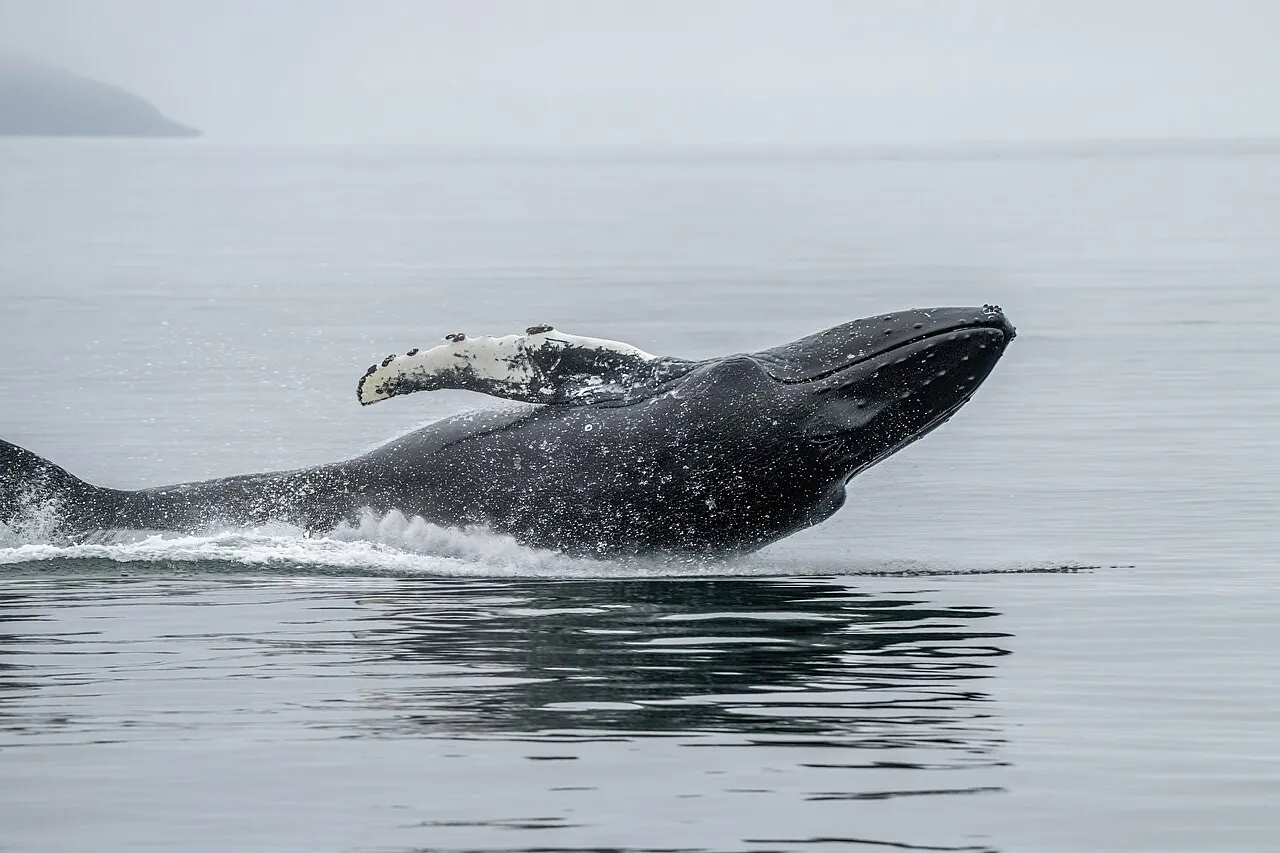
Why Would a 40-Ton Whale Throw Itself Into the Air?
Humpback whales hurl almost their entire bodies out of the sea, again and again. Scientists now have a good idea why.
Megaptera novaeangliae
A 40-ton whale that sings long, changing songs, herds fish with bubbles and launches itself out of the sea.
Photo: Giles Laurent / CC BY-SA 4.0
Humpback whales are mostly black, with different amounts of white on the flippers, the belly and the underside of the tail. The tail can be up to 18 feet (about 5.5 meters) wide, and its black and white pattern, shape and scars are unique to each whale. Adults reach about 18 meters (60 feet) long and weigh up to about 40 tons, according to NOAA Fisheries.
They live in all the world's major oceans and travel far between seasons. Some migrate about 8,000 kilometers (5,000 miles) between cold, productive feeding grounds at high latitudes and warm, shallow calving waters in the tropics, often near reefs or coasts. In the feeding months they filter krill and small fish from the water and build up blubber for winter. Some groups blow curtains of air bubbles around a school of fish, which pushes the fish toward the surface, then lunge up through the ring with their mouths open.
Most of this happens in shallow water. Off New Caledonia in the South Pacific, Solène Derville and colleagues put depth-recording tags on 18 humpbacks between 2016 and 2018. Of 7,986 recorded dives, 88.5 percent stayed above 80 meters (about 260 feet). The deepest reached 616 meters (about 2,020 feet).
Females usually have a single calf every two to three years, after an 11-month pregnancy, and the newborn is 13 to 16 feet (4 to 5 meters) long. Commercial whaling cut humpback numbers hard, and the International Whaling Commission's moratorium, in effect since 1985, helped them recover. The IUCN now lists the species as Least Concern, though under US law four of its 14 distinct population segments are still endangered and the Mexico segment is threatened. Entanglement in fishing gear, ship strikes, harassment by boats and underwater noise are the main threats.
Males sing long, repeating songs, and all the males in a population sing the current version. Over 11 years, Ellen Garland and colleagues traced new song types spreading east through the populations of the South Pacific, one after another. Breaching may be another long-distance message: in a study of migrating humpbacks led by Ailbhe Kavanagh, breaches were less likely when the nearest other group was within 4,000 meters (2.5 miles) than when it was farther away.



