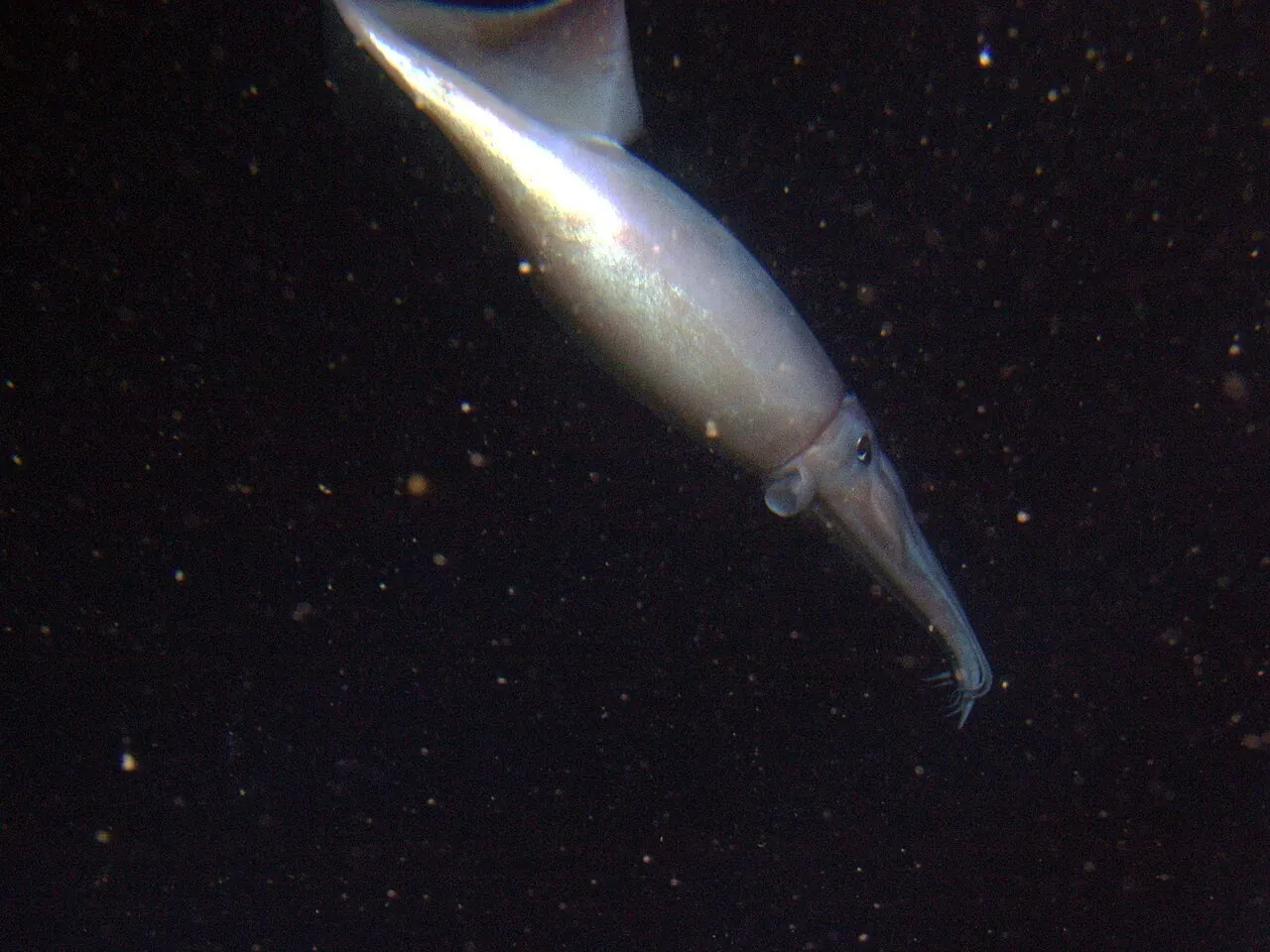
Humboldt Squid
Dosidicus gigas
A big, fast, cannibal squid of the eastern Pacific that moved into California waters in the 2000s and may signal with glowing skin.
Photo: Rick Starr/NOAA (Cordell Bank National Marine Sanctuary) / Public domain
3 things to know
- It has lived year-round off central California since 2002, north of its old range.
- A female can carry up to 32 million eggs, the highest potential fecundity known in a cephalopod.
- Its whole body may glow, backlighting the patterns on its skin.
- Scientific name
- Dosidicus gigas
- Depth
- 0 m – 1,200 m
0 – 3,937 ft - Size
- Mantle up to 1.2 m (3.9 ft); total length nearly 2.5 m (8.2 ft)
- Weight
- Up to 50 kg (110 lb); commonly 20–30 kg (44–66 lb)
- Lifespan
- About 1 year; the largest probably up to 2 years
- Diet
- Lanternfishes and other small fish, squid (including its own kind), red crabs and krill
- Where
- Eastern Pacific, mainly between about 22°N and 22°S; since 2002 resident off central California, with strays north to Alaska and south toward Tierra del Fuego
- IUCN status
- Data Deficient
- Depth zones
- Sunlight · Twilight · Midnight
The FAO's catalog of the world's cephalopods ranks the Humboldt squid, or jumbo flying squid, among the largest and most abundant squids of the open ocean. Its mantle can reach 1.2 meters (3.9 feet), its total length nearly 2.5 meters (8.2 feet) and its weight 50 kilograms (110 pounds), though most weigh 20 to 30 kilograms. It grows fast: most live about a year, and the biggest probably two. A female can carry up to 32 million eggs, the highest potential fecundity known in any cephalopod.
It lives only in the eastern Pacific, mainly between about 22°N and 22°S. Three squid tracked with acoustic tags off Costa Rica and Peru spent nights above 200 meters (660 feet) and dove below 1,000 meters (3,300 feet) by day, much of it in low-oxygen water. It eats lanternfishes and other small fish, krill, red crabs and squid, including smaller members of its own species, and it readily attacks squid hooked on fishing jigs.
It has also moved north. Using video from MBARI's remotely operated vehicle surveys in Monterey Bay, which began in 1989, Louis Zeidberg of Stanford and Bruce Robison of MBARI found no Humboldt squid there from 1989 to 1997, a pulse after the strong 1997 El Niño, and large numbers from 2002 on. They reported in 2007 that the squid appeared to be feeding and reproducing off central California, possibly helped by the decline of large tunas and billfish that eat and compete with it, and that within a month of the squid's increase, Pacific hake numbers dropped sharply. Some have reached Alaska, as far north as 59°N.
MBARI's cameras also suggest the squid communicate with their skin. In 2020, Ben Burford, working with Robison, analyzed footage from more than two dozen dives at 266 to 838 meters (870 to 2,750 feet) and found the squid showed specific color patterns mostly when interacting in groups. They proposed that light organs under the skin make the whole body glow yellow-green, backlighting the dark patterns like words on an e-reader screen, though the cameras were not sensitive enough to see the glow.
A large international fleet fishes for it off Peru with jigs and lights bright enough to be detected from space. The IUCN lists it as Data Deficient.
Sources
- fao.org/4/i1920e/i1920e07.pdf
- mbari.org/humboldt-squid-on-the-move
- Study: doi:10.1073/pnas.0702043104
- mbari.org/humboldt-squid-signaling
- Study: doi:10.1073/pnas.1920875117
- sealifebase.se/summary/Dosidicus-gigas.html
- marinespecies.org/aphia.php
- commons.wikimedia.org/wiki/File:Sanc1686_-_Flickr_-_NOAA_Photo_Library.jpg



