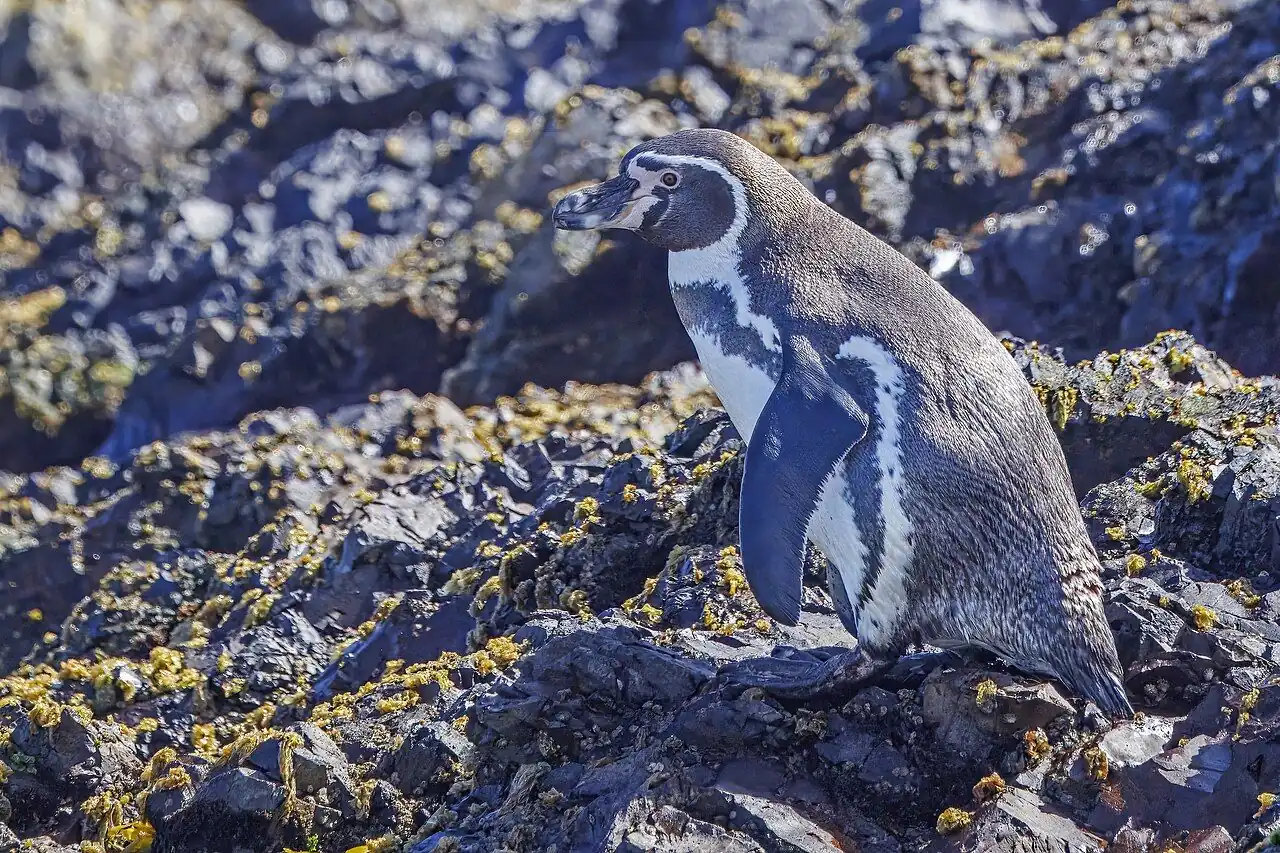
Humboldt Penguin
Spheniscus humboldti
A penguin of the desert coasts of Peru and Chile that once nested in deep guano, lost it to fertilizer miners, and swims hundreds of km in El Niño years.
Photo: Charles J. Sharp / CC BY-SA 4.0
3 things to know
- It once dug its nests into thick deposits of seabird guano.
- During the 1997–98 El Niño, tracked birds moved up to 895 km (556 miles) away.
- It has been listed as threatened under the US Endangered Species Act since 2010.
- Scientific name
- Spheniscus humboldti
- Depth
- 0 m – 54 m
0 – 177 ft - Size
- About 66–70 cm (26–28 in) long
- Weight
- About 4–5 kg (8.8–11 lb)
- Lifespan
- Not well known in the wild; 15–20 years reported in captivity
- Diet
- Schooling fish such as anchovy, sardine, silversides, garfish and Araucanian herring, plus squid
- Where
- Pacific coast of Peru and Chile, from about 5° S to Chiloé Island at 42° S
- IUCN status
- Vulnerable
- Depth zones
- Sunlight
Humboldt penguins once dug their nesting burrows into guano, the thick deposits of droppings left by cormorants, boobies and pelicans on islands off Peru and Chile. The burrows kept eggs and chicks out of the heat and away from predators. Over the last century and a half the guano was mined for fertilizer, and many penguins now nest in the open or in caves and under plants, according to the US Fish and Wildlife Service.
They are medium-sized penguins, about 66 to 70 centimeters (26 to 28 inches) long and 4 to 5 kilograms (9 to 11 pounds), blackish gray above and white below, with a solid black band across the breast and white stripes on the black head. They live along the Pacific coast of South America from Foca Island in northern Peru to the Puñihuil Islands off Chiloé, Chile, and their range follows the cold, rich Humboldt Current. They eat schooling fish such as anchovy, sardine, silversides and garfish, along with squid.
El Niño years test them hardest. When the upwelling of cold water fails, anchovy and sardine stocks crash. In a study published in 2000, a German team satellite-tracked five Humboldt penguins from Pan de Azúcar Island in northern Chile during the strong 1997 to 1998 El Niño and found that as the sea warmed, the birds spent up to 12.5 hours a day diving and moved as far as 895 kilometers (556 miles) away. Two of them, independently, found a productive patch 150 kilometers (93 miles) offshore. Their dives, however, were no deeper than in previous years, reaching at most 54 meters (177 feet).
Breeding runs from March to December, and pairs are monogamous and recognize each other in the colony. Tourism can stress them: one study found heart rates rose sharply with a person 150 meters (490 feet) away, and breeding success fell at heavily visited sites.
The IUCN's 2020 assessment counts about 23,800 mature birds and lists the species as Vulnerable, and in 2010 the US Fish and Wildlife Service listed it as threatened under the Endangered Species Act. Little is known about how long they live in the wild; SeaWorld reports 15 to 20 years in captivity.
Sources
- federalregister.gov/documents/2010/08/03/2010-18884/endangered-and-threatened-wildlife-…
- animaldiversity.org/accounts/Spheniscus_humboldti
- Study: doi:10.1242/jeb.203.15.2311
- Study: doi:10.2305/IUCN.UK.2020-3.RLTS.T22697817A182714418.en
- en.wikipedia.org/wiki/Humboldt_penguin
- iucnredlist.org/species/22697817/182714418
- Study: doi:10.3354/meps296173



