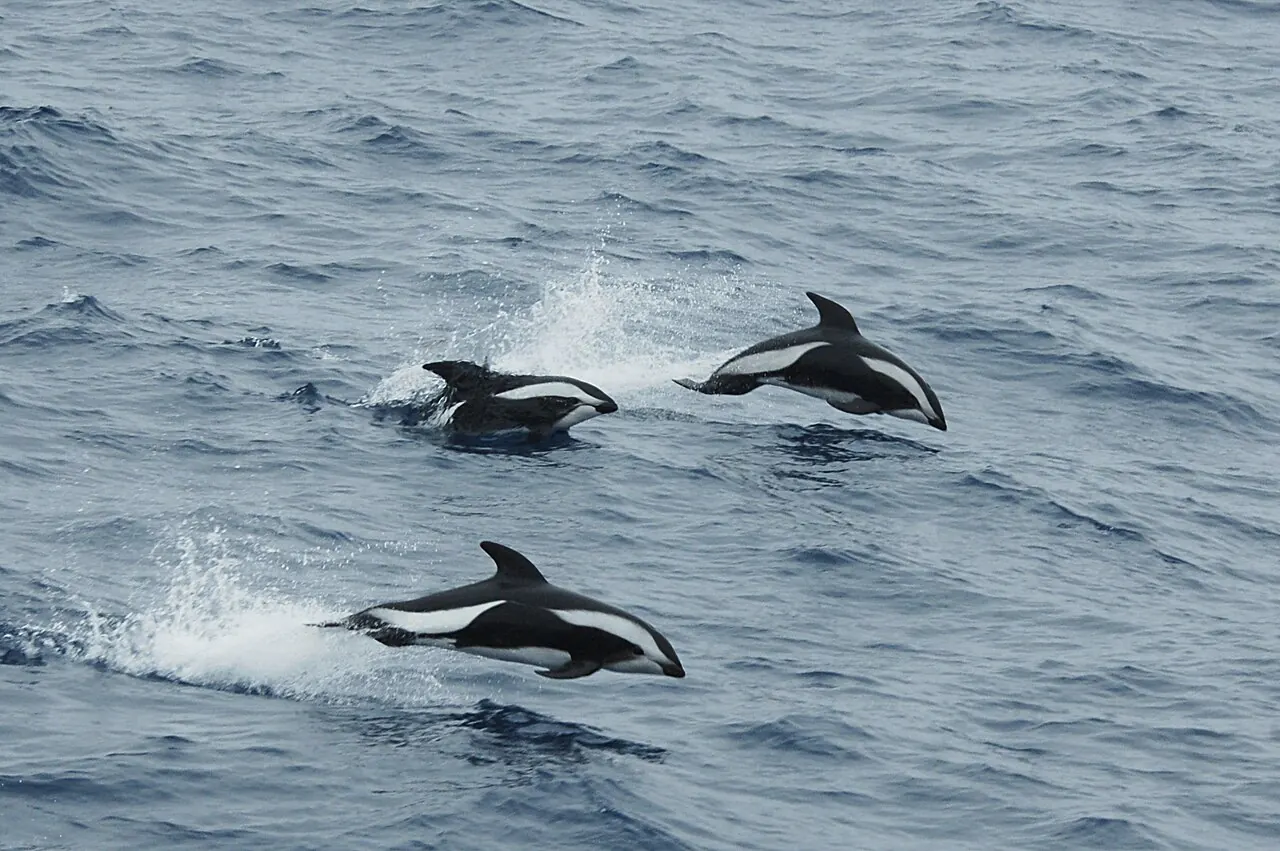
Hourglass Dolphin
Cephalorhynchus cruciger
A black-and-white dolphin of the Southern Ocean that rides ships' bow waves, clicks like a porpoise and now sits in the genus of Hector's dolphin.
Photo: Lomvi2 / CC BY-SA 3.0
3 things to know
- It steers toward big ships to ride their bow waves.
- Its echolocation clicks are high-pitched and narrow-band, like a porpoise's, unlike those of most dolphins.
- Surveys in the 1970s and 1980s estimated about 144,300 south of the Antarctic Convergence.
- Scientific name
- Cephalorhynchus cruciger
- Depth
- 0 m – 200 m
0 – 656 ft - Size
- Five females averaged 1.57 m (5.2 ft) and three males 1.75 m (5.7 ft); few have been measured
- Weight
- 73.5–94 kg (162–207 lb) in the three animals weighed
- Lifespan
- Unknown
- Diet
- Small fish such as lanternfishes, squid and crustaceans
- Where
- Southern Ocean all the way around Antarctica, mostly between 43° and 67° S near the Antarctic Convergence
- IUCN status
- Least Concern
- Depth zones
- Sunlight
Hourglass dolphins are boldly black and white. The back is black, and each side carries two white patches: one runs from behind the beak over the eye to mid-flank, the other from behind the dorsal fin to the tail stock, and the two may or may not join below the fin, giving the hourglass shape. The belly is white and the dorsal fin tall and strongly curved. In the handful measured, five females averaged 157 centimeters (5.2 feet) and three males 174.5 centimeters (5.7 feet), and three weighed between 73.5 and 94 kilograms (162 and 207 pounds).
Jean René Constant Quoy and Joseph Paul Gaimard named the species in 1824, calling it cruciger, the cross-bearer. It lives far from land all the way around Antarctica, mostly between 43° and 67° south and often near the Antarctic Convergence, in surface water of about -0.3 to 7°C (31 to 45°F). The dolphins steer toward big ships to ride their bow waves, and in one study 17 percent of encounters were with other whales, including fin whales. They feed near the surface in large gatherings that draw albatrosses and petrels; one stomach examined held squid beaks and another a lanternfish. How deep they dive has not been measured. Surveys from 1976 to 1988 estimated about 144,300 south of the Antarctic Convergence.
In the Drake Passage, Line Kyhn, Jakob Tougaard and colleagues made the first recordings of the species' echolocation clicks, published in 2008. The clicks were high-pitched, around 128 kilohertz, and narrow in bandwidth, the type used by porpoises and a few dolphins of the genus Cephalorhynchus but strikingly different from other dolphins. A 2009 follow-up found them louder than the clicks of Hector's dolphins, which the authors estimated should let hourglass dolphins detect prey at more than twice the distance.
For most of its history the species was placed in Lagenorhynchus, until in 2025 Anders Galatius and colleagues used more than 3,000 nuclear genes to show that it is more closely related to Hector's, Commerson's and the other Cephalorhynchus dolphins, and both the Society for Marine Mammalogy and the IUCN Red List now call it Cephalorhynchus cruciger.
The IUCN's 2018 assessment lists it as Least Concern. Only a few have been reported caught in fishing nets, though some are taken along with dusky dolphins for crab bait in Chile.
Sources
- animaldiversity.org/accounts/Lagenorhynchus_cruciger
- iucnredlist.org/species/11144/50361701
- marinemammalscience.org/science-and-publications/list-marine-mammal-species-subspecies
- Study: doi:10.1017/S0954102095000514
- Study: doi:10.1121/1.2933963
- Study: doi:10.1121/1.3075600
- en.wikipedia.org/wiki/Hourglass_dolphin



