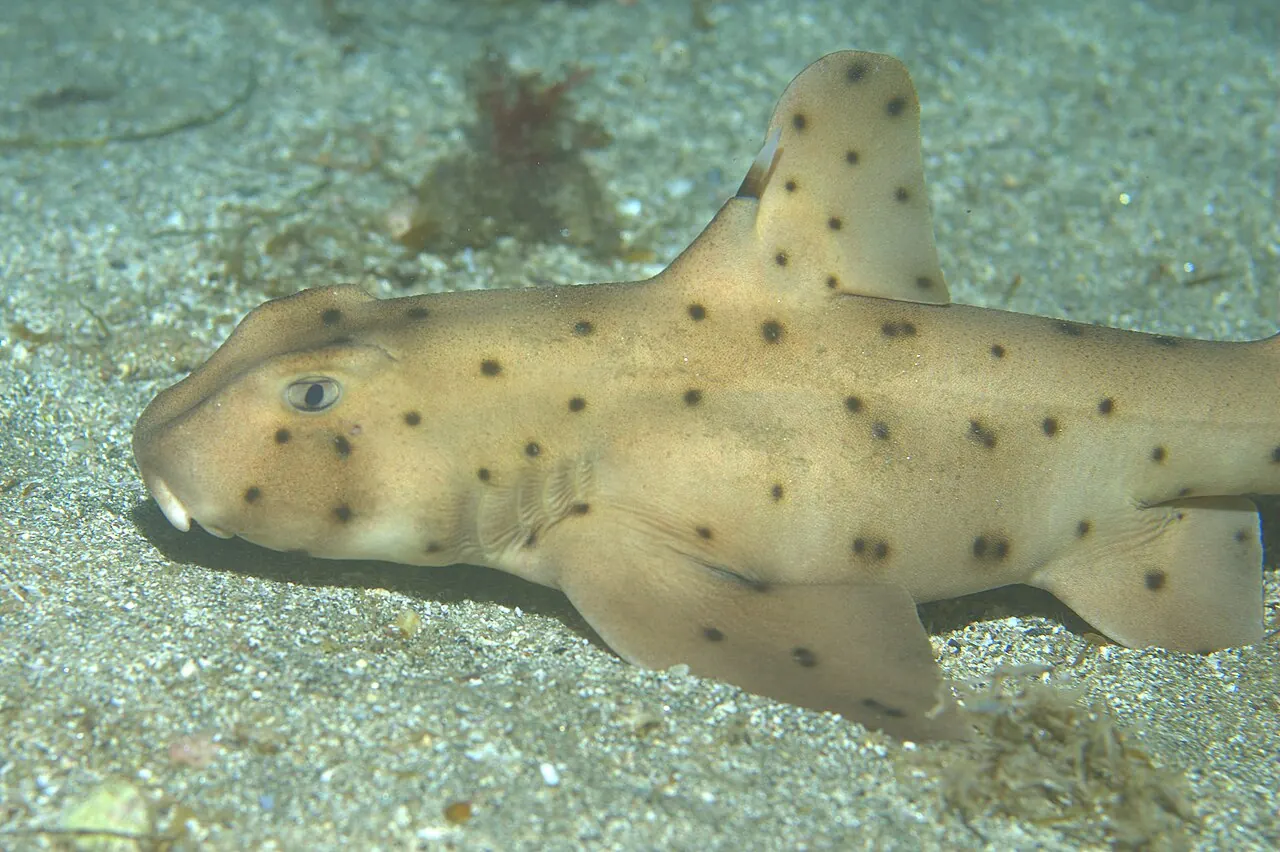
Horn Shark
Heterodontus francisci
A small, blunt-headed California shark with a spine before each dorsal fin, whose island and mainland populations rarely mix.
Photo: Ed Bierman / CC BY 2.0
3 things to know
- Females wedge their corkscrew-shaped egg cases into rock crevices, where the pups develop for six to nine months.
- Its pointed front teeth grip prey and its flat back teeth crush shells, which is what the name Heterodontus, 'different teeth', refers to.
- Horn sharks on the Channel Islands are genetically distinct from mainland sharks as little as 19 km (12 mi) away.
- Scientific name
- Heterodontus francisci
- Depth
- 2 m – 11 m
7 – 36 ft - Size
- Commonly about 97 cm (3.2 ft); up to about 122 cm (4 ft)
- Weight
- Not well known
- Lifespan
- Not well known: FishBase gives a maximum reported age of 12 years, while the Aquarium of the Pacific says about 25
- Diet
- Sea urchins, crabs and other bottom invertebrates, plus small fishes
- Where
- Eastern Pacific from central California and the Channel Islands to Baja California and the Gulf of California; possibly farther south
- IUCN status
- Least Concern
- Depth zones
- Sunlight
A ridge over each eye, a short blunt head and a stout spine in front of each of its two dorsal fins give the horn shark its odd profile. The "horns" are those fin spines. It is a small shark, gray or muddy brown with dark spots, commonly about 97 centimeters (3.2 feet) long and recorded to 122 centimeters (4 feet). Its scientific name, Heterodontus, means "different teeth": the pointed teeth at the front grip slippery prey, and the flat, molar-like teeth at the back crush shells.
Horn sharks live from central California to the Gulf of California, usually 2 to 11 meters (7 to 36 feet) down, on rocky reefs, in kelp beds and on sandy flats between rocks. They are sluggish and nocturnal. By day they rest in crevices, caves and under ledges, and adults tend to return to the same resting place every day. At night they hunt sea urchins, crabs and other invertebrates, along with small fish. They are poor swimmers and sometimes use their strong pectoral fins to clamber over rocks.
During courtship the male bites the female and wraps his body around her. Afterward she lays a series of egg cases shaped like corkscrews over about four months and wedges them into rock crevices. The young hatch after six to nine months.
Adults keep small home ranges, and that habit shows up in their genes. In a study published in 2022, researchers from the University of Hawai'i at Mānoa and Mexico's Instituto Politécnico Nacional compared mitochondrial DNA from 318 horn sharks across the range. Sharks along the mainland coast from Santa Barbara to Bahía Tortugas in Baja California were much alike, but those on the Channel Islands, as little as 19 kilometers (12 miles) offshore, were clearly distinct, a sign that horn sharks rarely cross deep, open water. Most sharks show such splits only over hundreds to thousands of kilometers, and the authors argued that local stocks need their own protection.
There is no commercial market for horn sharks, though they turn up as bycatch in crab traps, gillnets and trawls. The Monterey Bay Aquarium says numbers have fallen in parts of southern California with heavy diver activity, where the sharks are taken for sport and for their spines, which are made into jewelry. The IUCN's 2024 assessment lists the species as Least Concern with a stable population.



