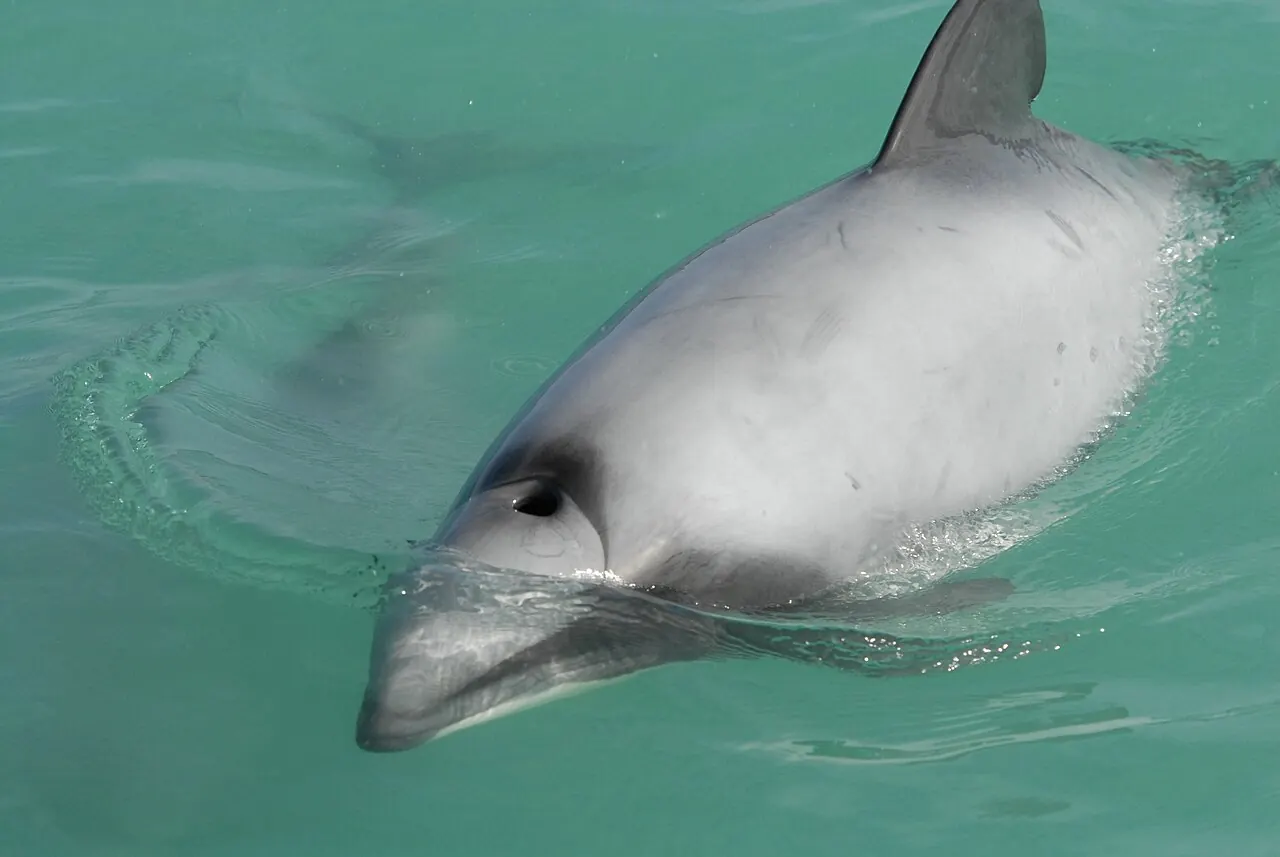
Hector's Dolphin
Cephalorhynchus hectori
One of the world's smallest dolphins, found only off New Zealand, where its North Island subspecies is down to about 54 animals.
Photo: Dr. Mridula Srinivasan, NOAA/NMFS/OST/AMD / Public domain
3 things to know
- Its rounded dorsal fin is often compared to one of Mickey Mouse's ears.
- Most stay within about 15 km (9 miles) of shore, in water less than 100 m (330 ft) deep.
- The Māui dolphin subspecies numbered about 54 animals aged one or older in 2020.
- Scientific name
- Cephalorhynchus hectori
- Depth
- 0 m – 100 m
0 – 328 ft - Size
- Up to about 1.5 m (5 ft); Māui dolphins up to about 1.6 m (5.3 ft)
- Weight
- Up to about 50 kg (110 lb); Māui dolphins up to about 65 kg (143 lb)
- Lifespan
- At least 22 years
- Diet
- Small fish and squid, such as red cod, ahuru, arrow squid, sprat, sole and stargazer
- Where
- Coastal waters of New Zealand only
- IUCN status
- Endangered
- Depth zones
- Sunlight
Hector's dolphin is one of the world's smallest dolphins, and it lives only in the coastal waters of New Zealand. It is short and stocky with no beak, and New Zealand's Department of Conservation says its rounded dorsal fin looks like one of Mickey Mouse's ears. Adults are mostly gray, with black on the sides of the head, the flippers, the fin and the tail, a white throat and belly, and a thin black line curving from the head to just behind the blowhole. NOAA Fisheries gives lengths of up to 1.5 meters (5 feet) and weights of up to 50 kilograms (110 pounds), with females larger than males.
There are two subspecies. The South Island Hector's dolphin lives around the South Island and numbers about 15,000 animals older than one year, by the department's count. The Māui dolphin, slightly larger, survives only off the northwest coast of the North Island, between Maunganui Bluff and Whanganui. Both keep close to land. According to the IUCN, Hector's dolphins are almost always within about 15 kilometers (9 miles) of shore in water less than 100 meters (330 feet) deep, and some individuals spend the whole year along about 30 kilometers (19 miles) of coastline. They eat small fish and squid, mainly red cod, ahuru, arrow squid, sprat, sole and stargazer.
They breed slowly. Females mature at about 6 to 9 years and have a single calf every 2 to 4 years, and the oldest known animals have reached at least 22. That leaves little room for losses, and the biggest loss is bycatch in commercial and recreational gillnets and trawls. The IUCN lists the species as Endangered, in an assessment made in 2008. Its 2023 assessment of the Māui dolphin, rated Critically Endangered, puts that subspecies at 54 animals aged one year or older in 2020.
Disease adds to the toll. In 2013 a team led by W. D. Roe reported that 7 of 28 dead Hector's dolphins they examined, including 2 of 3 Māui dolphins, had died of toxoplasmosis, caused by a parasite that can wash into the sea in cat feces. Among the ways people can help, the Department of Conservation lists putting cat feces in the trash, not the toilet. In the US, NOAA listed the Māui dolphin as endangered and the South Island subspecies as threatened under the Endangered Species Act in 2017.
Sources
- fisheries.noaa.gov/species/hectors-dolphin
- iucnredlist.org/species/4162/44199757
- iucnredlist.org/species/39427/50380174
- doc.govt.nz/nature/native-animals/marine-mammals/dolphins/hectors-dolphin
- doc.govt.nz/nature/native-animals/marine-mammals/dolphins/maui-dolphin
- Study: doi:10.1016/j.vetpar.2012.11.001
- Study: doi:10.1016/j.vetpar.2025.110439



