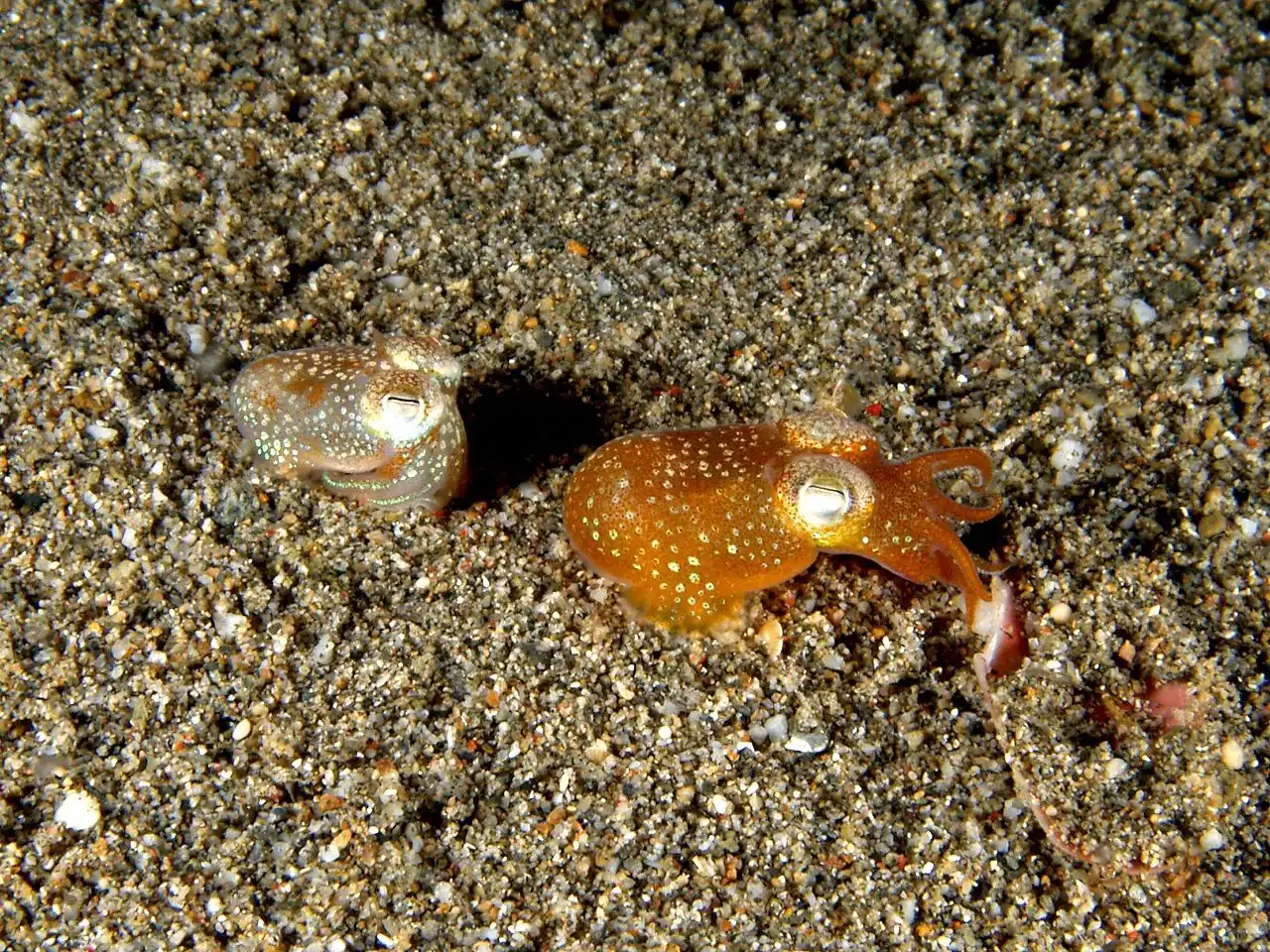
Hawaiian Bobtail Squid
Euprymna scolopes
A fingertip-sized Hawaiian squid that hides its shadow at night with light made by bacteria living inside its body.
Photo: Nick Hobgood / CC BY-SA 3.0
3 things to know
- Its light organ is colonized by one kind of glowing bacterium, Vibrio fischeri.
- At dawn each day it expels most of its bacteria, and the rest multiply again.
- Newly hatched bobtail squid flew to the International Space Station in 2021 for a NASA experiment.
- Scientific name
- Euprymna scolopes
- Depth
- 0 m – 1 m
0 – 3 ft - Size
- Mantle up to about 3 cm (1.2 in); adults average about 2.5 cm (1 in)
- Weight
- Not well known
- Lifespan
- About 3–10 months from egg to death
- Diet
- Mainly small shrimp; also small worms
- Where
- Shallow coastal waters of the Hawaiian Islands
- IUCN status
- Data Deficient
- Depth zones
- Sunlight
A Hawaiian bobtail squid could sit on your fingertip: adults average about 2.5 centimeters (1 inch) in mantle length. It is found only in the Hawaiian Islands, in very shallow water over sand flats and near seagrass, though adults are sometimes trawled offshore in mid-water as deep as 138 fathoms (about 250 meters). Researchers have collected it with dip nets in water less than a meter deep. By day it buries itself in the sand. At night it comes out to hunt, mostly small shrimp such as Palaemon debilis, and it keeps a coat of sand grains stuck to its body as camouflage.
Its main defense is light. An organ inside the mantle holds a colony of the glowing bacterium Vibrio fischeri, as many as a billion cells and essentially no other species. While the squid forages at night, the glow on its underside hides its silhouette from predators below. B. W. Jones and M. K. Nishiguchi reported in 2004 that the light from the organ rises and falls with the intensity of the light shining down from above.
The partnership starts over with every generation and is renewed every day. Hatchlings have no bacteria and must collect them from seawater. Each morning at dawn the squid expels most of its colony, about 90 percent according to a 2010 report from the University of Wisconsin in Madison on the lab of Margaret McFall-Ngai and Edward Ruby, and the cells left behind multiply again through the day. That daily release changes its surroundings. In 1994 Kyu-Ho Lee and Ruby found that water and sediments where the squid live in Hawaii held up to 24 to 30 times more of these bacteria than similar places without squid.
With only two partners involved, the squid became a standard model for studying how animals and helpful microbes get along. In June 2021, newly hatched squid that had never met the bacteria flew to the International Space Station on SpaceX's 22nd resupply mission for NASA's UMAMI experiment, led by Jamie Foster; the bacteria were added in orbit. In the lab, Roger Hanlon's team raised the species through a full life cycle in 4 months, and a whole life, egg to death, lasts about 3 to 10 months. The IUCN lists it as Data Deficient, from a 2009 assessment.
Sources
- sealifebase.se/summary/Euprymna-scolopes.html
- thecephalopodpage.org/Escolopes.php
- en.wikipedia.org/wiki/Euprymna_scolopes
- Study: doi:10.1007/s00227-003-1285-3
- serc.carleton.edu/resources/19916.html
- news.wisc.edu/in-sync-squid-glowing-companions-march-in-genetic-harmony
- Study: doi:10.1128/aem.60.5.1565-1571.1994
- Study: doi:10.2307/1542746
- archive.org/download/biostor-10358/biostor-10358.pdf
- archive.org/download/biostor-128634/biostor-128634.pdf
- science.nasa.gov/biological-physical/investigations/umami
- nasa.gov/missions/station/spacexs-22nd-commercial-resupply-mission-to-space-station-lau…
- iucnredlist.org/species/162598/925206
- Study: doi:10.2305/IUCN.UK.2012-1.RLTS.T162598A925206.en



