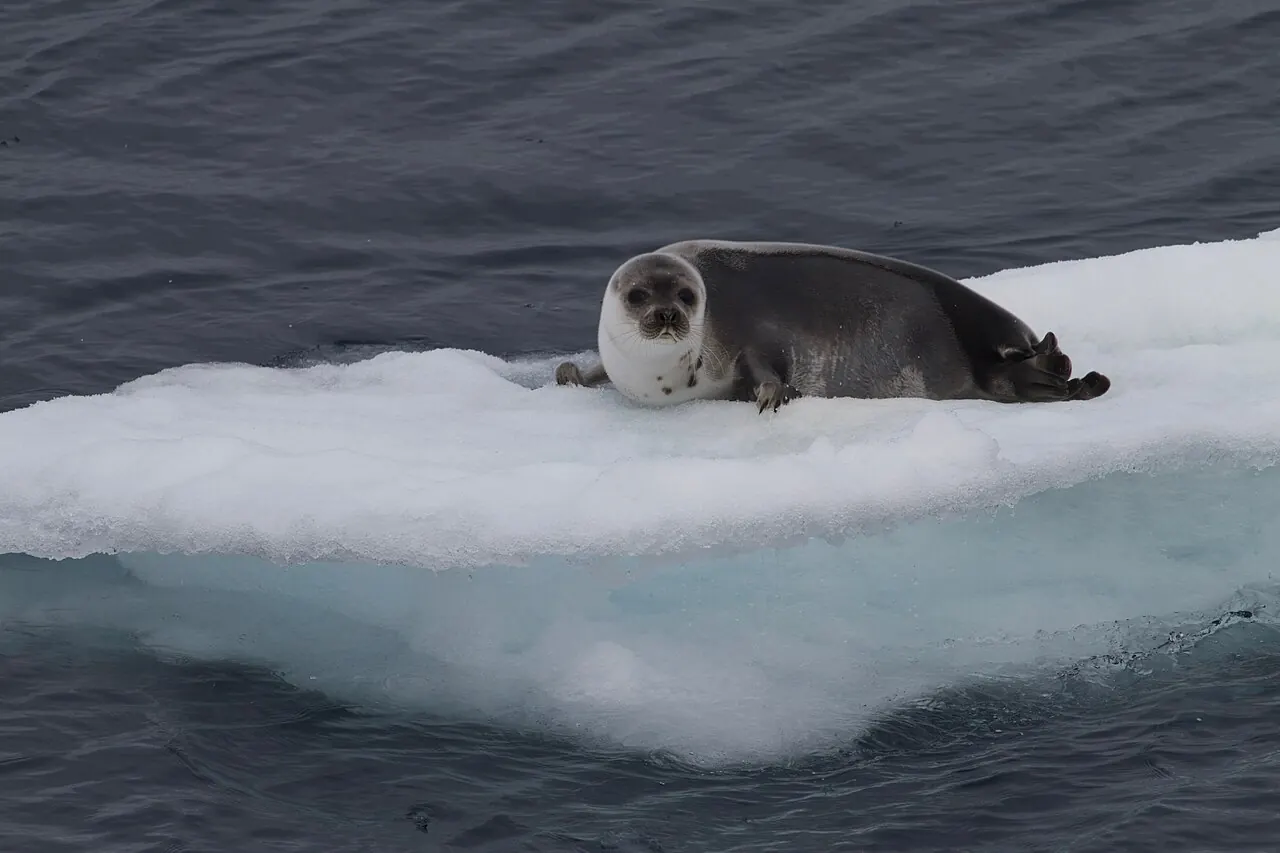
Harp Seal
Pagophilus groenlandicus
A North Atlantic seal born on pack ice in white fur, left alone to fast for six weeks, and uplisted to Near Threatened in 2025 as sea ice shrinks.
Photo: Brian Gratwicke / CC BY 2.0
3 things to know
- Pups are weaned after only about 12 days of nursing.
- Its yearly migrations can run more than about 5,000 km (3,100 miles) round trip.
- NOAA estimates about 7 million in the western North Atlantic stock.
- Scientific name
- Pagophilus groenlandicus
- Depth
- 0 m – 400 m
0 – 1,312 ft - Size
- About 1.5–1.8 m (5–6 ft) long
- Weight
- About 120–135 kg (260–300 lb)
- Lifespan
- Up to about 30 years
- Diet
- More than 130 species of fish and invertebrates, mostly small fish such as capelin, Arctic cod and polar cod
- Where
- Cold waters of the North Atlantic and Arctic Oceans
- IUCN status
- Near Threatened
- Depth zones
- Sunlight · Twilight
A newborn harp seal has almost no fat. Pups are born on Arctic pack ice between late February and mid-March, weighing about 11 kilograms (25 pounds) and wrapped in long, woolly white fur called lanugo, which absorbs sunlight and traps heat. For about 12 days they nurse on high-fat milk, gaining around 2 kilograms (5 pounds) a day, and they are weaned at roughly 36 kilograms (80 pounds). Then the mother leaves. The pup stays on the ice without eating for about six weeks and can lose up to half its weight before it enters the water and starts feeding itself.
Adults are light gray, about 1.5 to 1.8 meters (5 to 6 feet) long and 120 to 135 kilograms (260 to 300 pounds), with a black face and a curved black patch on the back that looks like a harp.
There are three populations, in the Barents Sea, off East Greenland and in the Northwest Atlantic. NOAA Fisheries estimates about 7 million seals in the western North Atlantic stock, which makes harp seals the most abundant marine mammal in the North Atlantic. They gather in groups of up to several thousand to breed and molt, then follow the ice north to feed in the Arctic, on migrations that can run more than about 5,000 kilometers (3,100 miles) round trip. Tagged adults from the Greenland Sea dived less than 100 meters (330 feet) deep near the ice edge in spring and early summer, and 100 to 400 meters (330 to 1,300 feet) in winter. They eat more than 130 species of fish and invertebrates, mostly small fish such as capelin, Arctic cod and polar cod. Some reach US shores in New England, and the species is protected throughout its range under the US Marine Mammal Protection Act.
Hunters in Canada have taken harp seals for meat and oil since the 1600s, and Canada's Department of Fisheries and Oceans sets a total allowable catch each year. The longer-term problem is ice, because females give birth only while pack ice is available to nurse on. In October 2025 the IUCN moved the harp seal from Least Concern to Near Threatened, one of three Arctic seals uplisted at once, and named sea ice loss driven by global warming as the main threat. Males mature at seven to eight years and females at four to seven, and the maximum lifespan is about 30 years.



