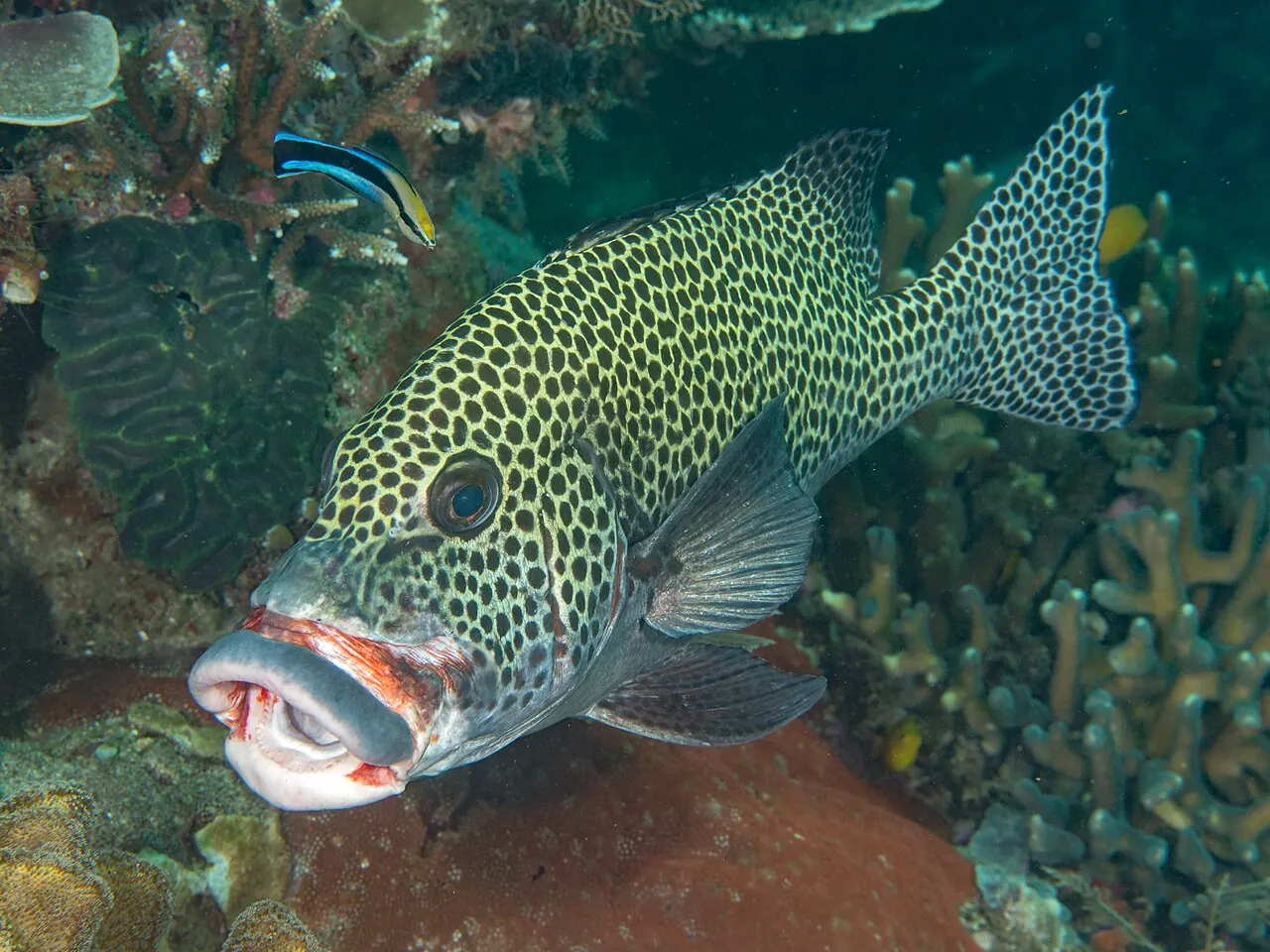
Harlequin Sweetlips
Plectorhinchus chaetodonoides
A thick-lipped reef fish whose brown-and-white young swim with an odd, wobbling motion that may make them look like toxic flatworms.
Photo: Rickard Zerpe / CC BY 2.0
3 things to know
- Juveniles are brown with big white blotches, while adults are pale with many dark brown spots.
- Small juveniles swim head-down with exaggerated fin movements, possibly mimicking a toxic flatworm.
- Adults rest under ledges and in caves by day and feed at night.
- Scientific name
- Plectorhinchus chaetodonoides
- Depth
- 1 m – 30 m
3 – 98 ft - Size
- Up to 72 cm (28 in) according to FishBase; Fishes of Australia gives 50 cm (20 in)
- Weight
- Up to 7 kg (15 lb)
- Lifespan
- Unknown
- Diet
- Crustaceans, mollusks and fishes, hunted at night
- Where
- Indo-West Pacific from the Maldives and Cocos Islands east to Fiji and New Caledonia, north to the Ryukyu Islands and south to Rowley Shoals
- IUCN status
- Least Concern
- Depth zones
- Sunlight
Young and old harlequin sweetlips look like two different fish. A juvenile under about 7 or 8 centimeters (3 inches) is brown with large, dark-edged white blotches. As it grows, brown spots appear inside the blotches, the brown background fades, and the adult ends up grayish to white and covered in dark brown spots, most of them bigger than the pupil of its eye. Its lips are fleshy and swell with age. FishBase gives a maximum of 72 centimeters (28 inches) and 7 kilograms (15 pounds), while Fishes of Australia puts the top size at 50 centimeters (20 inches).
The species lives in the Indo-West Pacific, from the Maldives and the Cocos Islands east through Indonesia to Fiji and New Caledonia, and from the Ryukyu Islands of Japan south to Australia's Rowley Shoals and the Great Barrier Reef. Juveniles live among corals in lagoons. Adults keep to coral-rich lagoon and seaward reefs from about 1 to 30 meters (3 to 98 feet) down, resting alone near ledges and in caves by day and coming out at night to eat crustaceans, mollusks and fish.
The juveniles move strangely. The Australian Museum describes them swimming head-down with exaggerated fin movements, so the whole body undulates. In 1971 John Randall and Alan Emery, writing in the New York Zoological Society journal Zoologica, compared that motion and coloring to soft-bodied animals such as nudibranchs and flatworms. Their main case was a young batfish in Palau, black with an orange border, that Randall at first took for a flatworm. Flatworms are believed to taste bad to predators because of their noxious skin secretions, and the authors reasoned that a fish mimicking one probably enjoys some freedom from attack. The young sweetlips, they wrote, was less convincing, though at first sight it gave the distinct impression of a soft-bodied invertebrate. It is still described as a possible mimic, not a proven one.
Those odd juveniles are collected for the aquarium trade. Adults are sold fresh as food, though FishBase notes that large fish have coarse, dry flesh. The IUCN lists the harlequin sweetlips as Least Concern, from a 2023 assessment.
Sources
- fishbase.se/summary/Plectorhinchus-chaetodonoides.html
- fishesofaustralia.net.au/home/species/2440
- australian.museum/learn/animals/fishes/spotted-sweetlips-plectorhinchus-chaetodonoides
- archive.org/download/biostor-193978/biostor-193978.pdf
- iucnredlist.org/species/68372590/68379346
- commons.wikimedia.org/wiki/File:Harlequin_sweetlips_(Plectorhinchus_chaetodonoides)_(40…



