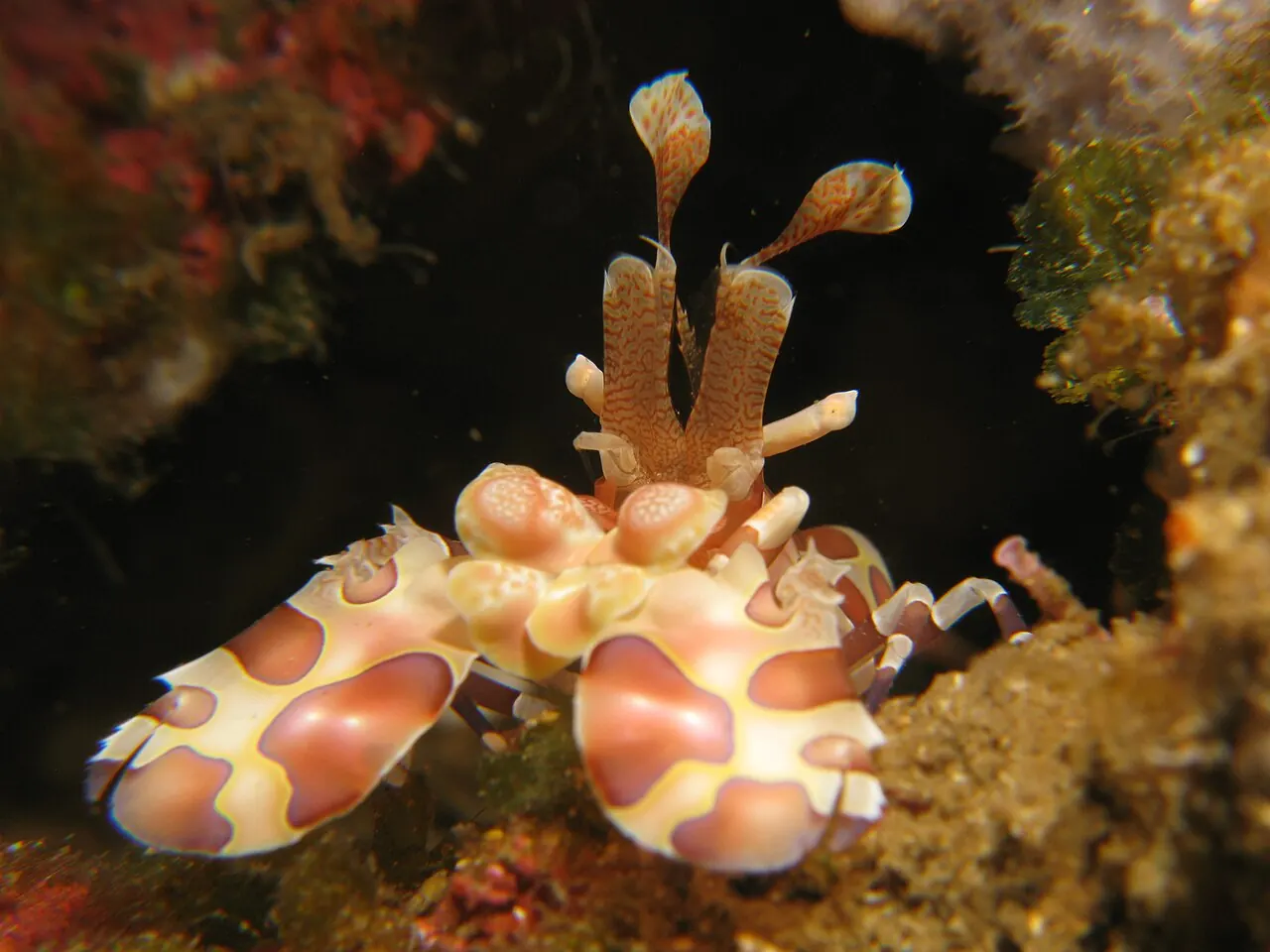
Harlequin Shrimp
Hymenocera picta
A tiny, flamboyantly spotted shrimp that lives in pairs and eats only sea stars, flipping them over and feeding on them alive.
Photo: prilfish / CC BY 2.0
3 things to know
- It eats nothing but sea stars, which it turns over and eats alive over several days.
- Harlequin shrimp usually live in pairs that can stay in one area for months or years.
- In Hawaii they are white with wine-red spots; elsewhere the spots are usually brown.
- Scientific name
- Hymenocera picta
- Depth
- 1 m – 20 m
3 – 66 ft - Size
- Up to about 5 cm (2 in) long
- Weight
- Unknown
- Lifespan
- Unknown
- Diet
- Sea stars only, occasionally including crown-of-thorns starfish
- Where
- Red Sea and East Africa across the Indo-Pacific to Hawaii and the eastern Pacific
- IUCN status
- Not Evaluated
- Depth zones
- Sunlight
In Hawaii, harlequin shrimp are white or cream with large wine-red spots; elsewhere the spots are usually brown edged with blue. John Hoover, in Hawaii's Sea Creatures, says they look more like orchids than shrimp. The pincers are expanded into broad, patterned plates held in front of the head, one pair of antennae ends in flag-like flaps, and the legs are banded. Adults reach about 5 centimeters (2 inches), and females are larger than males.
They live on reefs from the Red Sea and East Africa across the Indo-Pacific to Hawaii and the eastern Pacific, usually 1 to 20 meters (3 to 66 feet) down. Most live in pairs, and wild pairs can stay in the same area for months or years. A pair feeds only on sea stars, turning a star over and eating it alive over a period of days. Sometimes a star escapes, leaving an arm behind.
In 2013 Prakash and Kumar of Annamalai University in India described a pair collected at Agatti Island in the Lakshadweep islands attacking a blue sea star in a hatchery tank. The male struck first, piercing the star's tube feet at the arm tips. When he could not lift it alone, the larger female joined in, and within 30 to 60 minutes the star lay upside down. The shrimp then pulled out and ate its tube feet and reproductive tissue. Studies Prakash and Kumar cite found that harlequins track prey by chemical cues and that a single shrimp can turn a larger star upside down.
Their prey sometimes includes the crown-of-thorns starfish, which damages Indo-Pacific coral reefs. That earned the shrimp early publicity as a possible weapon against crown-of-thorns outbreaks, if it could be bred and released, publicity that Prakash and Kumar, citing Seibt and Wickler, describe as premature. A University of Hawaii database of invertebrate reproduction lists breeding as continuous, after each molt, with females brooding 100 to 5,000 eggs that hatch as swimming larvae. The World Register of Marine Species treats Hymenocera elegans as the same species. It has not been evaluated for the IUCN Red List.



