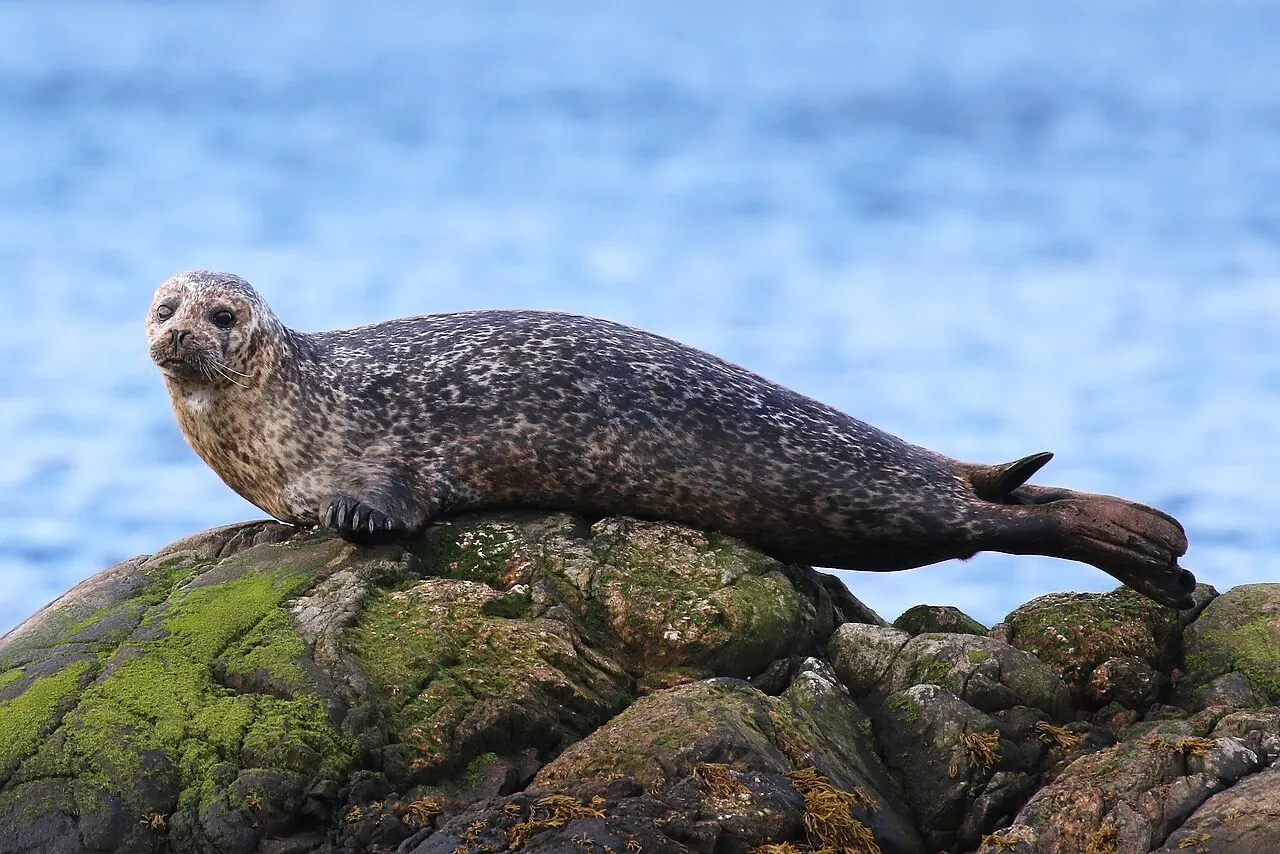
Harbor Seal
Phoca vitulina
A common spotted seal of US coasts that can dive to 500 m, sleep underwater, and in one famous case imitate human speech.
Photo: Charles J. Sharp / CC BY-SA 4.0
3 things to know
- Pups can swim within minutes of birth.
- On a dive its heart rate can drop from 75–120 beats a minute to 4–6.
- A captive harbor seal named Hoover imitated English phrases at Boston's New England Aquarium.
- Scientific name
- Phoca vitulina
- Depth
- 0 m – 20 m
0 – 66 ft - Size
- About 1.5–1.8 m (5–6 ft) long
- Weight
- Up to about 129 kg (285 lb); adults average about 82 kg (180 lb)
- Lifespan
- About 25–30 years; tooth-ring ages up to 26 (males) and 35 (females) in Alaska
- Diet
- Fish, shellfish and crustaceans
- Where
- Temperate coasts of the North Atlantic and North Pacific, north to 78° N
- IUCN status
- Least Concern
- Depth zones
- Sunlight
Harbor seals are often seen hauled out on rocks, beaches and floating glacier ice in a "banana" pose, head and rear flippers raised. They are true seals, with no external ear flaps and short front flippers, and their hind flippers cannot swing forward under the body, so on land they hump along like caterpillars. The fur comes in two basic patterns: light tan, silver or blue-gray with dark spots, or dark with light rings. Adults reach about 1.5 to 1.8 meters (5 to 6 feet) and up to about 129 kilograms (285 pounds).
They live along temperate northern coasts of North America, Europe and Asia, as far north as 78° N. In the United States they range from the Mid-Atlantic up through New England, and along the whole West Coast to the Bering Sea. NOAA recognizes 18 US stocks, 12 of them in Alaska, including a small population living in freshwater Iliamna Lake.
Harbor seals eat fish, shellfish and crustaceans, in the sea and also in rivers and lakes. Most dives are shallower than 20 meters (65 feet) and shorter than 4 minutes, but they can reach 500 meters (1,640 feet) and stay under for more than 20 minutes, slowing the heart from 75 to 120 beats a minute to only 4 to 6. They can also sleep underwater, surfacing about every 30 minutes. Pups swim within minutes of birth and nurse for 4 to 6 weeks on milk that is 50 percent fat. NOAA gives a lifespan of about 25 to 30 years; in Alaska, ages counted from rings in the teeth have reached 26 years for a male and 35 for a female.
A few have learned to copy human speech. In 1985 Katherine Ralls and colleagues described two captive adult males whose calls mimicked English words and phrases. The famous one was Hoover, rescued as a pup in Maine and later kept at Boston's New England Aquarium, who greeted visitors with phrases such as "hello there, how are you" in a rumbling New England accent until his death in 1985.
State-paid bounty hunters once killed harbor seals in Alaska, Washington, Oregon, Massachusetts and Maine as competitors of fishermen, until 1960. Since then, and since the Marine Mammal Protection Act of 1972, many US populations have grown. The IUCN lists the species as Least Concern.



