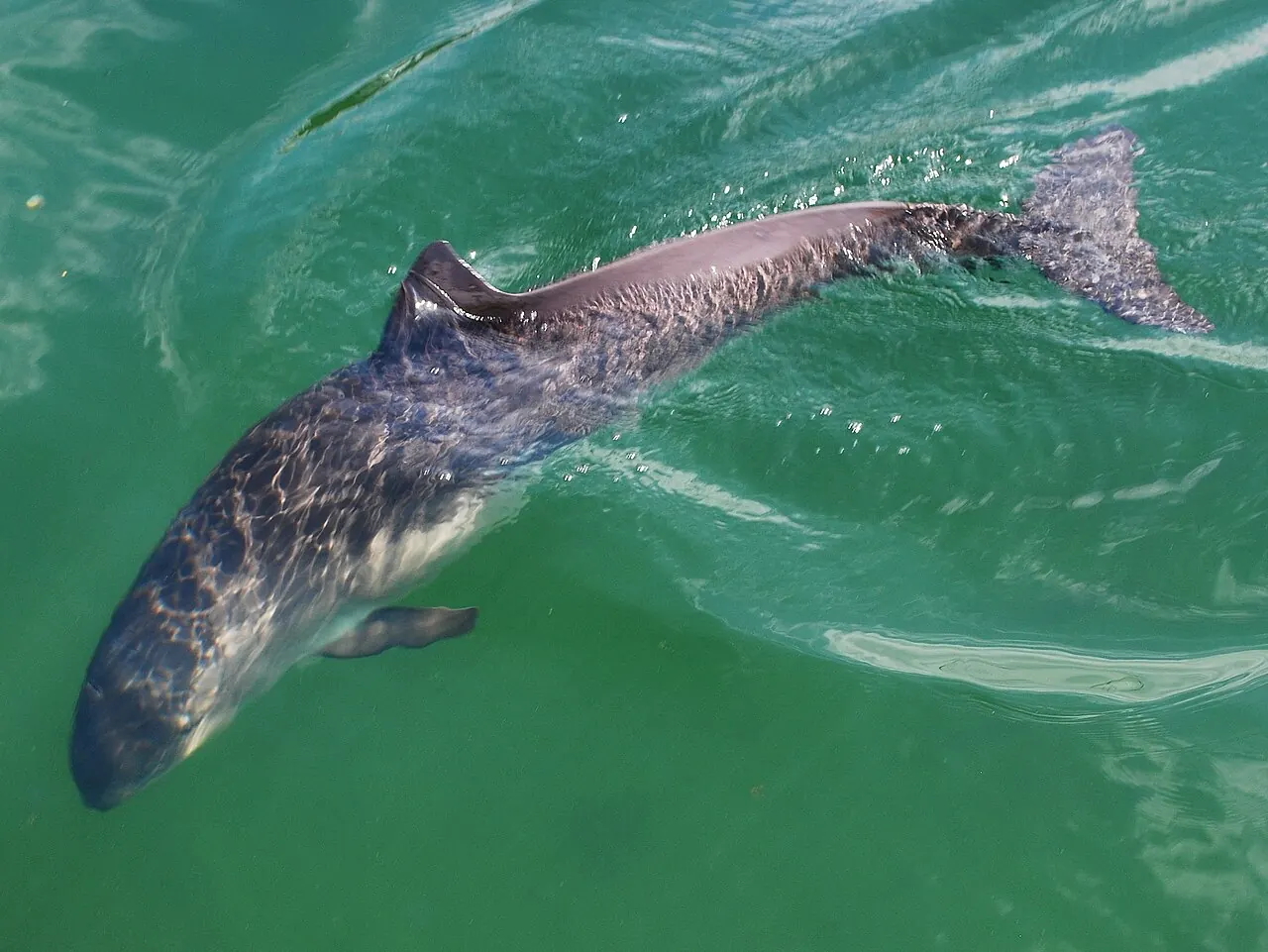
Harbor Porpoise
Phocoena phocoena
A shy, small porpoise of northern coasts that must hunt almost nonstop, catching hundreds of tiny fish an hour to stay warm.
Photo: Erik Christensen / CC BY-SA 3.0
3 things to know
- Tagged porpoises in Danish waters went after up to 550 small fish an hour and caught more than 90 percent of them.
- Unlike most other porpoises, it does not approach boats to ride their bow waves.
- The Baltic Proper population has fewer than 250 mature animals and is Critically Endangered.
- Scientific name
- Phocoena phocoena
- Depth
- 0 m – 200 m
0 – 656 ft - Size
- About 1.5–1.7 m (5–5.5 ft) long; females slightly larger
- Weight
- About 61–77 kg (135–170 lb)
- Lifespan
- About 24 years
- Diet
- Mainly small schooling fish such as herring and mackerel; sometimes squid and octopus
- Where
- Cold coastal waters of the North Atlantic, North Pacific and Black Sea
- IUCN status
- Least Concern
- Depth zones
- Sunlight
The harbor porpoise has a small, robust body, a short, blunt beak and a medium-sized triangular dorsal fin. Its back is dark gray, fading to lighter gray on the sides, with a white belly and throat and a dark gray chin patch. NOAA Fisheries gives adults a length of 1.5 to 1.7 meters (5 to 5.5 feet) and a weight of 61 to 77 kilograms (135 to 170 pounds), and females are slightly larger than males. It is shy, usually seen alone, in pairs or in groups of up to 10, and unlike most other porpoises it does not approach boats to bow-ride.
It lives in cold coastal waters of the Northern Hemisphere. In the western North Atlantic it ranges from West Greenland to Cape Hatteras, North Carolina, and in the eastern Pacific from Point Conception, California, north to the Beaufort Sea. It also lives from the Barents Sea to West Africa, from Japan to the Chukchi Sea, and in the Black Sea. Most stay in bays, estuaries, harbors and fjords less than 200 meters (650 feet) deep, although telemetry has recorded dives to at least 400 meters (1,300 feet). Schooling fish such as herring and mackerel make up most of the diet. Females mature at 3 to 4 years and may give birth several years in a row.
Staying warm costs a small animal in cold water a great deal of food. In 2016 Danuta Wisniewska and colleagues reported on five wild harbor porpoises, tagged under Danish permits, whose tags recorded their movements and the echoes from their prey. The porpoises hunted almost nonstop, day and night, going after up to 550 fish an hour, mostly 3 to 10 centimeters (1 to 4 inches) long, and catching more than 90 percent. The authors called them aquatic shrews and warned that even moderate disturbance in the busy shallow waters they share with people could hurt them.
The IUCN's global assessment, made in 2020 and amended in 2023, lists the species as Least Concern, with well over a million worldwide. Some populations are in trouble. The Baltic Proper subpopulation has fewer than 250 mature animals and is Critically Endangered, and the Black Sea subspecies is Endangered. Bycatch in fishing gear, especially gillnets, is a threat throughout its range. In US waters the species is not listed as endangered or threatened but is protected under the Marine Mammal Protection Act.



