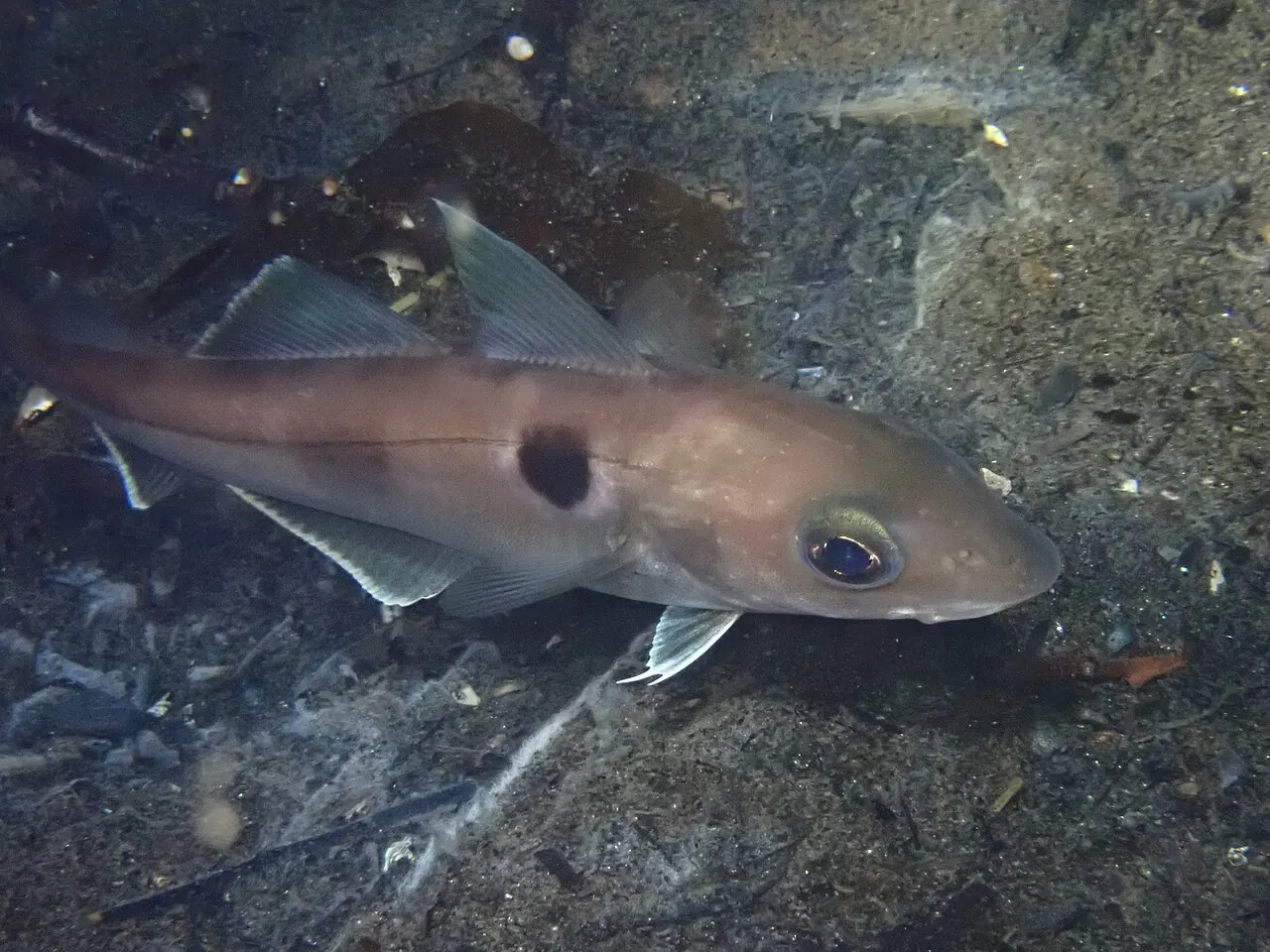
Haddock
Melanogrammus aeglefinus
A North Atlantic relative of the cod marked by a black thumbprint on each side, whose males drum with their swim bladders to court females.
Photo: Vsevolod Rudyi / CC BY 4.0
3 things to know
- Each side carries a large black blotch above the pectoral fin, often called a thumbprint.
- Males contract drumming muscles on their swim bladder to make knocking calls, and those muscles nearly double in size in the spawning season.
- A large female can produce up to 3 million eggs a year.
- Scientific name
- Melanogrammus aeglefinus
- Depth
- 40 m – 150 m
131 – 492 ft - Size
- Usually 30–90 cm (1–3 ft) at maturity; FishBase lists up to 112 cm (44 in)
- Weight
- Usually 0.9–3.2 kg (2–7 lb); the heaviest published is 16.8 kg (37 lb)
- Lifespan
- 10 or more years; FishBase gives a maximum reported age of 20 years
- Diet
- Bottom animals such as mollusks, worms, crustaceans, sea stars, sea urchins and brittle stars; sometimes small fish such as herring
- Where
- Both sides of the North Atlantic and nearby Arctic waters; in the west from Newfoundland to Cape May, New Jersey, most abundant on Georges Bank and in the Gulf of Maine
- IUCN status
- Vulnerable
- Depth zones
- Sunlight
A haddock is easiest to tell from its cousin the Atlantic cod by a large black blotch on each side, just below the lateral line and above the pectoral fin. NOAA Fisheries calls it a thumbprint. The haddock's skin is also less mottled than a cod's, its lateral line is dark rather than pale, and its mouth is small, with the lower jaw shorter than the upper and only a small chin barbel. It is the smaller fish of the two. NOAA gives 30 to 90 centimeters (1 to 3 feet) and 0.9 to 3.2 kilograms (2 to 7 pounds) for adults, though FishBase lists fish up to 112 centimeters (44 inches).
Haddock live on both sides of the North Atlantic. In the western Atlantic they range from Newfoundland to Cape May, New Jersey, and are most abundant on Georges Bank, where gravel, pebbles and smooth hard sand suit them, and in the Gulf of Maine. NOAA says they are most common at about 40 to 150 meters (130 to 500 feet) in water below 7°C (45°F), and FishBase records them from 10 to 450 meters (33 to 1,480 feet). They feed on bottom animals, from worms, mollusks and crustaceans to sea stars, sea urchins and brittle stars, and adults sometimes eat herring. Cod, spiny dogfish, skates and halibut eat young haddock, and gray seals hunt them too.
Spawning runs from January to June. Females release eggs in batches near the seafloor for a courting male to fertilize, and the eggs float up and drift. An average female produces about 850,000 eggs a year and a large one up to 3 million.
That courtship is noisy. Anthony Hawkins and Clara Amorim described the spawning sounds of male haddock in a 2000 paper, and later work summarized on the DOSITS ocean-sound website shows how they are made: males contract drumming muscles attached to the swim bladder, producing knocks and hums mostly below 600 hertz. The muscles are larger in males than in females and nearly double in size during spawning. DOSITS notes that listening with underwater microphones is an effective way to find spawning groups.
NOAA's 2024 assessments found both US stocks, on Georges Bank and in the Gulf of Maine, not overfished. The IUCN's global listing is Vulnerable, but it dates from 1996; a 2013 IUCN assessment for Europe rated haddock Least Concern.
Sources
- fisheries.noaa.gov/species/haddock
- fishbase.se/summary/Melanogrammus-aeglefinus.html
- dosits.org/galleries/audio-gallery/fishes/haddock
- Study: doi:10.1023/A:1007615517287
- iucnredlist.org/species/13045/3406968
- iucnredlist.org/species/13045/45097487
- api.gbif.org/v1/species/2415822/iucnRedListCategory
- commons.wikimedia.org/wiki/File:Melanogrammus_aeglefinus_318932194.jpg



