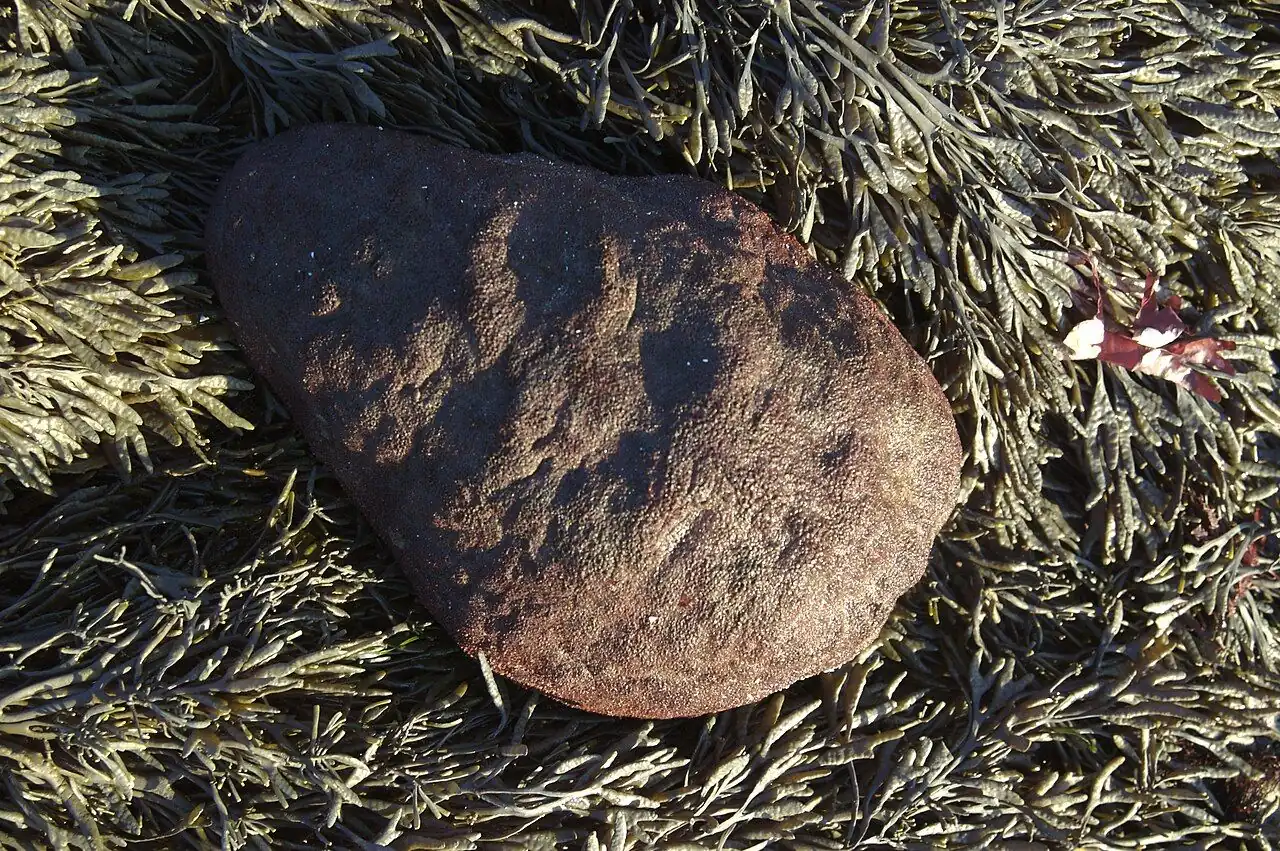
Gumboot Chiton
Cryptochiton stelleri
The world's largest chiton, a brick-red, leathery mollusk of North Pacific shores whose eight shell plates are hidden under its skin.
Photo: Jerry Kirkhart from Los Osos, Calif. / CC BY 2.0
3 things to know
- Its eight shell plates are completely covered by its thick, leathery mantle.
- Its teeth are capped with magnetite, a hard, magnetic iron mineral.
- In one experiment, adults moved less than 20 m (66 ft) in two years.
- Scientific name
- Cryptochiton stelleri
- Depth
- 0 m – 20 m
0 – 66 ft - Size
- Up to about 33 cm (13 in) long
- Weight
- About 1 kg (2.2 lb) for one at least 30 cm long, per a NOAA photo caption
- Lifespan
- 20 years or more
- Diet
- Mostly red algae; also some brown and green algae
- Where
- North Pacific, from Japan, the Kuril Islands and Kamchatka to the Aleutian Islands and south to San Nicolas Island, California
- IUCN status
- Not Evaluated
- Depth zones
- Sunlight
At low tide a gumboot chiton can pass for a loose slab of brick-red leather. It is the largest chiton in the world, up to about 33 centimeters (13 inches) long, and a NOAA Photo Library caption describes one at least 30 centimeters long as weighing a kilogram (2.2 pounds). Like all chitons it has eight shell plates along its back, but here a thick, leathery mantle grows over every one of them, so none show. The underside is orange or yellow. The plates themselves are white or robin's-egg blue and shaped like butterflies, and loose ones sometimes wash up on beaches.
It lives on both sides of the North Pacific, from Japan, the Kuril Islands and Kamchatka to the Aleutians and south along North America to San Nicolas Island off southern California, on rocky bottoms and especially in kelp beds, from the low intertidal zone to about 20 meters (66 feet). It grazes mostly on red algae and barely travels: in one experiment adults moved less than 20 meters (66 feet) in two years.
Its teeth are among the hardest materials any animal makes. Chitons grind food off rock with a radula, a ribbon of teeth, and the gumboot's teeth are capped with magnetite, a hard and magnetic iron oxide. In 2019, Michiko Nemoto of Okayama University in Japan, David Kisailus of the University of California, Riverside, and colleagues analyzed the gumboot's tooth-making tissue and found 22 proteins made only in the mineralized tooth tips, including a new one they named RTMP1. In a 2025 paper in Science, Nemoto's team, working with other chitons, including Acanthopleura japonica, showed that this protein guides where the iron mineral is laid down.
Males and females are separate. In California the gumboot spawns from March to May. Females release eggs in gelatinous, cinnamon-red spiral strings up to a meter (3.3 feet) long, which the waves soon break apart, and nearby males respond by releasing sperm. The larvae swim for about 20 hours before settling, and adults may live 20 years or more. About 44 percent of an animal's weight is blood.
Predators include the snail Ocenebra lurida and tidepool sculpins. Sea otters seem to ignore it, but river otters eat it, and Indigenous peoples of the coast often ate it as well. The IUCN has not assessed the species.
Sources
- inverts.wallawalla.edu/Mollusca/Polyplacophora/Cryptochiton_stelleri.html
- sealifebase.se/summary/Cryptochiton-stelleri.html
- commons.wikimedia.org/wiki/File:Fish4620_-_Flickr_-_NOAA_Photo_Library.jpg
- Study: doi:10.1038/s41598-018-37839-2
- Study: doi:10.1126/science.adu0043
- biorxiv.org/content/10.1101/2024.11.02.621658v1.full
- okayama-u.ac.jp/eng/research_highlights/index_id254.html
- api.gbif.org/v1/species/5193725/iucnRedListCategory



