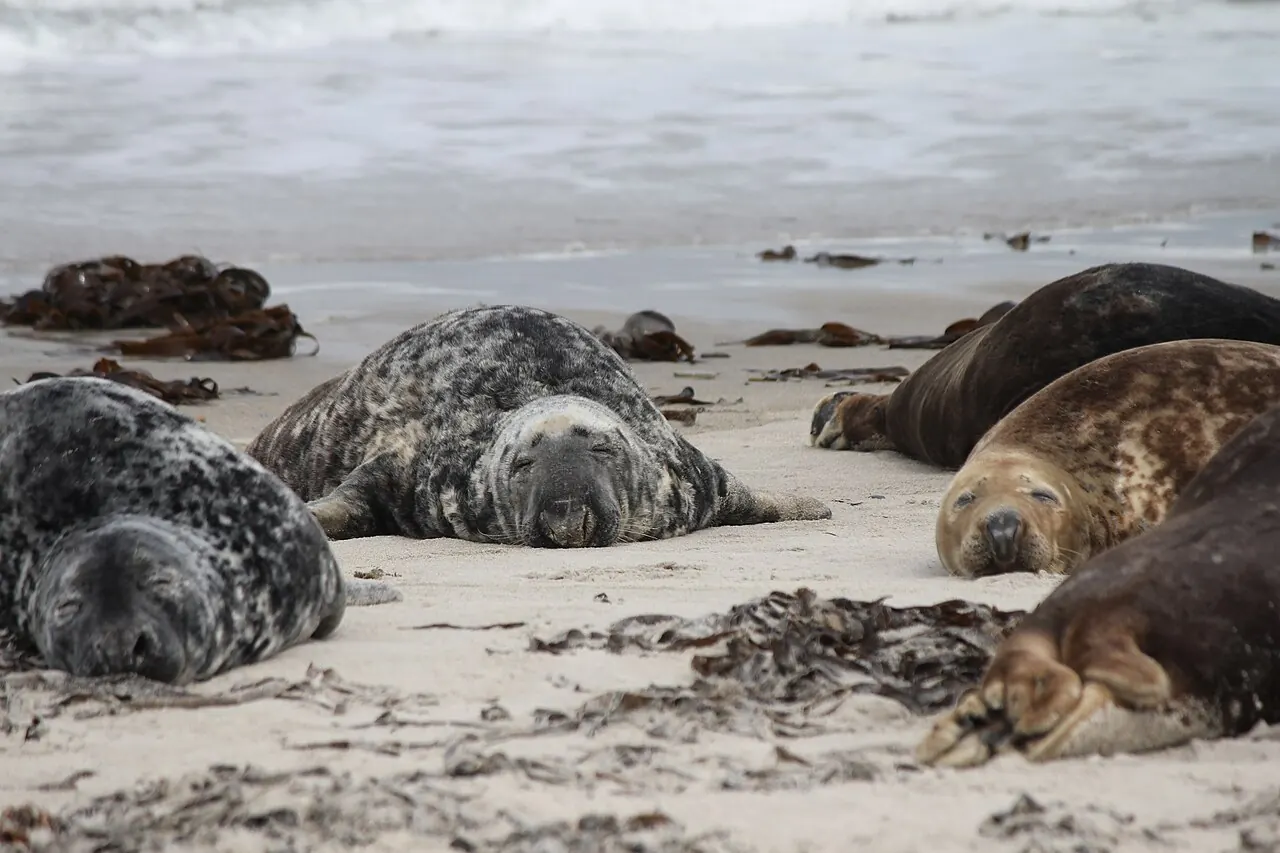
Gray Seal
Halichoerus grypus
A big North Atlantic seal with a horse-like head that can dive 475 m, and whose males were filmed clapping their flippers underwater in 2020.
Photo: Maseltov / CC BY-SA 4.0
3 things to know
- Its scientific name means hooked-nosed pig of the sea.
- It can dive to 475 m (1,560 ft) and stay down for up to an hour.
- Males clap their front flippers underwater to make a loud, gunshot-like crack.
- Scientific name
- Halichoerus grypus
- Depth
- 0 m – 150 m
0 – 492 ft - Size
- Males up to about 3 m (10 ft); females about 2.3 m (7.5 ft)
- Weight
- Males about 400 kg (880 lb); females about 250 kg (550 lb)
- Lifespan
- 25–35 years
- Diet
- Fish such as sand eels, hake, cod, haddock, pollock and flatfish, plus squid, octopus, crustaceans and sometimes seabirds
- Where
- Coasts of the North Atlantic, from the US Mid-Atlantic to the Baltic Sea
- IUCN status
- Least Concern
- Depth zones
- Sunlight
Adult male gray seals have a long, curved nose that earned the species the nickname "horsehead" and its scientific name, Halichoerus grypus, which means hooked-nosed pig of the sea. Males reach about 3 meters (10 feet) and 400 kilograms (880 pounds). Females are smaller, around 2.3 meters (7.5 feet) and 250 kilograms (550 pounds), with silver-gray or brown fur that may carry scattered dark spots; males are darker.
They live along the coasts of the North Atlantic in three stocks: eastern Canada and the northeastern United States; Britain, Iceland, Norway, Denmark, the Faroe Islands and Russia; and the Baltic Sea. NOAA Fisheries counts roughly 450,000 in Canadian and US waters combined, where they haul out on rocky coasts, islands, sandbars and ice, often beside harbor seals. In the US they are protected under the Marine Mammal Protection Act.
Off southwest Ireland, Mark Jessopp and colleagues logged nearly 325,000 dives by tagged seals. They averaged 57 meters (187 feet), most were in water less than 150 meters (490 feet) deep, and many reached the seabed. NOAA says they can dive to 475 meters (1,560 feet) for up to an hour. They often hunt in groups and eat 4 to 6 percent of their body weight a day: sand eels, hake, cod, haddock, pollock and flatfish, along with squid, octopus, crustaceans and the occasional seabird. They do not eat during the breeding and molting seasons.
The loud, gunshot-like cracks gray seals make underwater in the breeding season were long thought to be vocal. Ben Burville of Newcastle University, who first saw a male clap while diving off England's Farne Islands, spent 17 years trying to film it before recording a male clapping his front flippers together. The footage was published in Marine Mammal Science in 2020, in a study led by David Hocking of Monash University in Australia. Bulls use the high-frequency clap as a show of strength to ward off rivals and attract mates; when Burville first saw it, nearby rival males quickly scattered.
Females give birth to a single white-coated pup after a pregnancy of about 11 months, from September to November in the eastern Atlantic, December to February in the western Atlantic and in March in the Baltic. Pups nurse for about three weeks and their cries can sound like a human baby's. Gray seals live 25 to 35 years, and the IUCN lists them as Least Concern.



