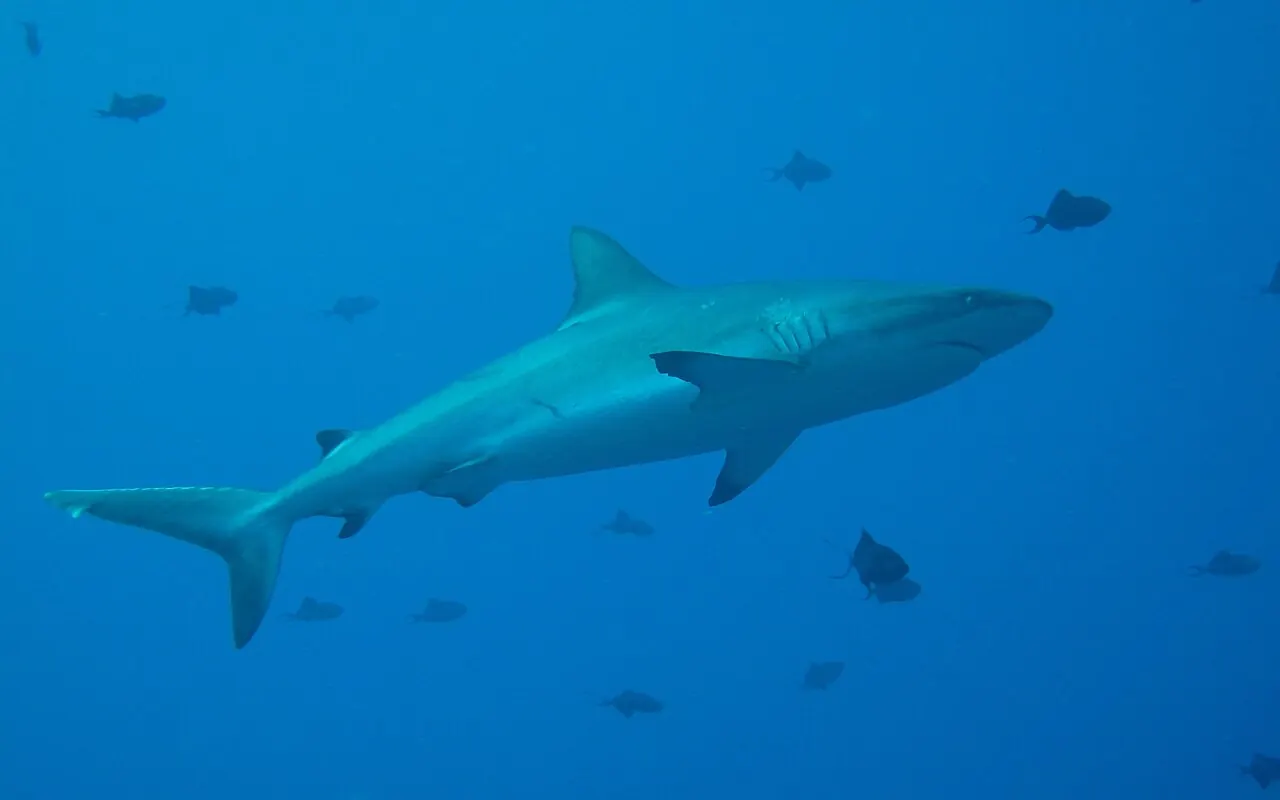
Grey Reef Shark
Carcharhinus amblyrhynchos
A sleek Indo-Pacific reef shark with a black-edged tail, known for its hunched threat display and for gathering by the hundreds in tidal channels.
Photo: Tanaka Juuyoh (田中十洋) / CC BY 2.0
3 things to know
- The whole trailing edge of its tail fin carries a broad black margin.
- A threatened grey reef shark raises its snout, drops its pectoral fins and arches its back while swimming with an exaggerated sway.
- In Fakarava's south pass, sharks holding station in current updrafts may cut their routine energy use by an estimated 10 to 15 percent.
- Scientific name
- Carcharhinus amblyrhynchos
- Depth
- 0 m – 280 m
0 – 919 ft - Size
- Up to about 1.9 m (6.2 ft) per the Florida Museum; FishBase lists a maximum of 2.55 m (8.4 ft)
- Weight
- Up to about 34 kg (74 lb)
- Lifespan
- About 25 years (estimated maximum)
- Diet
- Mostly reef fishes; also squid, octopus, crabs, lobsters and shrimps
- Where
- Indo-West and Central Pacific, from Madagascar and the Seychelles to the Tuamotu Archipelago, north to southern China and south to northern Australia
- IUCN status
- Endangered
- Depth zones
- Sunlight · Twilight
A grey reef shark is dark gray to bronze-gray on top and white underneath, and the giveaway is its tail: the entire trailing edge carries a broad black margin. Females grow to about 1.9 meters (6.2 feet), males slightly less. It lives on coral reefs from Madagascar and the Seychelles to the Tuamotu Archipelago in French Polynesia, usually near drop-offs, in atoll passes and in lagoons next to strong currents. FishBase gives its usual depth range as 0 to 280 meters (920 feet). It eats mostly reef fishes along with squid, octopus, crabs, lobsters and shrimps, and it is most active at night. Females give birth to 1 to 6 live pups after a pregnancy of about 12 months.
Divers know it for its warning. When a grey reef shark feels cornered, it raises its snout, drops its pectoral fins and arches its back, swimming with an exaggerated side-to-side sway. If the threat continues, it may flee or deliver a quick bite before leaving. The Florida Museum's International Shark Attack File counts 8 confirmed bites on people, one of them fatal.
It is also known for crowds. The south pass of Fakarava atoll in French Polynesia holds an average of about 600 reef sharks. Johann Mourier and colleagues reported in Current Biology in 2016 that by their bioenergetics models the sharks need roughly 90 tons of fish a year, while the pass produces only about 17 tons. Using acoustic tags and underwater surveys, the team concluded that the sharks probably make up the difference by feeding on spawning aggregations of groupers, which concentrate fish from elsewhere in one place.
In 2021, a team led by Yannis Papastamatiou of Florida International University looked at the more than 500 grey reef sharks living in that channel. On incoming tides, the sharks gathered in tight groups in zones where the current is predicted to push water up the slope. Individuals swam to the front of the group and let the current carry them to the back, then did it again. The team's model estimated that riding these updrafts lowers the sharks' routine energy use by 10 to 15 percent, much as soaring birds use rising air.
The IUCN's 2020 assessment lists the grey reef shark as Endangered.



