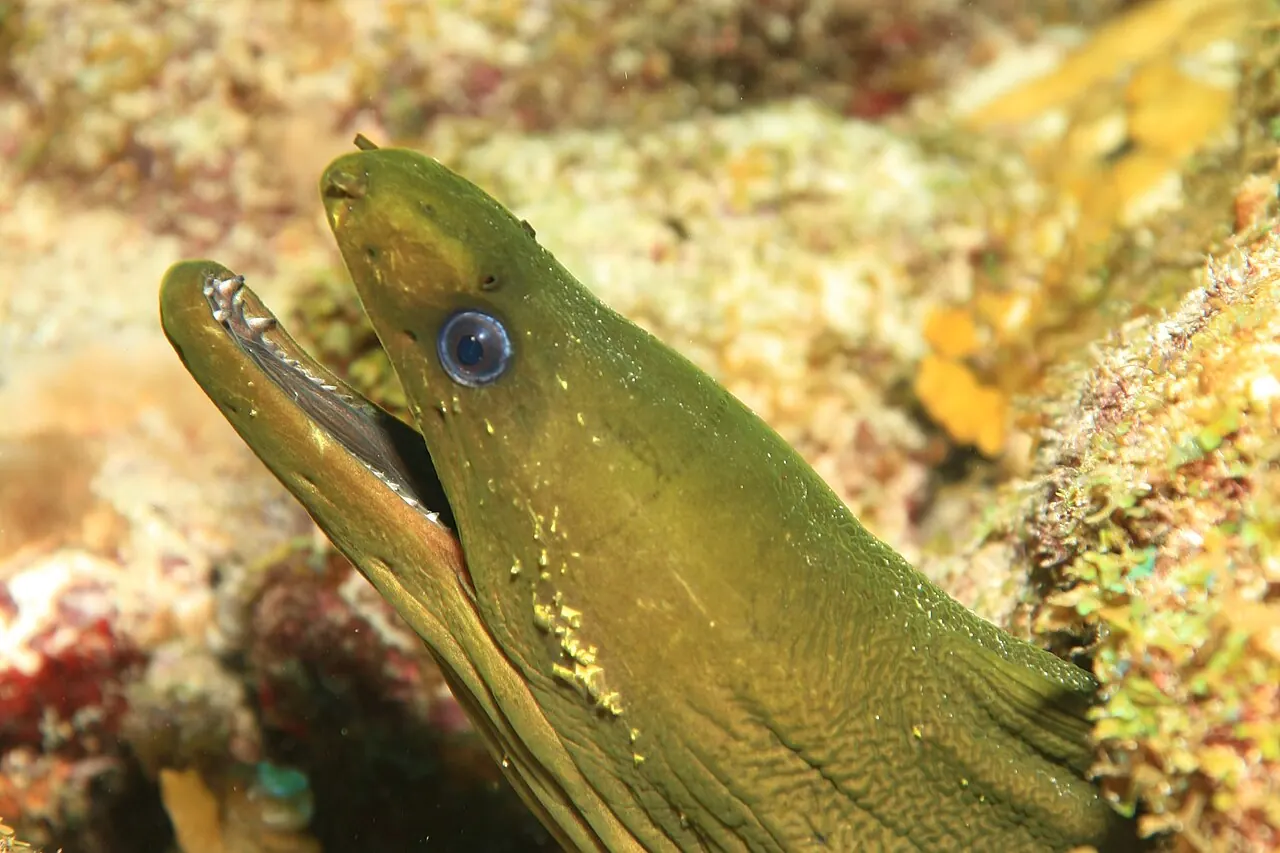
Green Moray
Gymnothorax funebris
The big Caribbean moray whose green is a coat of yellow slime over dark skin, and whose bigger eels move from mangrove bays to the reef.
Photo: Laszlo Ilyes / CC BY 2.0
3 things to know
- Its green color comes from yellowish mucus over dark gray-brown skin.
- It can reach about 2.5 meters (8 feet) and 29 kilograms (65 pounds).
- Tagged eels in the US Virgin Islands left their mangrove bays for the reef in a single night.
- Scientific name
- Gymnothorax funebris
- Depth
- 1 m – 30 m
3 – 98 ft - Size
- Up to about 2.5 m (8 ft) long; often about 1.8 m (6 ft)
- Weight
- Up to about 29 kg (65 lb)
- Lifespan
- Unknown
- Diet
- Fish, crabs, shrimps and cephalopods, hunted mostly at night
- Where
- Western Atlantic from New Jersey and Bermuda to the northern Gulf of Mexico and south to Brazil
- IUCN status
- Least Concern
- Depth zones
- Sunlight
Green is only the coat. Under a layer of yellowish mucus, the green moray's thick, scaleless skin is dark gray-brown, and the yellow over the dark is what reads as green. The Florida Museum says the slime also protects the eel from parasites and disease. The species name funebris, meaning funereal, comes from that dark ground color. Green morays are often seen at about 1.8 meters (6 feet) and can reach 2.5 meters (8 feet) and 29 kilograms (65 pounds), the largest moray species in the Caribbean region.
It lives in the western Atlantic from New Jersey and Bermuda to the northern Gulf of Mexico and south to Brazil, and is common in the Florida Keys, the Bahamas and the Caribbean. A stray once turned up off Nova Scotia. Rocky shores, coral reefs and mangroves are typical homes, mostly shallower than 30 meters (100 feet), though FishBase lists records to 50 meters.
By day a green moray rests in a crevice with its head out, its mouth opening and closing to pump water over its small gills. At night it hunts fish, crabs, shrimps and cephalopods, finding them largely by smell and working into tight holes in the reef. Large ones can carry ciguatera toxin, and eating them has poisoned people. Bites are uncommon but can be severe; the Florida Museum says they happen most often when divers feed or touch an eel. The IUCN lists the species as Least Concern, from a 2011 assessment.
Much of its life is still unrecorded. Between July and November 2018, NOAA's Matthew Kendall and colleagues trapped 16 green morays, all but one along the mangrove edges of Salt River Bay on St. Croix, in the US Virgin Islands, and fitted them with acoustic tags. For up to 11 months, 37 underwater receivers showed the eels staying put, with home ranges averaging about 5.8 hectares (14 acres), most of them detected more often at night than by day. Then six of the larger eels left for good. Every departure happened after sunset, within a single night, between December and May, at an average of 3.4 kilometers per hour (about 2 mph), toward the back reef, a submarine canyon and beyond. The team called it the first documented case of a moray moving to a new habitat as it grows.



