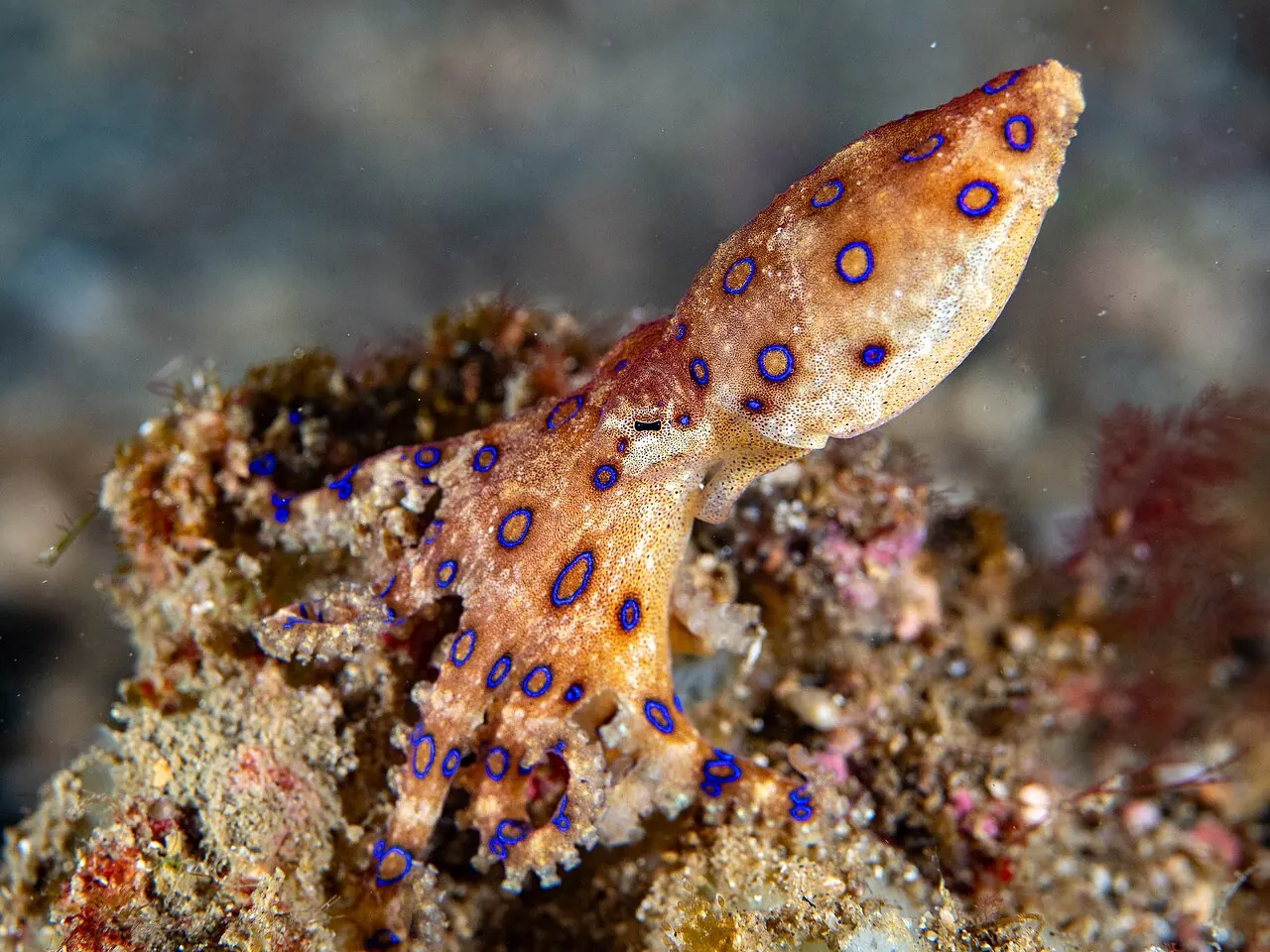
Greater Blue-ringed Octopus
Hapalochlaena lunulata
A small, well-camouflaged western Pacific octopus that flashes about 60 blue rings when disturbed and carries a venom that can kill a person.
Photo: Rickard Zerpe / CC BY 2.0
3 things to know
- When disturbed it flashes around 60 iridescent blue rings.
- Muscles above and around each ring hide or reveal it, a mechanism not reported before in cephalopods.
- Blue-ringed octopus venom contains tetrodotoxin, the nerve toxin also found in pufferfish.
- Scientific name
- Hapalochlaena lunulata
- Depth
- 0 m – 20 m
0 – 66 ft - Size
- Up to about 12 cm (5 in) long including arms; mantle about 5 cm (2 in)
- Weight
- Not well known
- Lifespan
- Not well known; most blue-ringed octopuses live less than 2 years
- Diet
- Mainly small crabs
- Where
- Tropical western Pacific, including Papua New Guinea, the Solomon Islands, the Philippines and Indonesia
- IUCN status
- Least Concern
- Depth zones
- Sunlight
Most of the time a greater blue-ringed octopus is hard to spot, a small, mottled animal camouflaged against the reef. Disturb it, and it flashes around 60 iridescent blue rings. In 2012, Lydia Mäthger, Roger Hanlon and colleagues at the Marine Biological Laboratory in Woods Hole, Massachusetts, worked out how. Each ring holds layered reflectors that bounce blue-green light over a wide range of viewing angles, and dark pigment cells beneath and around the ring add contrast. Unusually for a cephalopod, no pigment cells sit on top of the ring. Instead, muscles above it contract to hide the ring; when they relax and muscles outside the ring contract, the blue shows. The team had not seen this way of making iridescent signals in any cephalopod before and called it an exceptionally effective way to create a fast, conspicuous warning.
The warning is real. Blue-ringed octopuses carry tetrodotoxin, the nerve toxin named after the pufferfish family, which blocks nerve signals and can paralyze the muscles used for breathing. There is no antidote, but victims kept breathing on a ventilator until the toxin wears off can survive. A 2008 review by Susan Jacups and Bart Currie of Charles Darwin University notes that bacteria are thought to make the toxin, and that in almost all recorded bites the octopus had clearly been provoked, often by being lifted out of the water. The octopuses use the venom mainly on small crabs.
The species reaches about 12 centimeters (5 inches) including the arms, with a mantle about 5 centimeters (2 inches) long, and lives in water shallower than about 20 meters (66 feet). Its range is narrower than once thought. Jacups and Currie, citing a 2008 paper by R. C. Willan, restrict Hapalochlaena lunulata to the tropical western Pacific, including Papua New Guinea, the Solomon Islands, the Philippines and Indonesia, and treat the greater blue-ringed octopus of northern Australia as a separate, undescribed species. That northern Australian animal, not H. lunulata, is blamed for the first documented death from a blue-ringed octopus, in Darwin in 1954.
Most blue-ringed octopuses live less than two years and mature at about four months. The hatchlings of this species drift in the plankton. The IUCN lists it as Least Concern.



