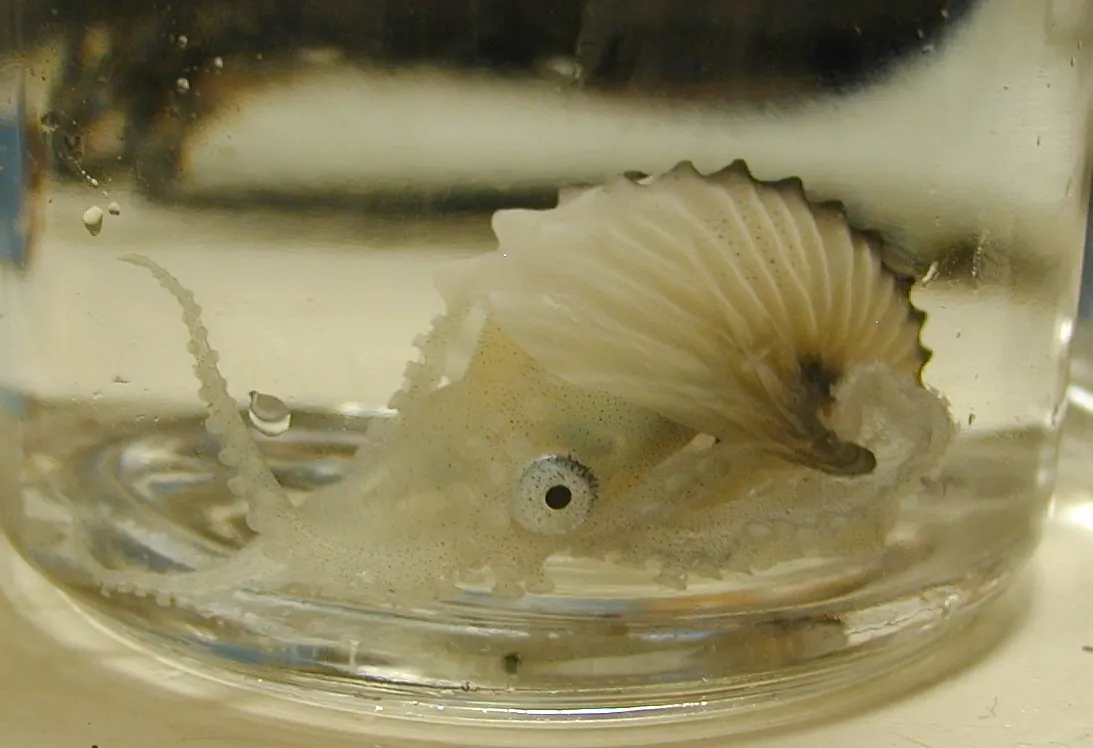
Greater Argonaut
Argonauta argo
An open-ocean octopus whose females build a thin white shell from their arms and use trapped air in it as a float.
Photo: Shannon Rankin, NMFS, SWFSC (NOAA) / Public domain
3 things to know
- The female secretes her shell from webs on her first pair of arms; it is not a true mollusk shell.
- She gulps air at the surface into the shell to float at depth.
- Males are only 1.5 to 2 cm long and grow no shell.
- Scientific name
- Argonauta argo
- Depth
- 0 m – 200 m
0 – 656 ft - Size
- Female shells up to about 30 cm (12 in) long; males 1.5–2 cm (under 1 in)
- Weight
- Not well known
- Lifespan
- Not well known
- Diet
- Not well known; seen attacking jellyfish
- Where
- Tropical and warm temperate seas worldwide
- IUCN status
- Least Concern
- Depth zones
- Sunlight
The ridged, paper-thin white shell of an argonaut belongs only to the female, and she makes it herself. Broad, flag-like webs on her first pair of arms secrete the shell and spread over its surface. It is not a true mollusk shell like a snail's, and it serves as a brood chamber for her eggs. In Argonauta argo, the greater argonaut, shells reach about 30 centimeters (12 inches). Males are dwarfs only 1.5 to 2 centimeters (under an inch) long, and they grow no shell.
Like its relative the blanket octopus, the male mates with a detachable arm, the hectocotylus, which is thought to break off when he meets a female. Several of these arms can stay in a female's shell or mantle cavity for a long time, and one shell can hold eggs at up to five stages of development, according to SeaLifeBase.
The shell's job puzzled naturalists for millennia. In January 2006, Julian Finn and Mark Norman took three live females from commercial fishing nets off Japan's Shimane Peninsula, emptied the air from their shells and let them go in Okidomari Harbour. Each one jetted to the surface, gulped as much air as the top of the shell would hold, sealed it off with its arms and rolled the shell under. Then it drove itself down to the depth where the squeezed air balanced its weight, and swam off level. Finn and Norman argued in 2010 that the shell works as a float, letting an octopus whose ancestors lived on the seafloor live in open water and possibly helping the female carry the extra weight of her eggs.
The greater argonaut drifts in the upper 200 meters (660 feet) of tropical and warm temperate seas around the world. Its diet is not well studied, but it is regularly seen attached to jellyfish, and one was watched clasping and attacking a Phyllorhiza jellyfish, Henk-Jan Hoving and Steven Haddock noted in a 2017 paper. The IUCN lists it as Least Concern, from a 2014 assessment that includes US waters in its range.



