Great Hammerhead Shark
Sphyrna mokarran
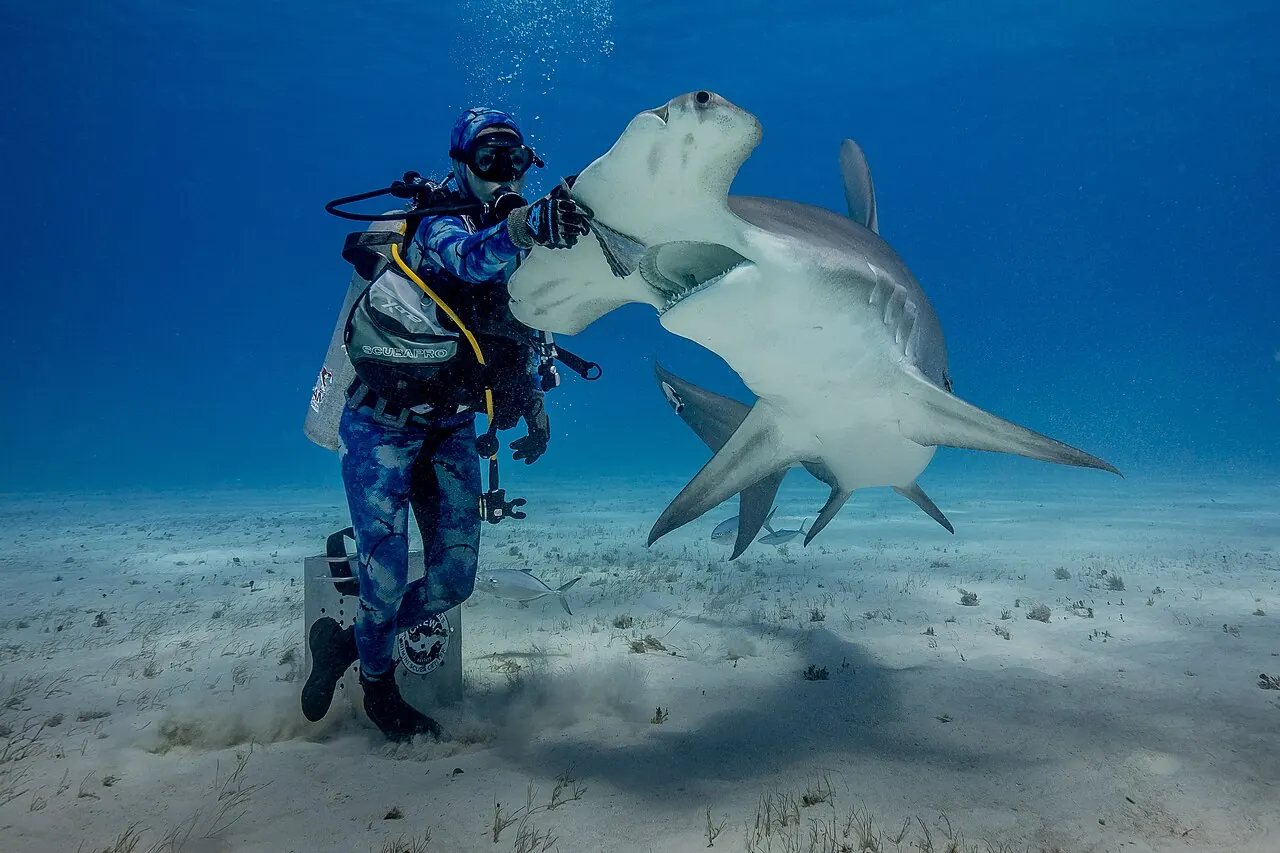
The largest hammerhead, a Critically Endangered hunter of stingrays that often swims tilted onto its side to save energy.
Photo: Stevelaycock21 / CC BY-SA 4.0
3 things to know
- Adults have an almost straight front edge to the hammer, with a shallow notch in the middle.
- Tagged great hammerheads spent up to 90 percent of their time swimming rolled 50 to 75 degrees onto one side.
- A female has up to 42 pups in a litter and breeds once every two years.
- Scientific name
- Sphyrna mokarran
- Depth
- 1 m – 100 m
3 – 328 ft - Size
- Commonly about 3.7 m (12 ft) long; the largest reported 6.1 m (20 ft)
- Weight
- Averages over 230 kg (500 lb); the world record, caught off Sarasota, Florida, weighed 450 kg (991 lb)
- Lifespan
- About 20–30 years
- Diet
- Stingrays and other rays, bony fishes such as groupers and sea catfishes, other sharks, crabs, squid and lobsters
- Where
- Warm temperate and tropical coasts worldwide; in the western Atlantic from North Carolina to Uruguay, including the Gulf of Mexico and the Caribbean
- IUCN status
- Critically Endangered
- Depth zones
- Sunlight
A hammer-shaped head with an almost straight front edge marks the great hammerhead, the largest of the hammerhead sharks. In adults that edge has only a shallow notch in the middle, which sets the species apart from the scalloped and smooth hammerheads. The first dorsal fin is very tall and curves back like a sickle. Adults are commonly around 3.7 meters (12 feet) long, and the largest reported reached 6.1 meters (20 feet). The world-record great hammerhead, caught off Sarasota, Florida, weighed 450 kilograms (991 pounds).
Great hammerheads patrol warm coasts around the world. In the western Atlantic they range from North Carolina to Uruguay, including the Gulf of Mexico and the Caribbean. They are most common in shallow coastal water over continental shelves, lagoons and reefs, down to about 80 meters (260 feet), but they have been found far offshore at 300 meters (980 feet). Some populations move toward the poles in summer.
Stingrays are a favorite food. Like all sharks and rays, the hammerhead has jelly-filled pores on the underside of its head that pick up the faint electrical signals of prey, including rays buried in sand. It also eats bony fish such as groupers and sea catfish, along with crabs, squid and other sharks.
The tall dorsal fin has a second job. Nicholas Payne, Gil Iosilevskii and colleagues fitted motion-sensing tags to a great hammerhead at the Great Barrier Reef and another off Belize. The Australian shark spent about 90 percent of an 18-hour recording swimming rolled 50 to 75 degrees onto one side, and fin cameras on three sharks at South Bimini in the Bahamas caught the same posture. Wind-tunnel tests on a model at Israel's Technion showed that the tilt, which lets the dorsal fin work as a wing, cuts drag by around 10 percent. The team published the work in Nature Communications in 2016.
Females give birth to live young after about 11 months, with 6 to 42 pups in a litter. Great hammerheads are caught on longlines and in nets across the tropics and prized for their large fins, and the Florida Museum puts mortality among those taken in gillnets and on longlines at over 90 percent. The IUCN lists the species as Critically Endangered.



