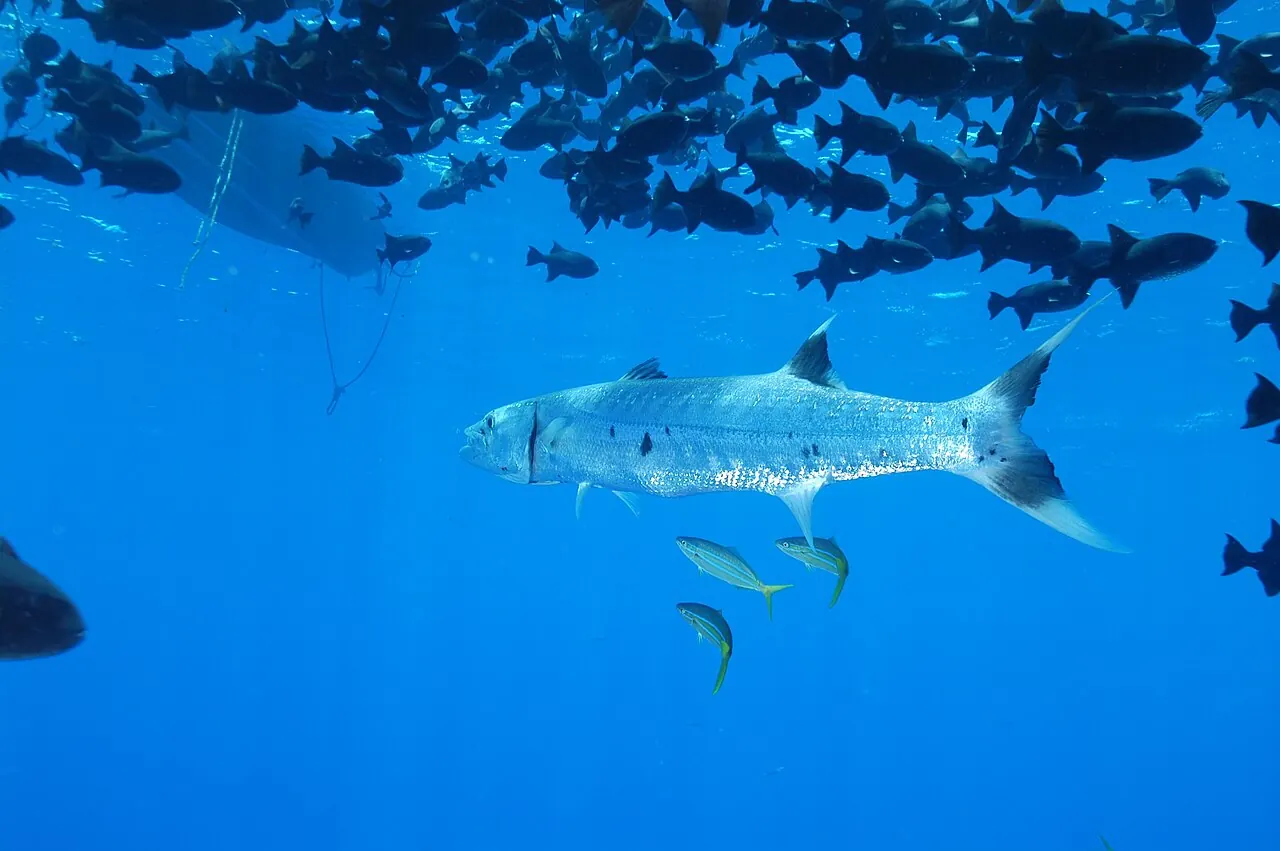
Great Barracuda
Sphyraena barracuda
A long, silver, sharp-toothed ambush hunter of warm seas whose famous burst speed may be half what older estimates claimed.
Photo: Marc Taquet (Ifremer) / CC BY 4.0
3 things to know
- Its jaws hold an outer row of small sharp teeth and an inner set of larger fangs.
- Muscle measurements put its top speed at about 6.2 meters per second (14 mph).
- Large barracuda can carry ciguatera toxin, which poisons people who eat them.
- Scientific name
- Sphyraena barracuda
- Depth
- 3 m – 30 m
10 – 98 ft - Size
- Up to about 2 m (6.6 ft) long
- Weight
- Up to about 50 kg (110 lb) reported; a cited hook-and-line record is about 47 kg (103 lb)
- Lifespan
- At least 14 years; FishBase lists a maximum reported age of 18
- Diet
- Mostly fish, plus cephalopods and sometimes shrimp
- Where
- Warm seas worldwide: Red Sea and East Africa to Hawaii, Massachusetts to Brazil, and West Africa; rare or absent in much of the eastern Pacific
- IUCN status
- Least Concern
- Depth zones
- Sunlight
Long, silver and full of teeth, the great barracuda hunts by sight in daylight. Its jaws hold an outer row of small, sharp teeth and a set of larger, dagger-like ones inside. Black spots scattered on the lower sides set it apart from other barracudas. It can reach about 2 meters (6.6 feet) and has been reported at 50 kilograms (110 pounds). FishBase and the Florida Museum cite a hook-and-line record from the Bahamas of 1.7 meters (5.5 feet) and 103 pounds (about 47 kilograms).
It lives in warm seas around the world: from the Red Sea and East Africa to Hawaii, from Massachusetts to Brazil in the western Atlantic, and off West Africa, though it is rare or absent in much of the eastern Pacific. Juveniles grow up among mangroves and seagrass and move out to reefs in their second year. Adults range from murky harbors to open water, mostly near the surface and usually 3 to 30 meters (10 to 100 feet) deep, with records to 100 meters.
The diet is mostly fish, from jacks, grunts and snappers to small tunas and herrings, along with cephalopods. Small prey is swallowed whole, and large prey is chopped in pieces. The barracuda's burst speed has been quoted as high as 58 kilometers per hour (36 mph). In February 2015, Morten Svendsen and colleagues measured how fast the swimming muscle of five barracuda, caught off Cancún, Mexico, could contract. Their 2016 estimate of top speed was about 6.2 meters per second, or 22 kilometers per hour (14 mph), roughly half a 1952 figure of 12 meters per second. Corrected for body size, the paper puts barracuda and little tunny ahead of the sailfish and dorado it also tested.
Attacks on people are rare, usually a single fast strike at a speared fish or a shiny object. Large barracuda can also carry ciguatera toxin, though FishBase notes it has not been reported as poisonous in the eastern Atlantic. As of November 2026, Florida limits anglers off Collier, Monroe, Miami-Dade, Broward, Palm Beach and Martin counties to two fish a day, 38 to 91 centimeters (15 to 36 inches) fork length, with one larger fish allowed per person or vessel. Barracuda live at least 14 years, and FishBase lists a maximum age of 18. The IUCN lists the species as Least Concern, from a 2013 assessment.



