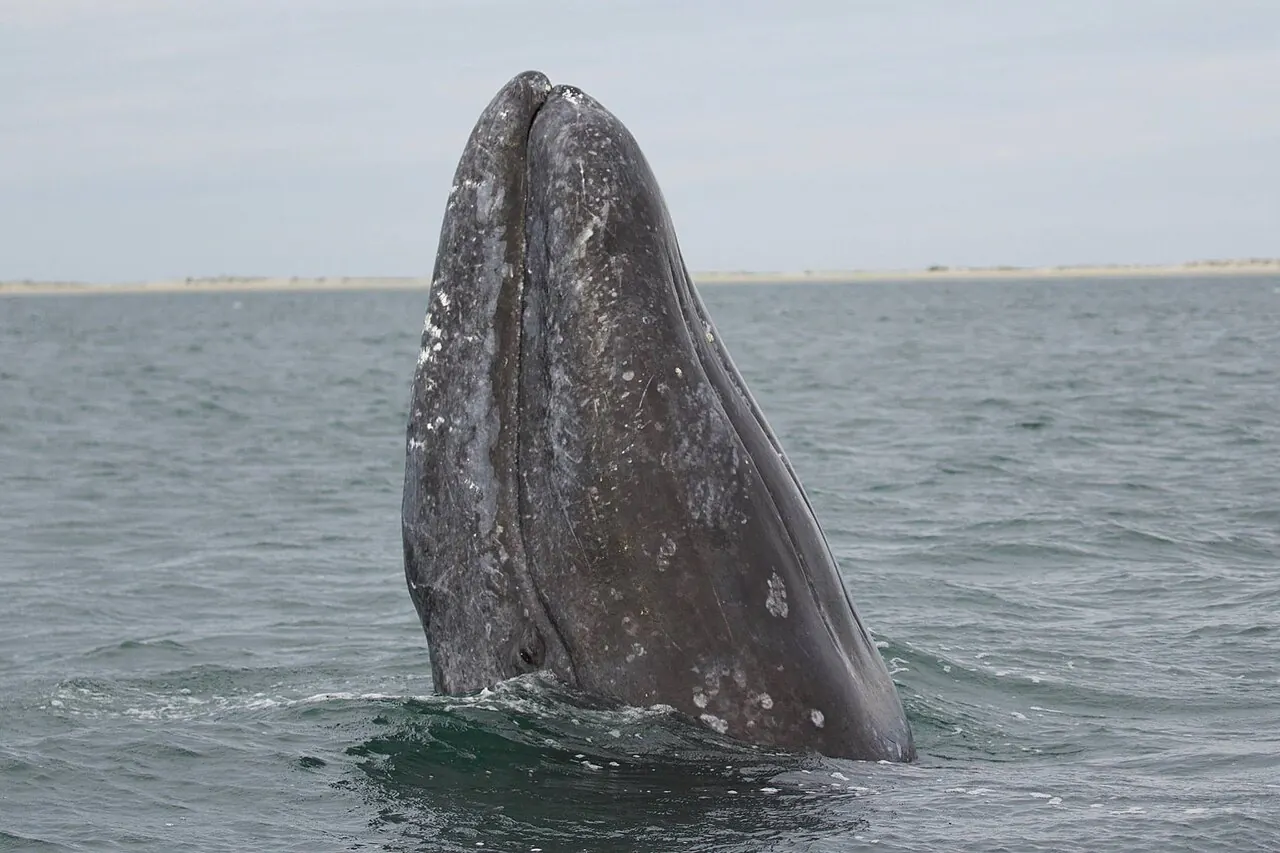
Gray Whale
Eschrichtius robustus
A barnacle-spotted North Pacific whale that sucks its food out of seafloor mud and makes one of the longest migrations of any mammal.
Photo: Marc Webber/USFWS / Public domain
3 things to know
- It feeds by rolling onto its side and sucking sediment and small animals off the seafloor.
- Eastern gray whales travel about 16,000 km (10,000 miles) on their yearly round trip.
- Instead of a dorsal fin, it has a hump and a row of 6 to 12 small bumps called knuckles.
- Scientific name
- Eschrichtius robustus
- Depth
- 0 m – 65 m
0 – 213 ft - Size
- Up to about 15 m (49 ft) long
- Weight
- About 41 metric tons (90,000 lb)
- Lifespan
- Unknown
- Diet
- Amphipods and other small animals on or just above the seafloor
- Where
- North Pacific, mainly shallow coastal water
- IUCN status
- Least Concern
- Depth zones
- Sunlight
Barnacles and whale lice cluster on the head and tail of the gray whale, a mottled North Pacific baleen whale with no dorsal fin. In its place is a hump about two-thirds of the way down the back, followed by 6 to 12 small bumps called knuckles. Adults grow to about 15 meters (49 feet) and roughly 90,000 pounds, and females are slightly larger than males.
They eat from the bottom. A gray whale rolls onto its side, swims slowly along the seafloor and takes in sediment along with amphipods and other small invertebrates, then strains its food through 130 to 180 coarse baleen plates on each side of the upper jaw. The feeding leaves muddy trails and pits behind. It happens in shallow water: off Sakhalin Island in Russia, one feeding area is less than 20 meters (66 feet) deep and the other is 30 to 65 meters (about 100 to 210 feet) deep.
There are two populations. Eastern gray whales spend summer mostly in the northern Bering and Chukchi seas and swim south in autumn to lagoons off Baja California, Mexico. Calves are born there, or on the way, from early January to mid-February, after a pregnancy of 12 to 13 months. NOAA Fisheries puts the round trip at about 10,000 miles (16,000 kilometers). This population was taken off the US endangered list in 1994, and the IUCN lists the species as Least Concern. The western population, which feeds off Sakhalin, is far smaller, an estimated 220 to 270 whales in 2020, not counting calves, and it is listed as endangered both by the IUCN and under US law. Entanglement, vessel strikes, noise, whale-watching disturbance and climate change are among the threats. How long gray whales live is unknown.
The line between the two populations has blurred. When Bruce Mate of Oregon State University and Russian colleagues tagged seven whales off Sakhalin, three swam into waters used by eastern grays. One female, Varvara, visited all three main breeding areas off Baja California and returned to Sakhalin the next spring, a 22,511-kilometer round trip that the team, writing in 2015, called the longest documented mammal migration. As of 2019, 54 individual whales were known to have visited both Russia and Mexico.



