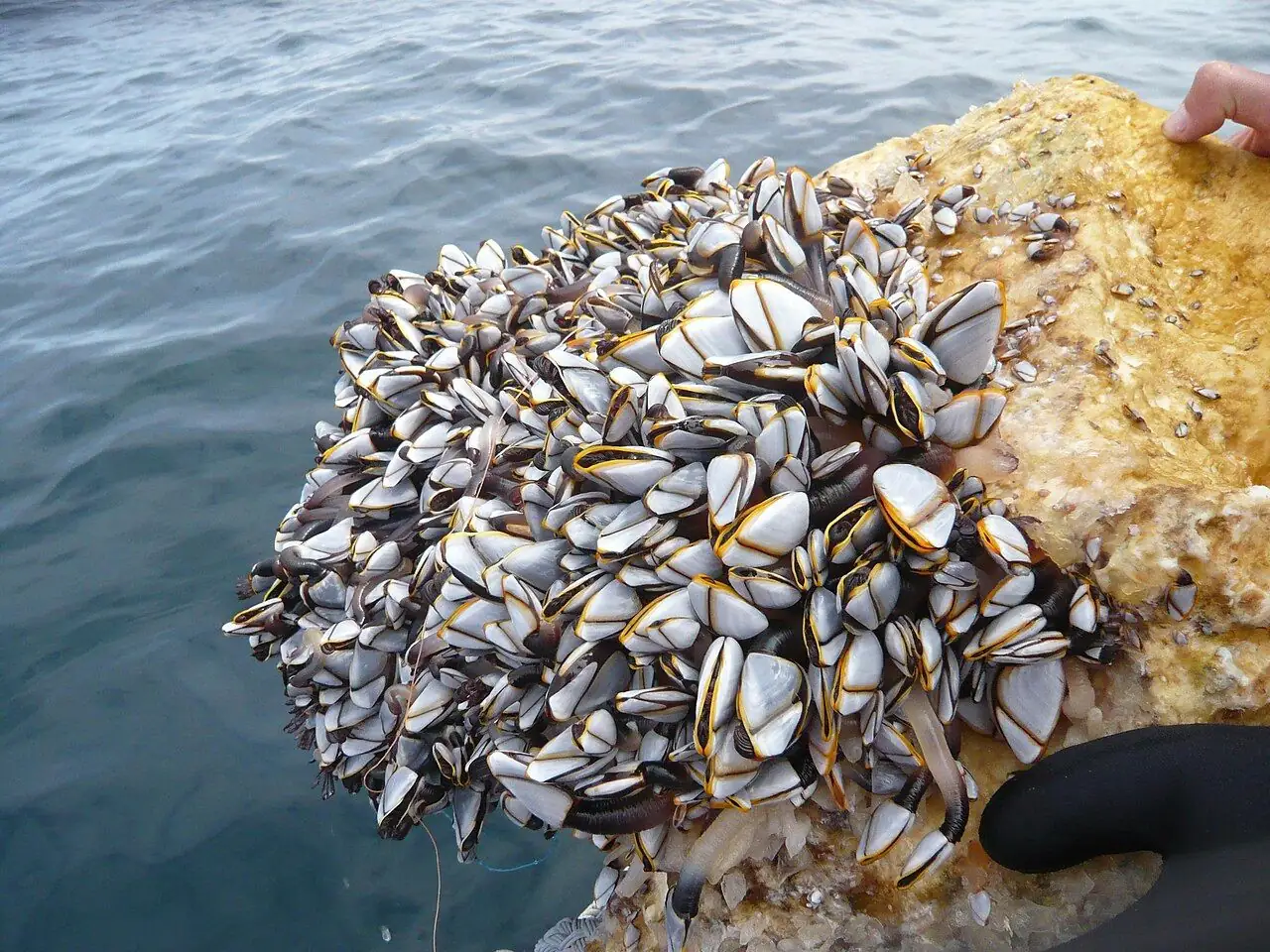
Goose Barnacle
Lepas anatifera
A stalked open-ocean barnacle that rides driftwood and debris, inspired a medieval tale of geese born from wood, and now helps trace lost wreckage.
Photo: Xavier Caisey / CC BY 4.0
3 things to know
- Its flexible stalk can be as long as 85 cm (33 in).
- In the 1180s, Gerald of Wales wrote that birds called barnacles grew in shells on driftwood.
- A wing part from Malaysia Airlines flight MH370 that washed up on Réunion Island in 2015 was covered in this species.
- Scientific name
- Lepas anatifera
- Depth
- 0 m – 1 m
0 – 3 ft - Size
- Shell (capitulum) about 4 to 5 cm (1.6 to 2 in), sometimes to 7 cm (2.8 in); stalk 4 to 85 cm (1.6 to 33 in)
- Weight
- Not well known
- Lifespan
- Not well known
- Diet
- Plankton filtered from the water, including prey up to about 5 mm across
- Where
- Open ocean worldwide, especially in warm water; often washes ashore on floating objects
- IUCN status
- Not Evaluated
- Depth zones
- Sunlight
Haul a waterlogged log out of the open ocean and it may come up hung with goose barnacles. Each has a flattened shell, the capitulum, made of five smooth white plates and usually 4 to 5 centimeters (1.6 to 2 inches) long, on a flexible, purplish-brown stalk that can run from 4 to 85 centimeters (1.6 to 33 inches). The opening of the shell is lined with scarlet tissue, and when the barnacle feeds, a brush of feeding legs sweeps out of it.
Lepas anatifera lives in the open sea around the world, especially in warm water, usually within a meter of the surface on whatever floats: driftwood, glass, plastic, buoys, ships' keels, even a cork life belt. Walla Walla University's invertebrate guide says it seems to be the most common pelagic gooseneck barnacle on the Washington coast, though it rarely washes up south of Point Conception, California. One cluster was found growing inside the mouth of a stranded ocean sunfish in the Azores.
It filters plankton without being choosy, and SeaLifeBase notes it readily takes prey up to 5 millimeters across. Like most of its relatives it is a hermaphrodite. Fertilization is internal, the young are brooded inside the shell, and larvae are released after about a week to drift until they settle on something new. The IUCN has not assessed it.
Shells dangling from driftwood fed a medieval legend. In his Topography of Ireland, written in the 1180s, Gerald of Wales wrote that birds called barnacles were born on timber washed by the waves and hung there in shells, and claimed he had seen more than a thousand on a single log. In parts of Ireland, he added, clergy ate them on fast days because they were not born of flesh. The Australian Museum notes that a legend linking goose barnacles to geese grew throughout the Middle Ages.
In July 2015 a flaperon from Malaysia Airlines flight MH370 washed ashore on Réunion Island covered with Lepas anatifera. Barnacle shells record the temperature of the water they grow in, so Gregory Herbert's team at the University of South Florida reared the species in the lab to calibrate that record, then read one MH370 barnacle's shell as a dated series of sea temperatures. Matched against 50,000 simulated temperature histories, it pointed to a drift path far south of an earlier isotope-based estimate, they reported in AGU Advances in 2023.
Sources
- marlin.ac.uk/species/detail/2058
- inverts.wallawalla.edu/Arthropoda/Crustacea/Maxillopoda/Cirripedia/Lepas_anatifera.html
- sealifebase.se/summary/Lepas-anatifera.html
- australian.museum/learn/animals/crustaceans/goose-barnacle
- sourcebooks.web.fordham.edu/source/1188geraldwales-barnacle.html
- archive.org/details/historicalworkso00gira
- Study: doi:10.1029/2023av000915
- usf.edu/news/2023/usf-geoscientist-creates-oceanic-tracking-model-to-urge-investigators…
- api.gbif.org/v1/species/5166339/iucnRedListCategory



