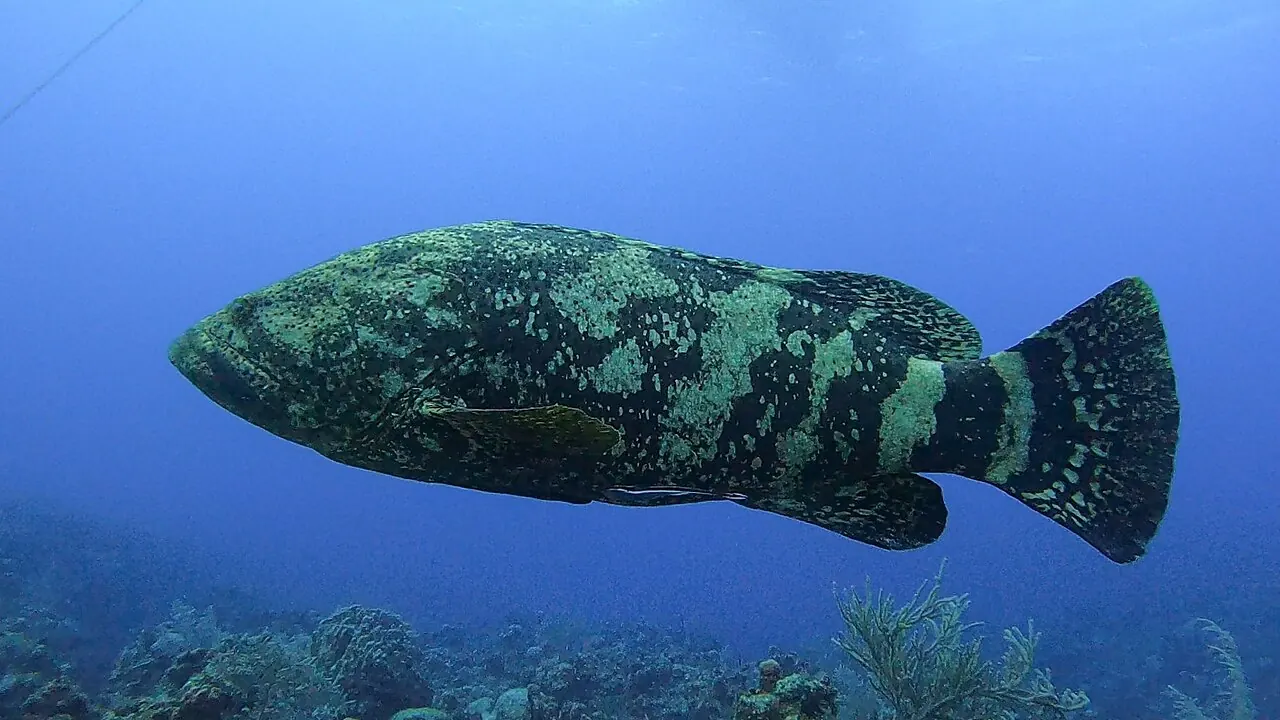
Goliath Grouper
Epinephelus itajara
The Atlantic's biggest grouper, a lobster-eating giant that calls at night on its spawning sites and came back after US fishing for it stopped in 1990.
Photo: Dan Schofield / CC BY 4.0
3 things to know
- NOAA puts the largest goliath groupers at about 8 feet long and 800 pounds.
- On spawning sites off southwest Florida, goliaths call most often between 1 and 3 a.m.
- Federal waters of the southeastern US have been closed to goliath grouper harvest since 1990.
- Scientific name
- Epinephelus itajara
- Depth
- 1 m – 100 m
3 – 328 ft - Size
- Up to about 2.4 to 2.5 m (8 ft) long
- Weight
- Up to about 363 kg (800 lb), per NOAA; FishBase lists a maximum published weight of 455 kg (1,000 lb)
- Lifespan
- More than 30 years; FishBase lists a maximum reported age of 37
- Diet
- Crustaceans, especially spiny lobsters, plus fish (including stingrays) and turtles
- Where
- Western Atlantic from Florida to southern Brazil, including the Gulf of Mexico and Caribbean; eastern Atlantic from Senegal to Congo
- IUCN status
- Vulnerable
- Depth zones
- Sunlight
No grouper in the Atlantic grows bigger. NOAA Fisheries puts the goliath grouper at up to about 2.4 meters (8 feet) and 363 kilograms (800 pounds). The body is brownish yellow, gray or greenish, with small black spots on the head and fins, and the head is extremely broad. Young fish are tawny with irregular dark bands. NOAA says goliaths live more than 30 years, and FishBase lists a maximum reported age of 37.
Goliaths live in shallow water on both sides of the Atlantic: from Florida, the Gulf of Mexico and the Caribbean to southern Brazil, and off West Africa from Senegal to Congo. The IUCN gives a depth range of about 1 to 100 meters (330 feet). Juveniles grow up in mangroves and brackish estuaries. Adults stay close to a home cave or wreck and can defend it with a threat display, mouth open and body quivering. They eat mostly crustaceans, spiny lobsters above all, along with fish such as stingrays, and even turtles.
They are also loud. In a 2009 study, David Mann and colleagues recorded goliaths on two aggregation sites in the Gulf of Mexico off southwest Florida, where fish with ripe gonads suggested spawning. The groupers made low single pulses of sound around 60 hertz, most often between 1 and 3 a.m., and went quieter for several days around the full moon. One fish fitted with a depth tag stayed near the bottom at about 46 meters (150 feet) for almost two months, with short trips upward near midnight and 3 a.m. that may have been spawning rises.
FishBase says goliaths were overfished mainly by spearfishing. Federal waters of the southeastern US closed to harvest in 1990, and the fish was named a candidate for Endangered Species Act listing in 1991. By 2006 the US population had grown enough for NOAA to drop it from its species of concern list. Red tides killed goliaths off Lee and Collier counties in 2003 and 2005. In March 2022 Florida's wildlife commission approved a small harvest in state waters from 2023 on: up to 200 fish a year by lottery permit, taken only from March 1 to May 31 and only at 61 to 91 centimeters (24 to 36 inches) long. Worldwide, the IUCN lists the goliath as Vulnerable, with numbers still falling.
Sources
- fisheries.noaa.gov/species/atlantic-goliath-grouper
- fishbase.se/summary/Epinephelus-itajara.html
- iucnredlist.org/species/195409/145206345
- Study: doi:10.3354/esr00109
- content.govdelivery.com/accounts/FLFFWCC/bulletins/30d39d9
- myfwc.com/fishing/saltwater/recreational/goliath
- commons.wikimedia.org/wiki/File:Epinephelus_itajara_465630335.jpg



