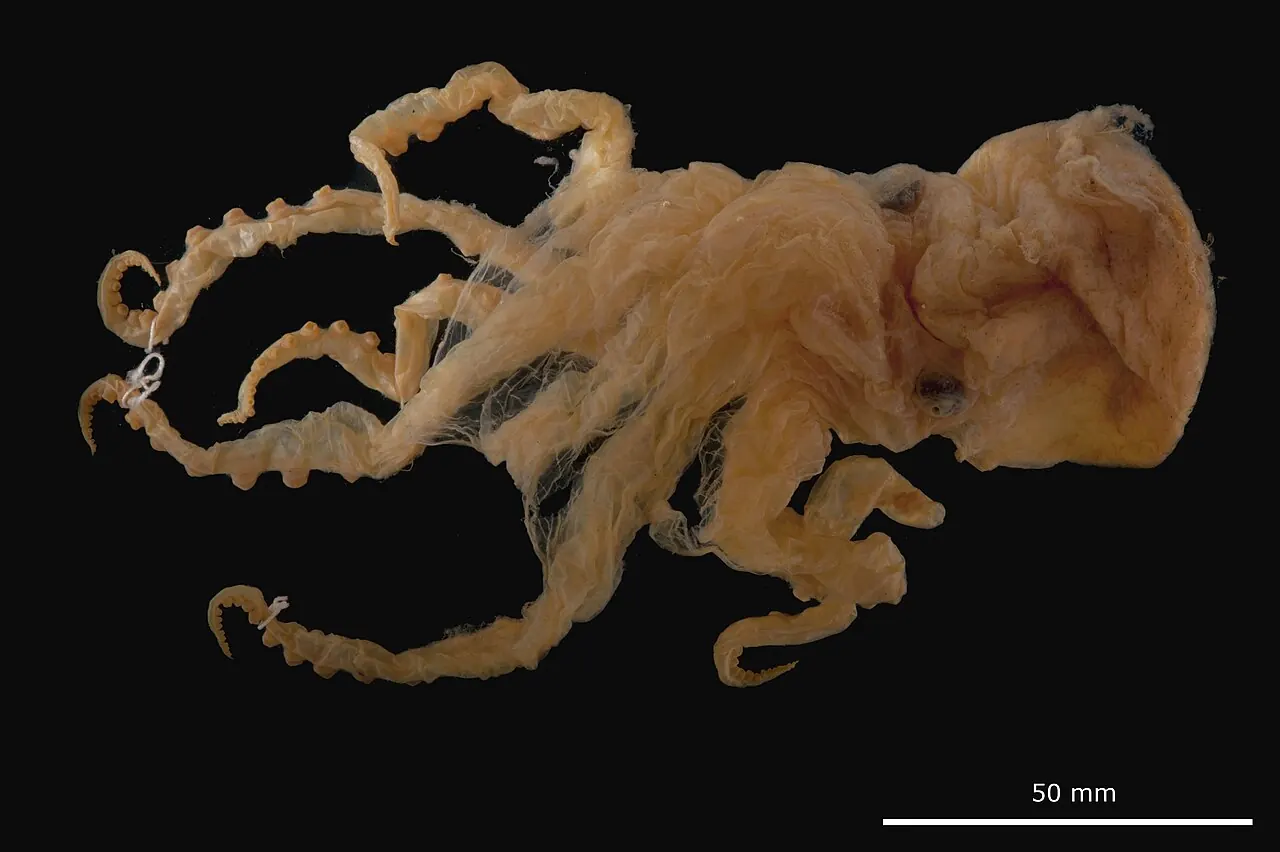
Glass Octopus
Vitreledonella richardi
A nearly transparent open-ocean octopus whose eyes and gut are shaped to cast as little shadow as possible.
Photo: Natural History Museum of Denmark / CC BY 4.0
3 things to know
- Its body is gelatinous, transparent and almost colorless.
- Its eyes are long and narrow, a shape that may shrink their silhouette when seen from below.
- In 2021 a Schmidt Ocean Institute expedition filmed two glass octopuses near the Phoenix Islands in the Pacific.
- Scientific name
- Vitreledonella richardi
- Depth
- 0 m – 1,000 m
0 – 3,281 ft - Size
- Up to about 45 cm (18 in) long including the arms
- Weight
- Unknown
- Lifespan
- Unknown
- Diet
- Not well known
- Where
- Tropical and subtropical oceans worldwide, usually over deep water
- IUCN status
- Least Concern
- Depth zones
- Sunlight · Twilight
Almost everything about Vitreledonella richardi is see-through. The body is gelatinous, transparent and almost colorless, so the parts you notice on a living animal are the few that cannot be made clear. When the Schmidt Ocean Institute announced two sightings in 2021, it described the glass octopus as nearly transparent, with only its optic nerve, eyeballs and digestive tract visible. SeaLifeBase gives a total length, arms included, of up to 45 centimeters (18 inches).
Even those visible organs seem built for hiding. The Tree of Life Web Project's account of the species describes a long, slender, spindle-shaped digestive gland that the octopus keeps upright as it swims, so this opaque organ casts a minimal shadow in the dim light from above. The eyes are odd too. Seen from the side they look nearly rectangular. Michael Land examined two specimens caught at 200 meters in the North Atlantic and reported in 1992 that this elongated eye, with its lens in the middle, has a narrower field of view to the sides. He argued that the shape shrinks the eye's silhouette as seen from below, as part of the animal's camouflage.
The glass octopus lives in tropical and subtropical waters around the world, from near the surface to at least 1,000 meters (3,300 feet), typically beyond the continental shelf. In the eastern North Atlantic, young ones under about 4 centimeters in mantle length have mostly been caught in the top 300 meters, while larger animals turn up mostly in the upper twilight zone. Its biology is largely unknown. Females are thought to brood their eggs until they hatch, and a submersible off Hawaii filmed one at about 900 meters with a second octopus held inside its web, presumably a mating pair.
For a long time scientists learned about it mostly from specimens found in the stomachs of predators. In 2021, on an expedition to seamounts in the Phoenix Islands of the Pacific led by Randi Rotjan of Boston University, the research vessel Falkor's robot SuBastian recorded two glass octopuses; the first was 680 meters (2,230 feet) down. Rotjan noted that neither was living inside a marine protected area. The IUCN lists the species as Least Concern, from a 2014 assessment.
Sources
- sealifebase.se/summary/Vitreledonella-richardi.html
- web.archive.org/web/20250922184357/http://www.tolweb.org/Vitreledonella_richardi/20195
- Study: doi:10.1017/S0025315400048803
- schmidtocean.org/scientists-explore-seamounts-in-phoenix-islands-archipelago-gaining-ne…
- schmidtocean.org/cruise-log-post/244-coral-samples-14-seamounts-and-2-glass-octopuses
- bu.edu/articles/2021/rare-glass-octopus-footage
- iucnredlist.org/species/162988/961420
- Study: doi:10.2305/IUCN.UK.2014-3.RLTS.T162988A961420.en



