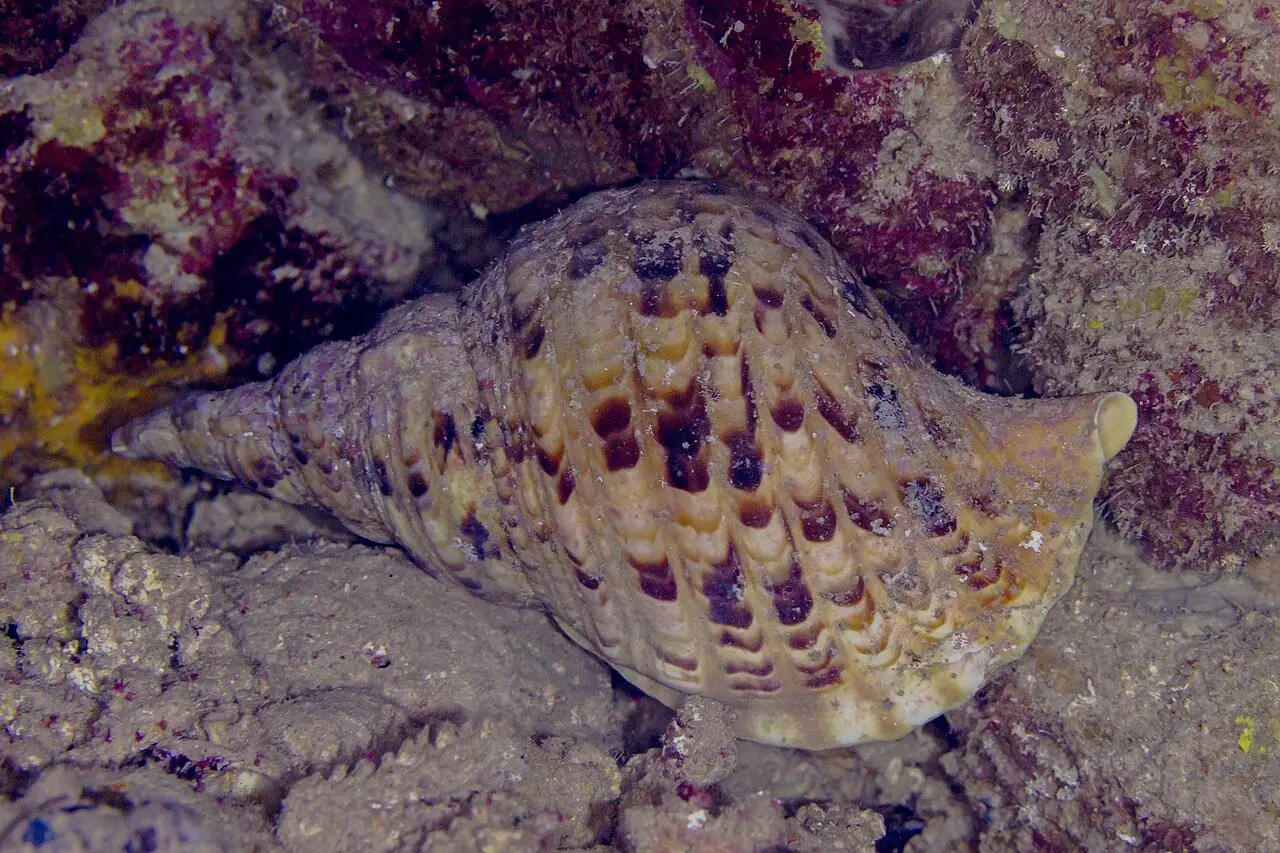
Giant Triton
Charonia tritonis
One of the largest sea snails, and one of the few animals that hunts adult crown-of-thorns starfish, the coral-eating pest of Indo-Pacific reefs.
Photo: Diego Delso / CC BY-SA 4.0
3 things to know
- Its proboscis can stretch up to 40 cm (16 in) to inject a paralyzing toxin or acidic saliva.
- Crown-of-thorns starfish move away from water that carries the smell of a triton.
- As of 2022, no triton larva raised in a lab had grown far enough to settle on the bottom.
- Scientific name
- Charonia tritonis
- Depth
- 1 m – 40 m
3 – 131 ft - Size
- Shell up to about 50 cm (20 in) long
- Weight
- Not well known
- Lifespan
- Unknown
- Diet
- Sea stars, including crown-of-thorns starfish, plus sea cucumbers and sea urchins
- Where
- Tropical Indo-Pacific, from the Red Sea and East Africa to Japan, Australia, Hawaii and the Galápagos
- IUCN status
- Not Evaluated
- Depth zones
- Sunlight
Few animals will take on an adult crown-of-thorns starfish, with its toxic spines, but the giant triton does. It is one of the largest living sea snails: the tall, pointed shell reaches about 50 centimeters (20 inches) and is cream to pink with red-brown crescent splashes and a flaring outer lip. It lives in and around shallow coral reefs across the tropical Indo-Pacific, from the Red Sea and East Africa to Japan, Australia, Hawaii and the Galápagos, mostly 1 to 40 meters (3 to 130 feet) down, though a few have turned up several hundred meters deep.
Tritons hunt mainly at night and hide in crevices by day. A hunting triton sweeps its tentacles from side to side to pick up the scent of prey, then homes in as the smell grows stronger. Close in, it extends a proboscis as long as 40 centimeters (16 inches), pierces the starfish's skin and injects a toxin or acidic saliva that paralyzes it. The foot clamps the prey, mucus coats it, and the triton rasps it away with its radula, unharmed by the starfish's saponin toxins. Captive tritons have eaten an adult crown-of-thorns in 4 to 24 hours. They also eat other sea stars, sea cucumbers and urchins.
Females glue clusters of capsules, each about 3.4 to 6 centimeters (1.3 to 2.4 inches) long, to rock and guard them without feeding for 35 to more than 60 days. The larvae drift as plankton for a very long time, perhaps long enough to cross oceans. Labs have kept them alive for 300 days, but as of a 2022 review none had settled into a young snail.
Shell collecting made the triton rare. Between 1966 and 1972, dive surveys of more than 130 Great Barrier Reef reefs found only 78. Australia, India, Fiji, Indonesia and the Philippines are among countries that ban its collection or export, and a 1993 proposal to list it under CITES failed for lack of evidence on its biology and trade. The IUCN has not assessed it.
Whether losing tritons helped cause crown-of-thorns outbreaks is unproven. In that 2022 review, Cherie Motti of the Australian Institute of Marine Science and colleagues note that the starfish flee water that smells of a triton. At about one starfish a week, tritons eat too few to control an outbreak, but the authors suggest their presence might break up gatherings of starfish at spawning time.



