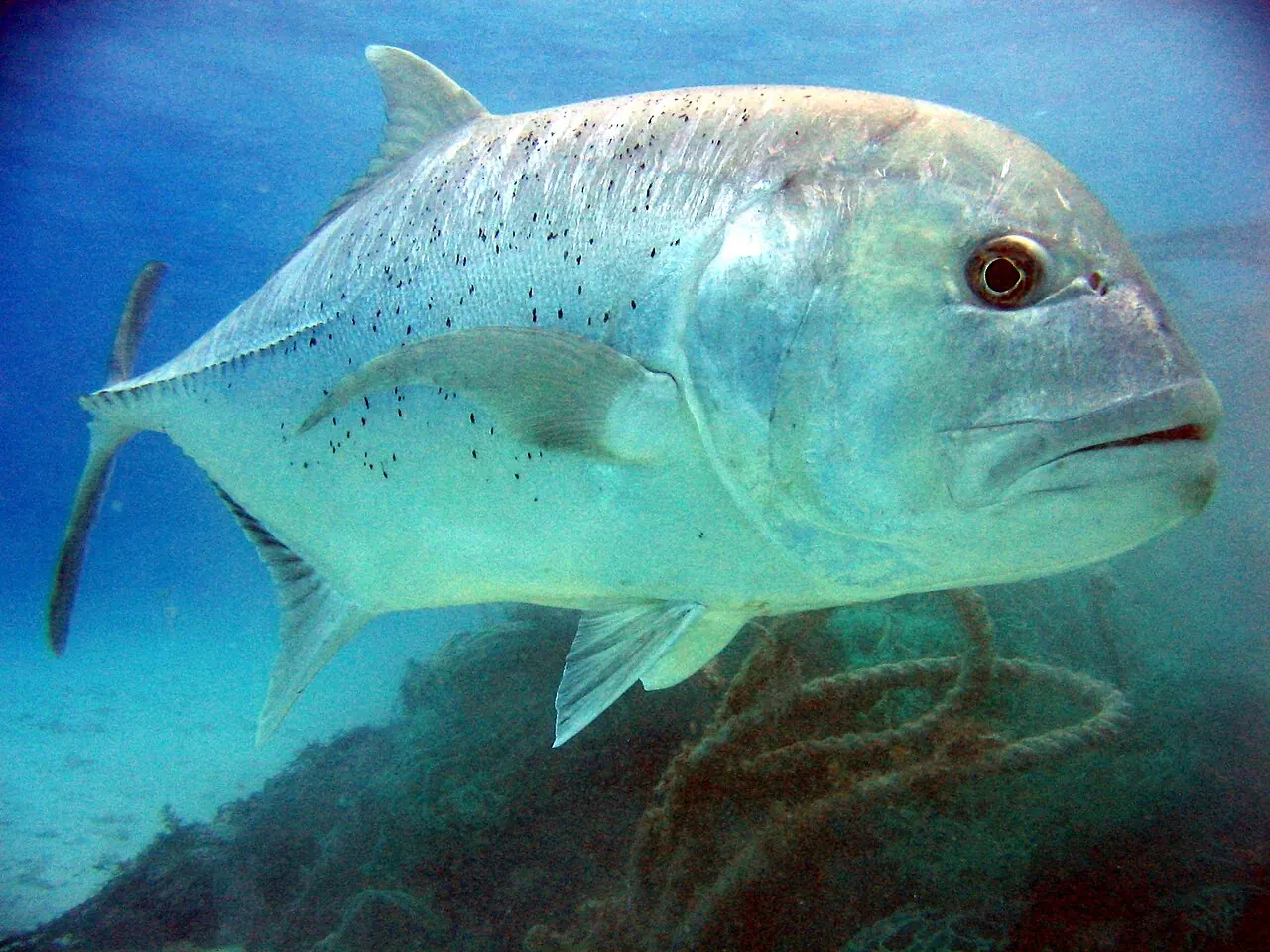
Giant Trevally
Caranx ignobilis
The largest trevally, a reef predator that tails Hawaiian monk seals for scraps and has been filmed snatching young terns at the sea surface.
Photo: Dr. Dwayne Meadows, NOAA/NMFS/OPR / Public domain
3 things to know
- The largest giant trevally reach about 1.7 m (5.6 ft) and over 60 kg (132 lb).
- A typical giant trevally in the Northwestern Hawaiian Islands was estimated to eat about 150 kg (330 lb) of prey a year.
- Giant trevally follow foraging Hawaiian monk seals and grab prey the seals flush from cover.
- Scientific name
- Caranx ignobilis
- Depth
- 10 m – 188 m
33 – 617 ft - Size
- Up to about 1.7 m (5.6 ft) long; commonly about 1 m (3.3 ft)
- Weight
- Over 60 kg (132 lb); FishBase lists a maximum published weight of 80 kg (176 lb)
- Lifespan
- Not well known
- Diet
- Mostly fish, plus crabs, spiny lobsters and cephalopods; sometimes seabirds
- Where
- Indo-Pacific from the Red Sea and East Africa to Hawaii and the Marquesas, north to southern Japan and south to Australia
- IUCN status
- Least Concern
- Depth zones
- Sunlight
FishBase calls the giant trevally the largest of the trevallies, reaching 1.7 meters (5.6 feet) and more than 60 kilograms (132 pounds). It has a steep forehead and a row of tough scutes, or hardened scales, along the rear of the lateral line. Adults are silvery gray to almost black above and usually paler below. The fins are usually plain gray to black, though fish from murky coastal water often have yellow fins.
It ranges across the tropical Indo-Pacific, from the Red Sea and East Africa to Hawaii and the Marquesas, and from southern Japan to Australia. Adults patrol clear lagoons, seaward reefs and drop-offs, usually alone, between about 10 and 190 meters (33 and 620 feet) deep. Juveniles school over sandy shallows and enter estuaries. Giant trevally eat mostly fish, along with crabs, spiny lobsters and octopus or squid, and FishBase notes that they often feed at night.
Much of the research comes from Hawaii, where it is called ulua aukea or giant ulua. Anthony Sudekum and colleagues, working in the nearly untouched Northwestern Hawaiian Islands, reported in 1991 that the diet was more than 90 percent fish and estimated that a typical giant trevally eats about 150 kilograms (330 pounds) of prey a year. They began breeding at about 60 centimeters (2 feet) long, roughly 3.5 years old. In 2007 Meyer, Holland and Papastamatiou tracked tagged giant trevally at five atolls there and never saw one move between atolls. At French Frigate Shoals, fish from across the atoll gathered at Rapture Reef in summer, during particular phases of the moon, to spawn. In a 2008 study, Parrish and colleagues put cameras on 42 Hawaiian monk seals at the same atoll and saw jacks, giant trevally among them, following foraging seals and snatching the prey the seals flushed out.
In the Seychelles, giant trevally take young terns from the sea surface, a hunt filmed for the BBC's Blue Planet II. In 2025 Ryan Daly and colleagues reported in the journal Ecology that giant trevally also use a breaching strategy to prey on seabirds in flight. In a 2021 study of tagged fish in the Seychelles, Daly and colleagues found that the home ranges of adults longer than 1 meter averaged about 210 square kilometers (81 square miles), more than five times that of juveniles.
The IUCN lists the giant trevally as Least Concern. Large fish may carry ciguatera toxin.
Sources
- fishbase.se/summary/Caranx-ignobilis.html
- fishbase.se/ComNames/CommonNamesList.php
- fishesofaustralia.net.au/home/species/4268
- iucnredlist.org/species/20430651/115377176
- spo.nmfs.noaa.gov/sites/default/files/pdf-content/1991/893/sudekum.pdf
- Study: doi:10.3354/meps333013
- Study: doi:10.3354/esr00090
- Study: doi:10.3354/meps13654
- Study: doi:10.1002/ecy.70211
- saveourseas.com/sosf-darros-research-centre/wp-json/wp/v2/posts/1674
- commons.wikimedia.org/wiki/File:Caranx_ignobilis.jpg



