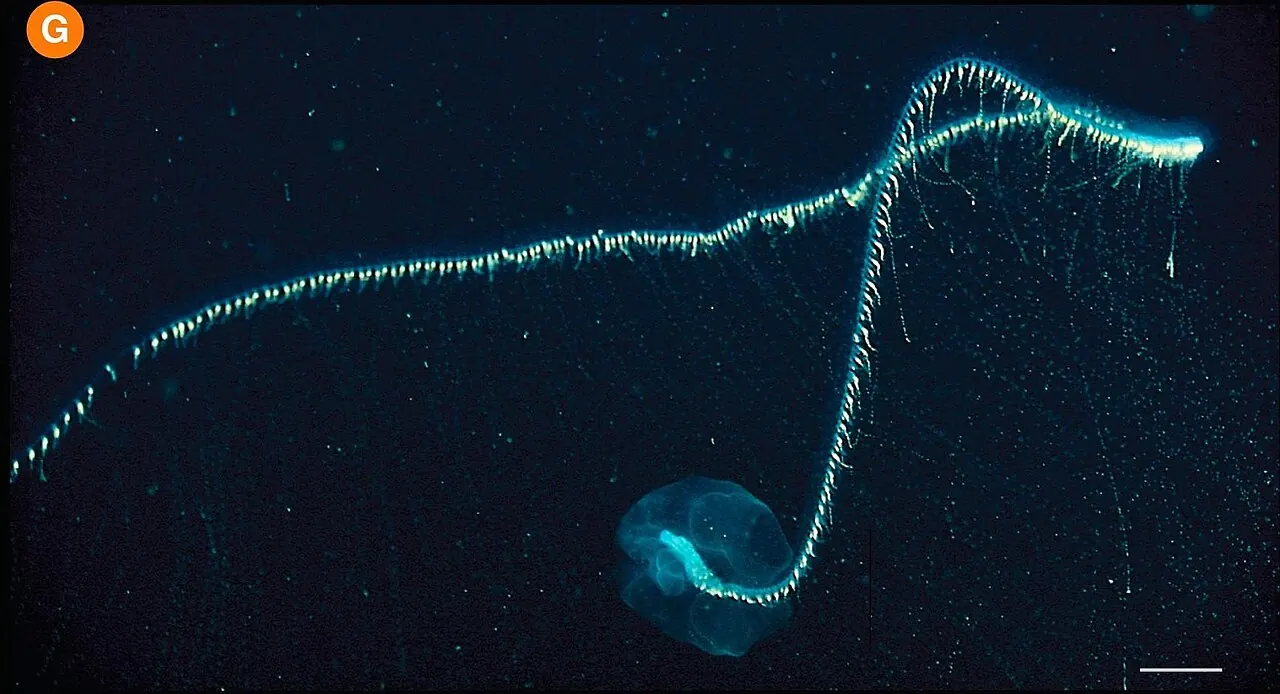
Giant Siphonophore
Praya dubia
A deep-water colony of linked zooids that can stretch more than 40 meters, longer than a blue whale, trailing a curtain of stinging tentacles.
Photo: Munro et al. 2018, Molecular Phylogenetics and Evolution (photo: MBARI) / CC BY 4.0
3 things to know
- Each giant siphonophore is a colony of many zooids, a colonial hydrozoan rather than a jellyfish.
- MBARI says it can grow longer than a blue whale, to about 40 meters (130 feet).
- It glows with a blue bioluminescent light.
- Scientific name
- Praya dubia
- Depth
- 0 m – 600 m
0 – 1,969 ft - Size
- Up to about 40 m (130 ft) long, according to MBARI; SeaLifeBase lists 45.7 m (150 ft)
- Weight
- Unknown
- Lifespan
- Unknown
- Diet
- Small crustaceans and jellies, according to MBARI, snared by a long curtain of stinging tentacles
- Where
- Atlantic and Pacific oceans and the Antarctic; first described from waters near Kangaroo Island, South Australia
- IUCN status
- Not Evaluated
- Depth zones
- Sunlight · Twilight
Praya dubia is one of the longest animals in the sea, and also one of the oddest in how it is built. It is a siphonophore, a colonial hydrozoan, built from many linked bodies called zooids that work together as one. That makes it a relative of jellyfish, and a cousin of the Portuguese man o' war, but not a jellyfish itself. MBARI, the Monterey Bay Aquarium Research Institute, says it can grow longer than a blue whale, to about 40 meters (130 feet). A bioluminescence site at the University of California, Santa Barbara, says it can stretch for more than 40 meters.
At the front are two rounded, see-through swimming bells, which pull the rest along. Behind them runs a long stem lined with repeated groups of zooids. Each group carries a feeding polyp with a single tentacle, and together the tentacles hang down as a stinging curtain. Siphonophore expert Gillian Mapstone, in a 2014 review in PLoS ONE, describes the larger, fragile siphonophores of the calm twilight zone as passively spreading an enormous net of tentacles to snare prey, and an MBARI photo of a Praya in her review shows a stem with more than 100 of these groups. Like other cnidarians, it can deliver a powerful sting, and it gives off a blue glow.
The sources disagree on depth. MBARI puts it between the surface and 600 meters (2,000 feet), and notes that rough currents sometimes break the animal apart and carry pieces into shallower water. SeaLifeBase, citing the UK's NBN Atlas, gives 700 to 1,000 meters (2,300 to 3,300 feet). The header uses MBARI's range.
The species was named in 1833 by Quoy and Gaimard, naturalists on the French voyage of the Astrolabe, from waters near Kangaroo Island off South Australia. SeaLifeBase now lists it from the Atlantic and Pacific oceans and the Antarctic. Mapstone counted 175 valid siphonophore species in all, most of them living well below the surface in the open ocean. They are so hard to capture that the best specimens are collected by submersibles and by divers in open water.
MBARI lists its prey as small crustaceans and jellies. How long a colony lives is not known. It has not been assessed for the IUCN Red List.
Sources
- artsandculture.google.com/story/IQVx-CzUeGW3Ig
- biolum.eemb.ucsb.edu/organism/pictures/praya.html
- Study: doi:10.1371/journal.pone.0087737
- ucmp.berkeley.edu/cnidaria/chondrophorina.html
- sealifebase.se/summary/Praya-dubia.html
- sealifebase.se/references/FBRefSummary.php
- api.gbif.org/v1/species/5185512/iucnRedListCategory



