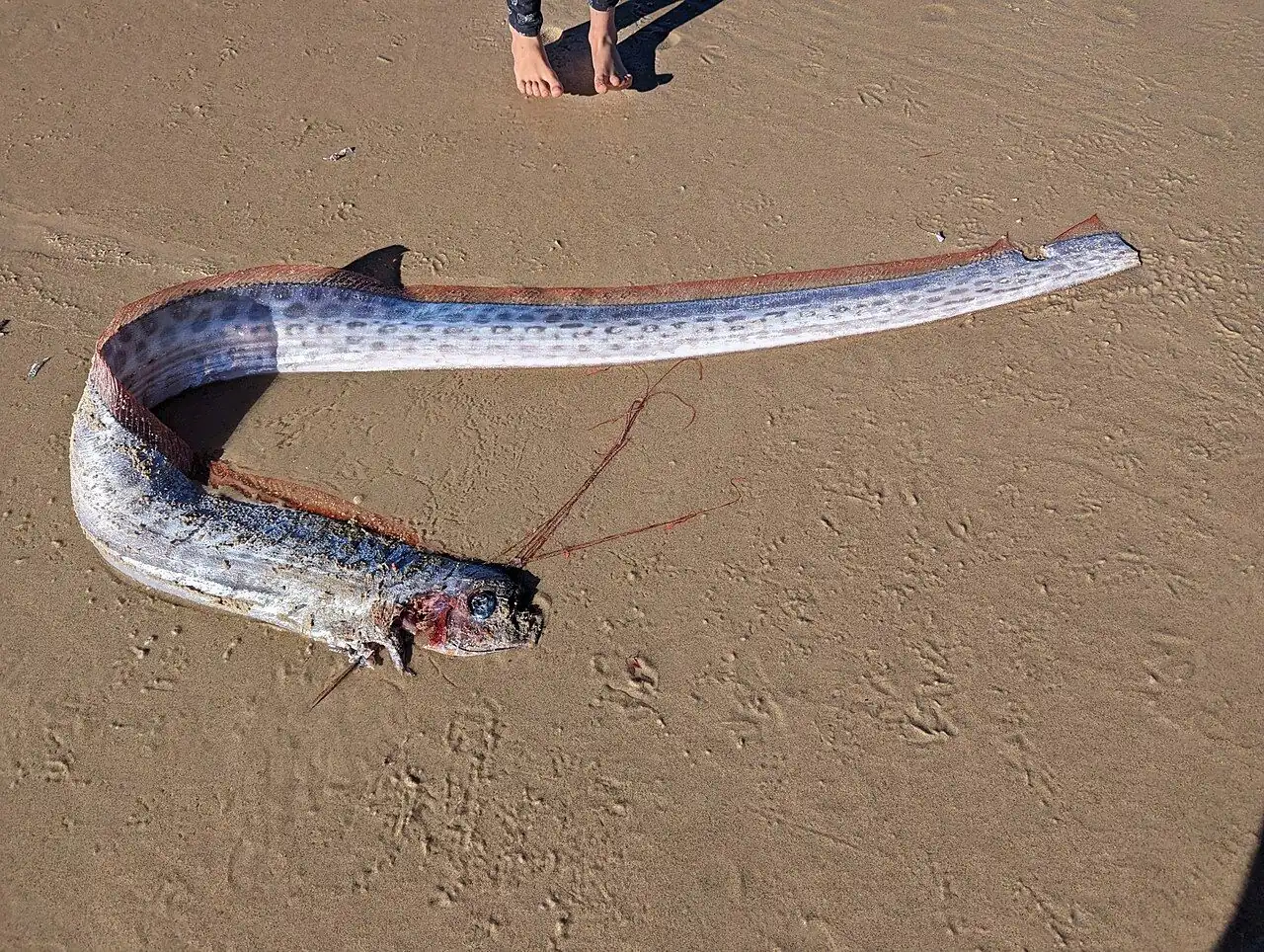
Giant Oarfish
Regalecus glesne
The longest bony fish known, a silver ribbon with a red crest that can shed the end of its own body and swims head-up in open water.
Photo: Gary Dickson / CC BY 4.0
3 things to know
- The giant oarfish is the longest bony fish known, with documented specimens of 7 to 8 meters.
- Every oarfish longer than about 1.5 meters has lost part of its tail end, which never grows back.
- A study of 336 deep-sea fish sightings in Japan found no real link to earthquakes.
- Scientific name
- Regalecus glesne
- Depth
- 20 m – 500 m
66 – 1,640 ft - Size
- Commonly about 3 m (10 ft); documented specimens reach 7 to 8 m (23 to 26 ft)
- Weight
- Up to 272 kg (600 lb) published
- Lifespan
- Unknown
- Diet
- Krill, small fishes and squid
- Where
- Oceans worldwide, mostly beyond about 15 degrees north and south of the equator, including the Mediterranean; in the eastern Pacific from Southern California to Chile
- IUCN status
- Least Concern
- Depth zones
- Sunlight · Twilight
No bony fish grows longer than the giant oarfish. FishBase says specimens of 7 to 8 meters (23 to 26 feet) are well documented, though most are around 3 meters (10 feet). The body is a flat silver ribbon marked with blue streaks and dark spots. A long crimson dorsal fin of roughly 400 rays runs along the back, and its first rays rise into a crest above the head. Each pelvic fin is a single, very long ray. The jaws are toothless or nearly so.
The tail end is often missing. Oarfish shed the back part of the body, sometimes several times in a lifetime, and the wound heals over into a stump without harming any vital organ. The lost part never regrows. According to FishBase, every oarfish longer than about 1.5 meters (5 feet) has been shortened this way, including all of the 8-meter giants.
Oarfish live in open ocean around the world, mostly outside the tropics, usually at 20 to 200 meters (65 to 650 feet). Between 2008 and 2011, remotely operated vehicles in the northern Gulf of Mexico filmed five apparently healthy oarfish, and Benfield and colleagues reported one at 463 to 492 meters (about 1,520 to 1,610 feet), the deepest verified record at the time. Footage shows them swimming slowly upright, head up, with a stiff body, rippling only the dorsal fin. FishBase suggests the pose may help the fish spot prey outlined against the light above. They suck in water full of krill and strain it with long, bristly gill rakers, and also take small fish and squid.
In Japan, folklore holds that deep-sea fish washing ashore warn of earthquakes. Yoshiaki Orihara of Tokai University and colleagues tested it with 336 sightings from 1928 to 2011 and 221 earthquakes. They found only one plausible match, and no quake above magnitude 6.0 within 10 days of a sighting.
Strandings are rare in California. On August 10, 2024, kayakers and snorkelers found a dead oarfish in La Jolla Cove near San Diego, only the 20th oarfish documented there since 1901, according to Scripps Institution of Oceanography. Scripps identified that fish as a different species, the short-crested oarfish (Regalecus russellii). The IUCN lists the giant oarfish as Least Concern.
Sources
- fishbase.se/summary/Regalecus-glesne.html
- Study: doi:10.1111/jfb.12144
- Study: doi:10.1785/0120190014
- eurekalert.org/news-releases/549711
- scripps.ucsd.edu/news/fish-experts-study-rare-deep-sea-oarfish-lab
- Study: doi:10.2305/IUCN.UK.2015-4.RLTS.T190378A21911480.en
- api.gbif.org/v1/species/2400566/iucnRedListCategory
- iucnredlist.org/species/190378/115316206



