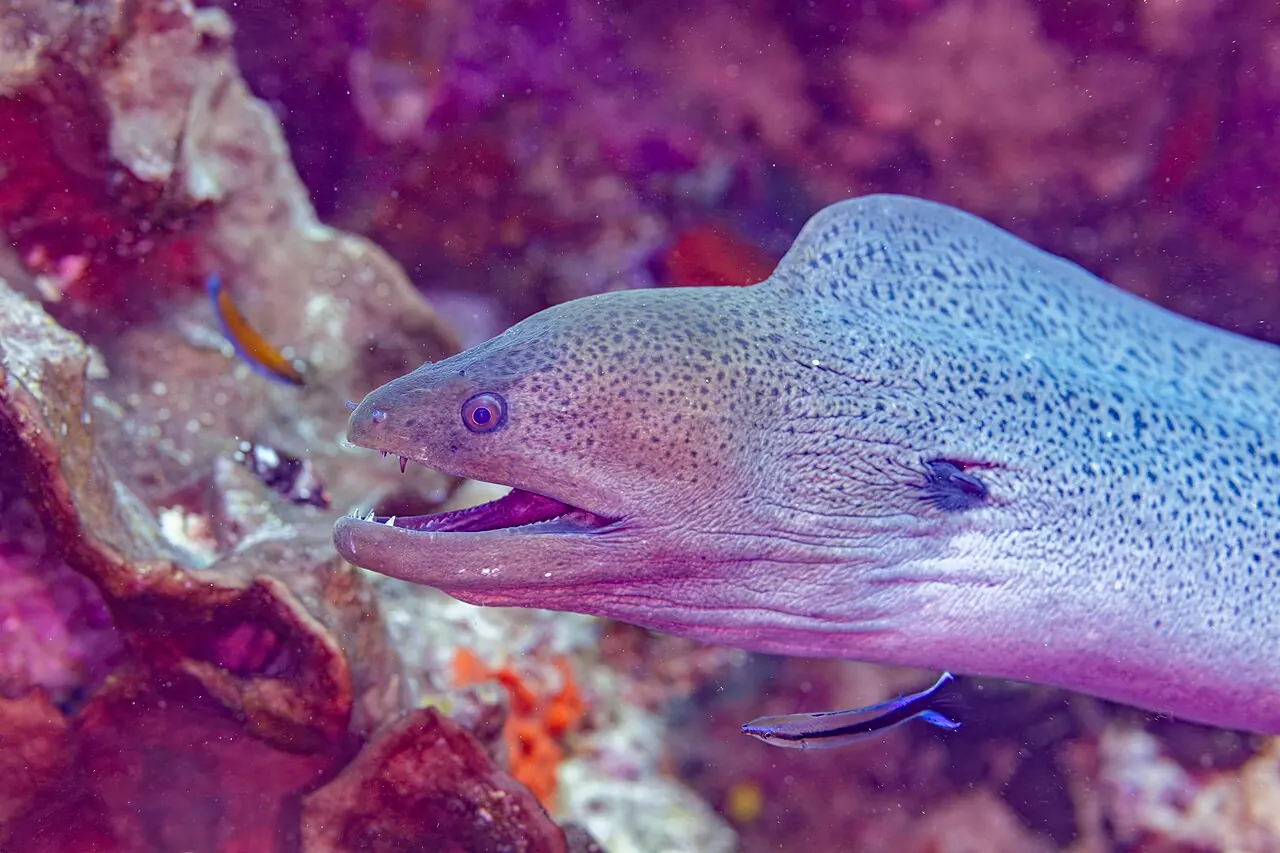
Giant Moray
Gymnothorax javanicus
The largest moray of the Indo-Pacific, a speckled reef eel up to 3 m long that rests in holes by day and hunts mostly at night.
Photo: Diego Delso / CC BY-SA 4.0
3 things to know
- It can grow to about 3 meters (10 feet) and 30 kilograms (66 pounds).
- As a top reef predator it often carries ciguatera toxin, which can poison people who eat it.
- In the Red Sea, groupers recruit it as a hunting partner with a shake of the head.
- Scientific name
- Gymnothorax javanicus
- Depth
- 0 m – 50 m
0 – 164 ft - Size
- Up to about 3 m (10 ft) long
- Weight
- Up to about 30 kg (66 lb)
- Lifespan
- Unknown
- Diet
- Mostly fish, sometimes crustaceans
- Where
- Indo-Pacific, from the Red Sea and East Africa to the Marquesas and Pitcairn islands, north to the Ryukyus and Hawaii
- IUCN status
- Least Concern
- Depth zones
- Sunlight
No moray in the Indo-Pacific grows larger. The giant moray may reach 3 meters (10 feet), and its published maximum weight is 30 kilograms (66 pounds). Adults are covered in black specks that turn into leopard-like spots behind the head, and a black patch surrounds the gill opening. Juveniles look different, tan with large black spots.
It lives on lagoon and seaward reefs from the Red Sea and East Africa to the Marquesas and the Pitcairn Islands, north to Japan's Ryukyu Islands and Hawaii, at depths down to about 50 meters (165 feet). In Indonesian waters it is often seen along deep drop-offs and slopes. Young eels are more secretive and live on intertidal reef flats.
Like most morays it is a crevice hunter. A giant moray rests alone in a reef hole by day and hunts mainly at dusk and at night, nosing into cracks where small fish hide. It eats mostly fish and occasionally crustaceans. Its breeding is barely known; FishBase notes a pair seen lying entwined on the reef bottom before spawning. Its lifespan is unknown.
Its place at the top of the reef food chain has a cost for anyone who eats one: its flesh is often ciguatoxic, and FishBase lists reports of ciguatera poisoning from giant morays. The eel can also bite when provoked. It is taken mainly in subsistence fisheries and shown in public aquariums, and the IUCN lists it as Least Concern.
Its daytime rest is when coral groupers come calling. In Egypt's Ras Mohammed National Park, Redouan Bshary and colleagues recorded groupers swimming up to resting morays and shaking their heads at them. In 58 percent of 120 cases the moray left its hole and the two hunted together, the grouper chasing in open water while the moray pushed into the crevices. The morays the team followed, 130 to 200 centimeters (4 to 6.5 feet) long, were never seen catching anything alone by day, but hunting beside groupers they caught five prey in 829 minutes.



