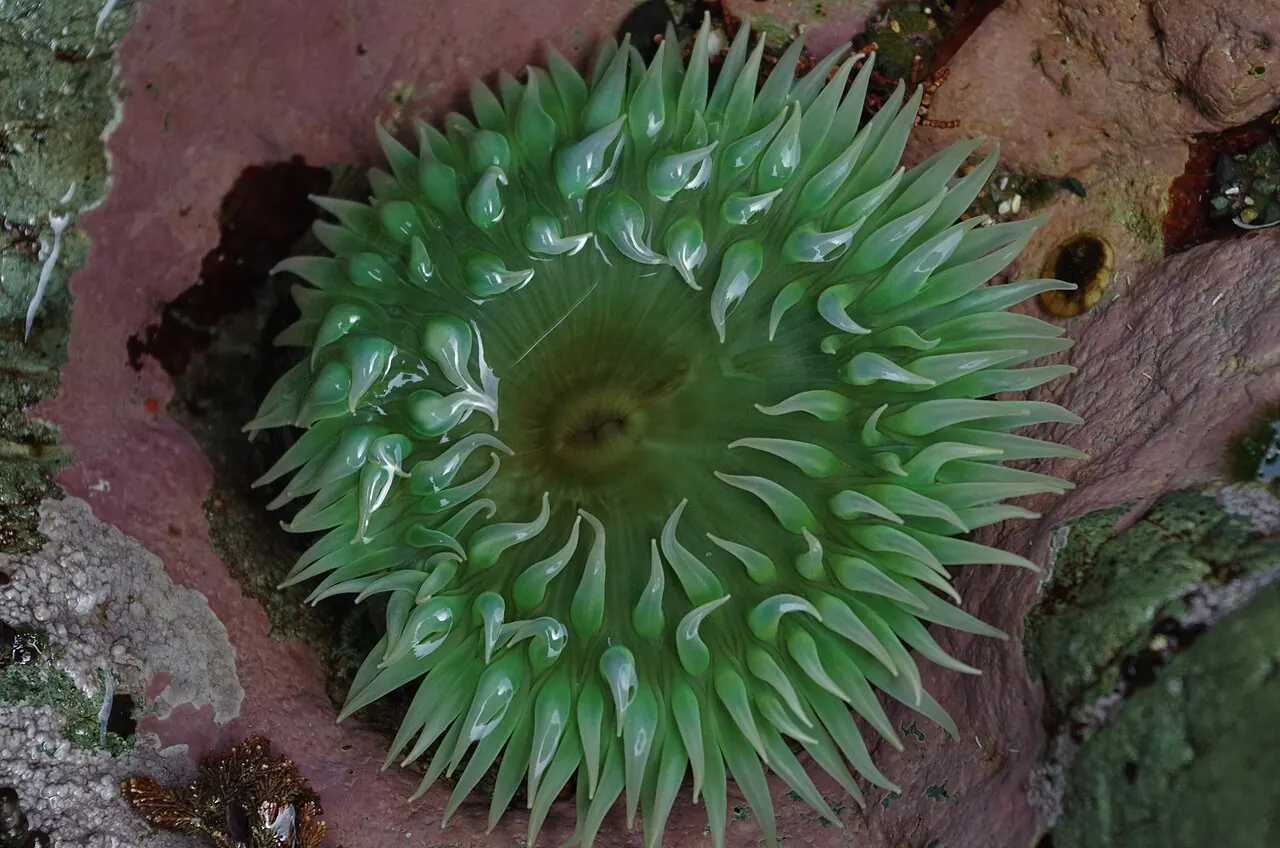
Giant Green Anemone
Anthopleura xanthogrammica
A big, solitary tide pool anemone of the North American Pacific coast that gets its green from pigment and algae living in its tissues.
Photo: Tim Gage / CC BY-SA 2.0
3 things to know
- It carries two different kinds of algae in its tissues, green ones and golden-brown ones.
- Groups can be as dense as 14 anemones per square meter (about 11 square feet).
- A potent heart stimulant, anthopleurin-A, was isolated from it in 1976.
- Scientific name
- Anthopleura xanthogrammica
- Depth
- 0 m – 30 m
0 – 98 ft - Size
- Crown up to about 18 cm (7 in) across, with tentacles up to 25 cm (10 in) long; up to about 30 cm (12 in) tall
- Weight
- Unknown
- Lifespan
- Not well known; one anemone in human care lived 80 years, according to the Oregon Coast Aquarium
- Diet
- Mussels, especially ones that have come loose, plus crabs, sea urchins and small fish
- Where
- Pacific coast of North America, from Alaska to Panama
- IUCN status
- Not Evaluated
- Depth zones
- Sunlight
On a wave-battered shore from Alaska to Panama, a giant green anemone looks like a bright green flower set into the rock. The crown can be about 18 centimeters (7 inches) across, the tentacles up to 25 centimeters (10 inches) long, and the column, studded with small sticky bumps, can stand about 30 centimeters (12 inches) tall. Adults settle in one spot early in life and rarely move.
It lives in tide pools, on rock walls and in surge channels on exposed rocky coasts, and down to about 30 meters (98 feet). It is often found near beds of California mussels, and young anemones settle right inside them. Mussels are a favorite food, especially ones that have come loose, and the anemone also eats crabs, sea urchins, worms and small fish, paralyzing prey with the stinging cells on its tentacles. Though it lives alone rather than in clones, it can crowd together at up to 14 anemones per square meter (about 11 square feet).
Part of the green is the anemone's own pigment. Much of it comes from single-celled algae in its tissues, and this anemone carries two very different kinds: green algae called zoochlorellae and golden-brown dinoflagellates called zooxanthellae. David Secord and Leon Augustine sampled anemones at eight sites along 2,500 kilometers (1,550 miles) of the Pacific coast and found that the green partners dominate low on the shore and farther north, while the golden-brown ones take over higher on the shore and farther south. They suggested the mix could serve as a signal of El Niño events and longer climate change.
The anemone reproduces only sexually, spawning once a year, and matures at 5 to 10 years old. The Oregon Coast Aquarium says one individual in human care lived for 80 years. In 1976 Ted Norton and colleagues isolated anthopleurin-A, a highly potent heart-stimulating polypeptide, from this anemone.
The species has not been evaluated for the IUCN Red List. Coastal development, pollution and trampling by tide pool visitors are the main pressures the Monterey Bay Aquarium lists.



