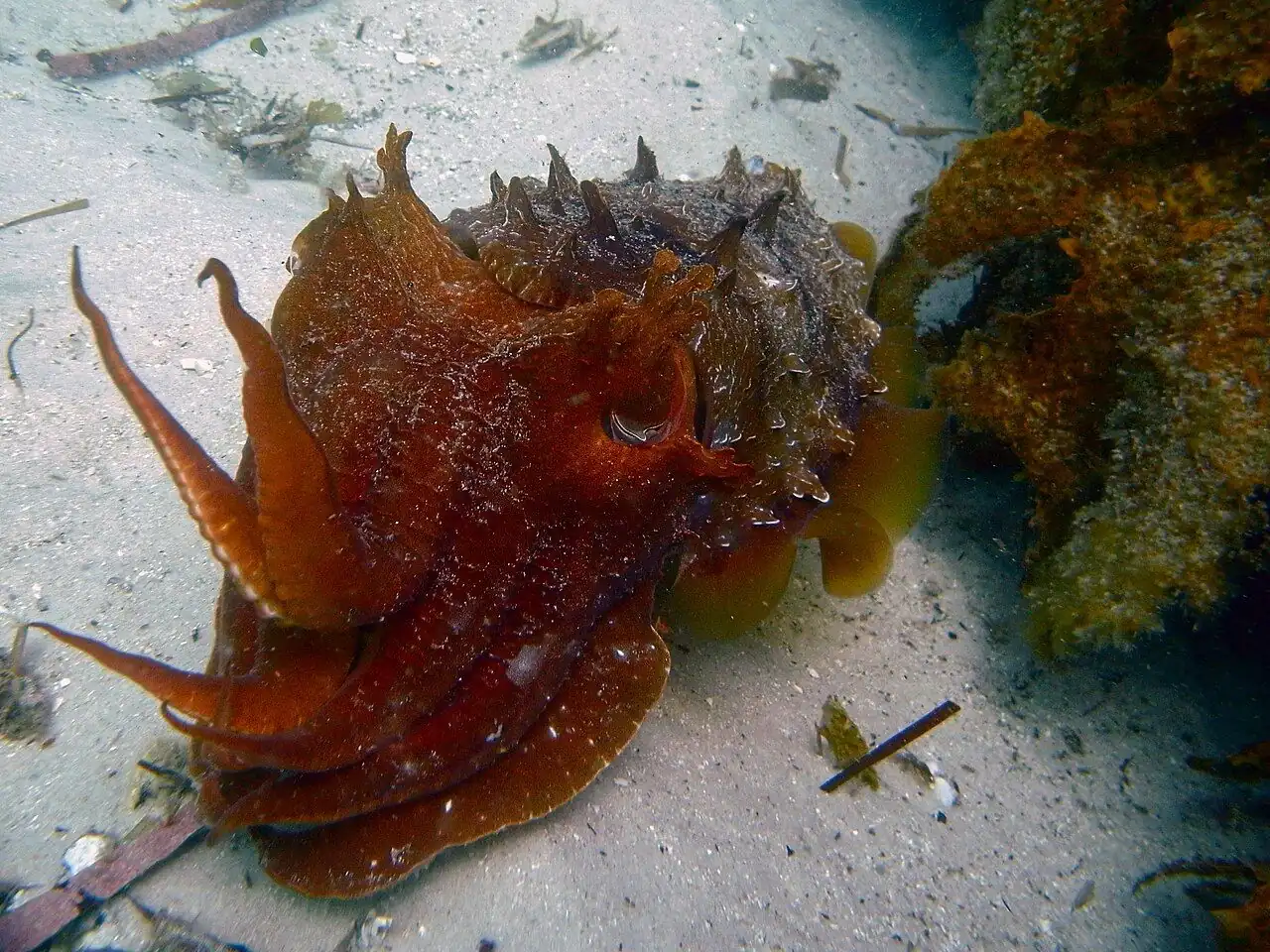
Giant Cuttlefish
Ascarosepion apama
Among the largest cuttlefish in the world, from southern Australia, where small males sneak matings by disguising themselves as females.
Photo: Sylke Rohrlach / CC BY-SA 2.0
3 things to know
- Its mantle can grow to 50 cm (20 in) long, among the largest of any cuttlefish.
- Small males can take on a female's shape and colors to slip past a guarding male.
- In 2026 the estimate at its famous breeding site near Whyalla, South Australia, fell to 1,811, the lowest on record.
- Scientific name
- Ascarosepion apama
- Depth
- 1 m – 100 m
3 – 328 ft - Size
- Mantle up to 50 cm (20 in) long
- Weight
- Up to about 10.5 kg (23 lb)
- Lifespan
- About 1–2 years
- Diet
- Mainly crustaceans and fish
- Where
- Southern Australia, from New South Wales to Western Australia, including Lord Howe Island
- IUCN status
- Near Threatened
- Depth zones
- Sunlight
Australia's giant cuttlefish is among the largest cuttlefish in the world. Its body, or mantle, reaches 50 centimeters (20 inches), and SeaLifeBase gives a top published weight of 10.5 kilograms (23 pounds). It lives on rocky reefs, seagrass beds and sandy or muddy bottoms along Australia's southern coasts, from the shallows to about 100 meters (330 feet), and eats mostly crustaceans and fish. For most of its history it was called Sepia apama; after a 2023 revision of the cuttlefish family, the World Register of Marine Species now places it in the genus Ascarosepion.
Like other cuttlefish, it lives only a year or two, breeds in a single season and dies. Across most of its range it breeds in pairs or small groups. Every southern winter, though, thousands crowd onto a short stretch of rocky reef in northern Spencer Gulf, South Australia, at Point Lowly near the town of Whyalla. Karina Hall of the South Australian Research and Development Institute (SARDI) and Roger Hanlon of the Marine Biological Laboratory in Woods Hole, Massachusetts, called it the only known spawning aggregation of cuttlefish in the world. Watching it in 1999, they counted on average four males for every female, and at times 11. Females rejected 70% of the 122 mating attempts they recorded.
Males without a partner have several options, and small ones can cheat. In a 1999 paper, Mark Norman, Julian Finn and Tom Tregenza described small males that took on the body shape and patterns of a female and tagged along beside a mating pair. The big guarding male never attacked them. More than 20 times, when he was distracted by another rival, the small male switched to male colors and display and tried to mate with the female, often with success.
The IUCN lists the giant cuttlefish as Near Threatened, with a decreasing population trend, in an assessment from 2009 that is flagged as needing an update. SARDI surveys at Point Lowly began in 1998, and the numbers swing widely: about 13,500 in 2013, more than 100,000 by 2015 and 247,000 in 2020. In August 2026 the estimate was 1,811, the lowest on record. South Australia is studying whether a harmful algal bloom played a part. Taking cuttlefish in northern Spencer Gulf is banned, and from July 1, 2026, swimming, diving and boat anchoring at the breeding site were restricted for 90 days.
Sources
- sealifebase.se/summary/Sepia-apama.html
- iucnredlist.org/species/162627/931625
- Study: doi:10.2305/IUCN.UK.2012-1.RLTS.T162627A931625.en
- marinespecies.org/aphia.php
- Study: doi:10.1007/s00227-023-04195-3
- en.wikipedia.org/wiki/Giant_cuttlefish
- Study: doi:10.1007/s00227-001-0718-0
- Study: doi:10.1098/rspb.1999.0786
- pir.sa.gov.au/news/fishing-and-aquaculture/more-monitoring-and-research-for-giant-austr…



