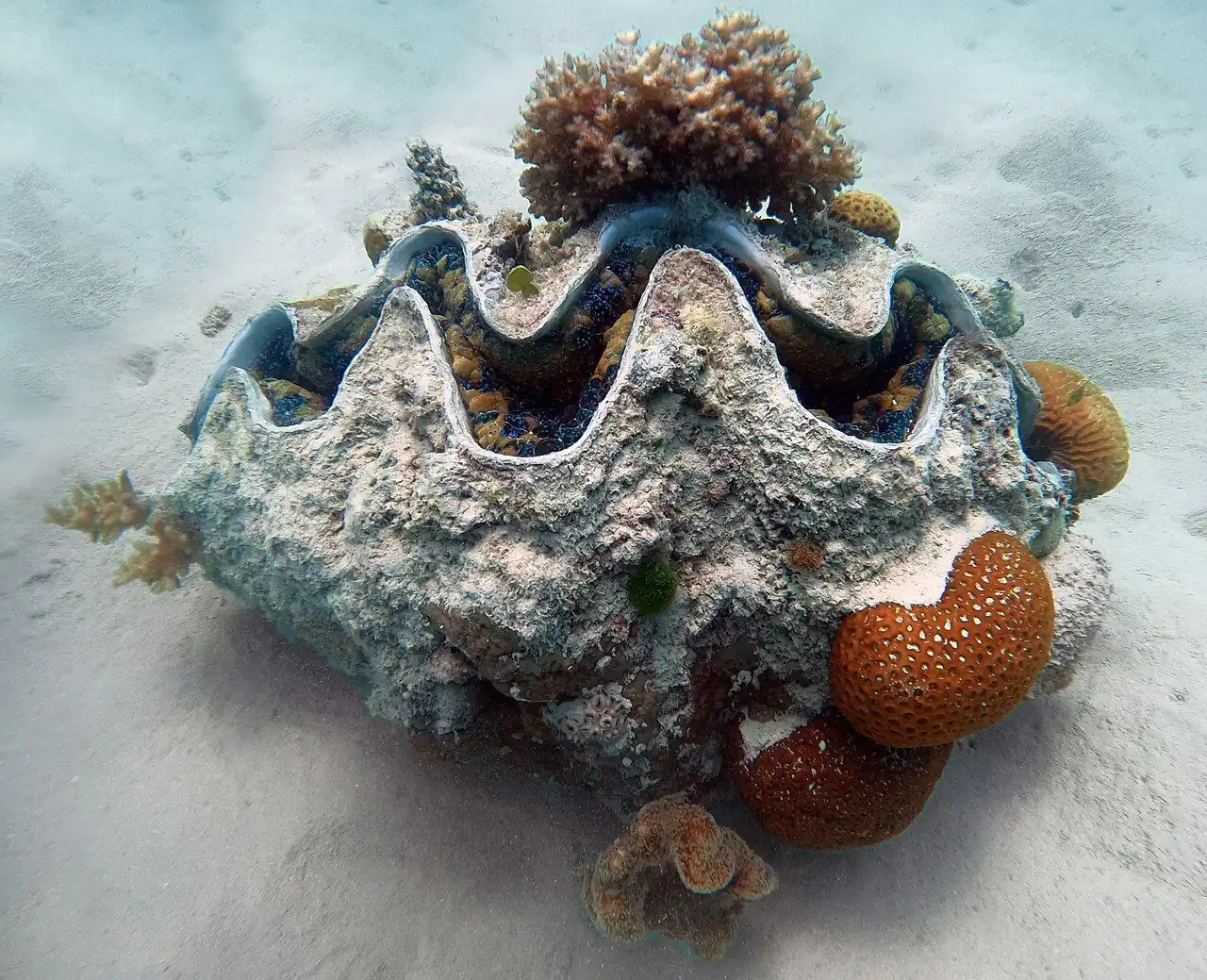
Giant Clam
Tridacna gigas
The largest living bivalve, a reef clam that can top 225 kg and gets most of its food from algae farmed in its own tissues.
Photo: Charles J. Sharp / CC BY-SA 4.0
3 things to know
- It is the largest living bivalve, with a record shell 137 cm (4.5 ft) long.
- Algae living in its tissues supply much of its food.
- In 2024 NOAA Fisheries proposed listing it as endangered under the US Endangered Species Act.
- Scientific name
- Tridacna gigas
- Depth
- 2 m – 20 m
7 – 66 ft - Size
- Shell over 1 m (3.3 ft) wide; record shell 137 cm (4.5 ft)
- Weight
- More than 225 kg (496 lb)
- Lifespan
- Not well known
- Diet
- Mostly food made by algae living in its tissues; also filters plankton from the water
- Where
- Shallow reefs of the Indo-Pacific, from Myanmar east to Kiribati and from southern Japan to Queensland, Australia
- IUCN status
- Critically Endangered
- Depth zones
- Sunlight
No living bivalve grows bigger than Tridacna gigas, the true giant clam. NOAA Fisheries describes shells more than a meter (3.3 feet) wide and animals heavier than 225 kilograms (496 pounds), and the record shell in SeaLifeBase is 137 centimeters (4.5 feet) long. The shell is thick and heavy with deep radial folds. The fleshy mantle that shows between the two halves of the shell is often yellowish brown to olive green and speckled with small, bright blue-green rings.
NOAA describes its range in the shallow tropical Indo-Pacific as running from Myanmar east to Kiribati and from the Ryukyu Islands of Japan south to Queensland, Australia, though the IUCN now lists it as extinct or possibly extinct in several places, including Singapore, Taiwan and the Ryukyus. Most are found 2 to 20 meters (6 to 65 feet) down, among hard corals, on reef rock or on bare sand, in lagoons and on fringing reefs.
Much of its food is made by single-celled algae living in its tissues, which the young clam takes in early in life. The clam also filters plankton from the water. In 2024, a team led by Alison Sweeney of Yale, with Amanda Holt and Lincoln Rehm, modeled how giant clams in Palau handle sunlight. A thin layer of light-scattering cells called iridocytes spreads the light evenly around algae packed in vertical columns. Their model put the clams' quantum efficiency, the share of light turned into electrons, at 42%, rising to 67% once it allowed for the way the clams stretch as the light changes. A green leaf in the tropics manages about 14%, according to Sweeney.
As it ages, each clam becomes a simultaneous hermaphrodite, making both eggs and sperm, and it spawns in season. How long it lives is not well known.
Decades of heavy, unregulated harvest for meat and shells have left it at very low numbers through much of its range, NOAA says. The IUCN Red List assessed it as Critically Endangered in 2024. On July 25, 2024, NOAA Fisheries proposed listing it as endangered under the US Endangered Species Act; as of November 2026, no final rule had been published in the Federal Register. Farms are raising giant clams in trials to restock reefs.
Sources
- fisheries.noaa.gov/species/true-giant-clam
- sealifebase.se/summary/Tridacna-gigas.html
- en.wikipedia.org/wiki/Giant_clam
- Study: doi:10.1103/PRXEnergy.3.023014
- news.yale.edu/2024/06/28/giant-clams-may-hold-answers-making-solar-energy-more-efficient
- federalregister.gov/documents/2024/07/25/2024-14970/endangered-and-threatened-wildlife-…
- api.gbif.org/v1/species/4372619/iucnRedListCategory
- iucnredlist.org/species/22137/119167161



