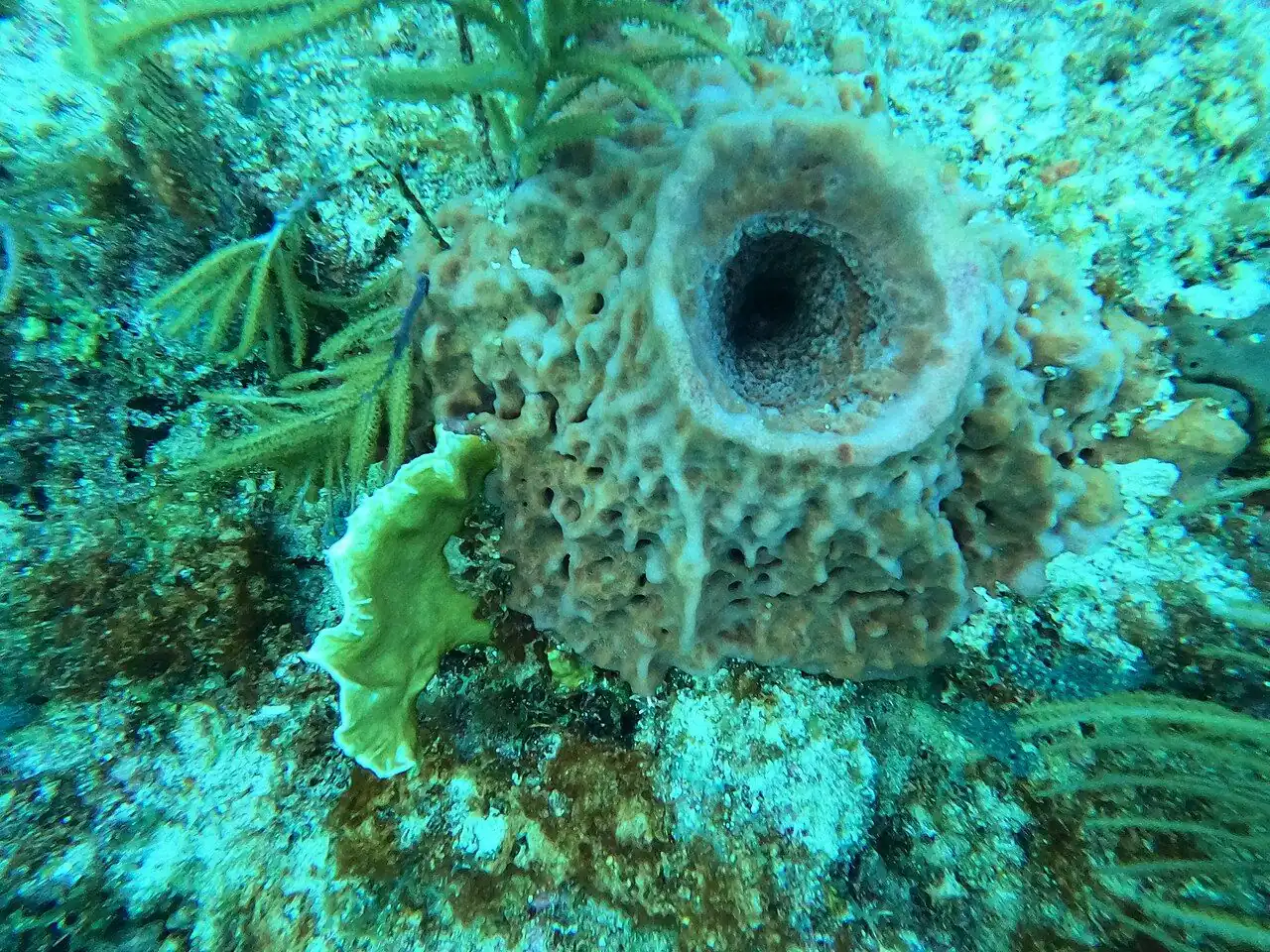
Giant Barrel Sponge
Xestospongia muta
A brown, barrel-shaped Caribbean sponge that grows more than a meter tall. Researchers estimate the biggest have been alive for centuries.
Photo: Jstuby / CC0
3 things to know
- The largest sponge in one Key Largo study area, 1.23 m (4 ft) tall, was estimated at 127 years old.
- Its eggs sink and blanket the area in and around the parent sponge.
- Barrel sponges on Conch Reef off Key Largo increased by an average of 46 percent between 2000 and 2006.
- Scientific name
- Xestospongia muta
- Depth
- 10 m – 30 m
33 – 98 ft - Size
- Often more than 1 m (3.3 ft) tall and as wide; base up to about 2.5 m (8 ft) across
- Weight
- Unknown
- Lifespan
- Oil-drum-sized sponges on Florida reefs are about 100–200 years old; one giant from Curaçao was estimated, by extrapolation, at about 2,300 years
- Diet
- Particles and dissolved organic matter filtered from seawater
- Where
- South Florida, the Bahamas and the Caribbean
- IUCN status
- Not Evaluated
- Depth zones
- Sunlight
Xestospongia muta has been called the "redwood of the reef," a phrase Joseph Pawlik's group at the University of North Carolina Wilmington used as the title of a 2008 paper on its age. The giant barrel sponge is a thick-walled tube open at the top, reddish brown to grayish brown or reddish purple outside and tan inside, and it often grows more than 1 meter (3.3 feet) tall and as wide. Its ridged walls are brittle and crumbly, stiffened by spicules. Bacteria live in its tissue, including a cyanobacterium that helps give it its color.
It is common on reefs from South Florida through the Caribbean. Pawlik's lab describes it as common deeper than 10 meters (33 feet), Animal Diversity Web gives 10 to 30 meters (33 to 98 feet), and the Porifera Tree of Life guide records it from about 4 meters to at least 100 meters (13 to 330 feet). Like all sponges it feeds by drawing seawater through its body and filtering it. In his 2008 thesis, Steven McMurray noted reports that on some Caribbean reefs this species exceeds every other bottom-dwelling invertebrate in biomass and in the amount of water it filters.
Pawlik's group has monitored barrel sponges off Key Largo, Florida, since 1997. From growth measured there, McMurray, J. E. Blum and Pawlik estimated that the largest sponge in their plots, 1.23 meters (4 feet) tall, was 127 years old. Two sponges measured off Plana Cay in the Bahamas, 1.7 and 1.4 meters tall, came out at 258 and 242 years. Applied to a photographed giant from Curaçao, the same growth model gave about 2,300 years, a figure McMurray warned is a big extrapolation.
Those Florida populations grew between 2000 and 2006, by an average of 46 percent on Conch Reef, which the researchers put down to pulses of new young sponges. From 32 spawning records over 17 years in Florida, Belize and Haiti, Karen Neely and C. B. Butler found that spawning clusters from mid-April to late May, mostly around the first-quarter moon, and always in the morning. The eggs sink and blanket the area in and around the parent, which the authors suggest may help explain why populations stay genetically local. A disease-like condition called sponge orange band, which Pawlik's lab describes as usually fatal, also kills barrel sponges. The species has not been assessed by the IUCN.
Sources
- dl.uncw.edu/etd/2008-3/r1/mcmurrays/stevenmcmurray.pdf
- Study: doi:10.1007/s00227-008-1014-z
- Study: doi:10.1890/08-2060.1
- people.uncw.edu/pawlikj/xmuta.html
- animaldiversity.org/accounts/Xestospongia_muta
- guide.poriferatreeoflife.org/sp_10.html
- sealifebase.se/summary/Xestospongia-muta.html
- nsuworks.nova.edu/occ_facarticles/1126
- Study: doi:10.1007/s00338-020-02009-2



