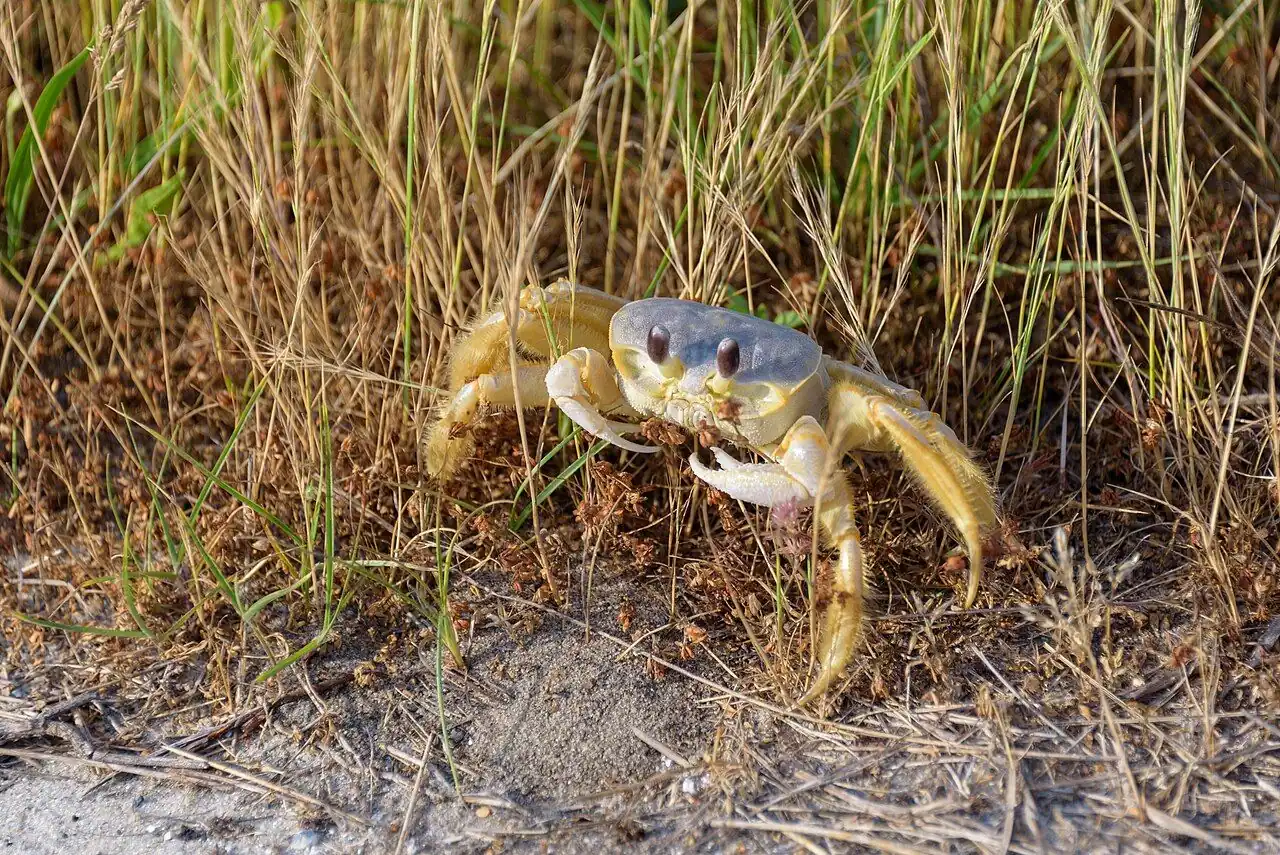
Ghost Crab
Ocypode species (Atlantic ghost crab: Ocypode quadrata)
Pale, fast beach crabs that dig deep burrows, hunt at night and growl with teeth in their stomachs, though their larvae grow up at sea.
Photo: Gordon Leggett / CC BY-SA 4.0
3 things to know
- The Atlantic ghost crab can run at about 16 km/h (10 mph), according to the National Park Service.
- It can wick water up to its gills from damp sand through fine hairs on its legs.
- Ghost crabs make a growling sound with teeth in their stomachs.
- Scientific name
- Ocypode species (Atlantic ghost crab: Ocypode quadrata)
- Depth
- At the surface
- Size
- Atlantic ghost crab: shell up to about 7.6 cm (3 in)
- Weight
- Unknown
- Lifespan
- About 3 years (Atlantic ghost crab)
- Diet
- Coquina clams, mole crabs, insects and carrion, plus the eggs and hatchlings of sea turtles and shorebirds
- Where
- Sandy beaches; the Atlantic ghost crab lives from Block Island, Rhode Island, to southern Brazil
- IUCN status
- Not Evaluated (Atlantic ghost crab)
- Depth zones
- Sunlight
The first sign of a ghost crab is usually its front door. Burrow openings range from the size of a finger to the size of a tennis ball, the National Park Service says, and the tracks look like rows of widely spaced commas. The crab itself is pale and sand-colored, hard to spot until it moves, and it moves fast: the park service puts the Atlantic ghost crab's top speed at about 16 kilometers per hour (10 miles per hour). Its eyes sit on club-shaped stalks, and the Chesapeake Bay Program gives a shell of up to about 7.6 centimeters (3 inches).
The World Register of Marine Species lists 25 species in the genus Ocypode. The species on US Atlantic and Gulf beaches is the Atlantic ghost crab, Ocypode quadrata, found from Block Island, Rhode Island, to southern Brazil, on sandy beaches from the waterline back to the dunes. It is mostly nocturnal. Burrows run 0.6 to 1.2 meters (2 to 4 feet) long, and the crabs hibernate in them through the cold months. They keep their gills wet with quick dips in the surf, or by wicking water up from damp sand with fine hairs at the base of their legs.
The sea still matters for breeding. A female carries her eggs under her body, wets them in the surf and releases them into the water. The larvae pass through five early stages and a final stage that takes at least 35 days, then turn into young crabs where the surf meets the beach. Larvae have turned up as far north as Woods Hole, Massachusetts, where no adults have been found.
Ghost crabs eat coquina clams, mole crabs, insects and dead animals, and they take the eggs and hatchlings of sea turtles and shorebirds. They also make noise. In 2019, Jennifer Taylor and Maya deVries of Scripps Institution of Oceanography and Damian Elias of UC Berkeley showed that Atlantic ghost crabs, besides rasping with their claws, produce a growl during aggressive encounters by grinding comb-like teeth in their stomachs.
The park service treats ghost crabs as an indicator of beach health, since heavy human use affects their numbers, size and behavior. They live about three years, and the Atlantic ghost crab has not been assessed by the IUCN.
Sources
- nps.gov/guis/learn/nature/ghostcrab.htm
- nps.gov/foma/learn/nature/ghost-crabs.htm
- animaldiversity.org/accounts/Ocypode_quadrata
- chesapeakebay.net/discover/field-guide/entry/atlantic-ghost-crab
- Study: doi:10.1098/rspb.2019.1161
- sealifebase.se/summary/Ocypode-quadrata.html
- marinespecies.org/aphia.php
- api.gbif.org/v1/species/2221529/iucnRedListCategory



