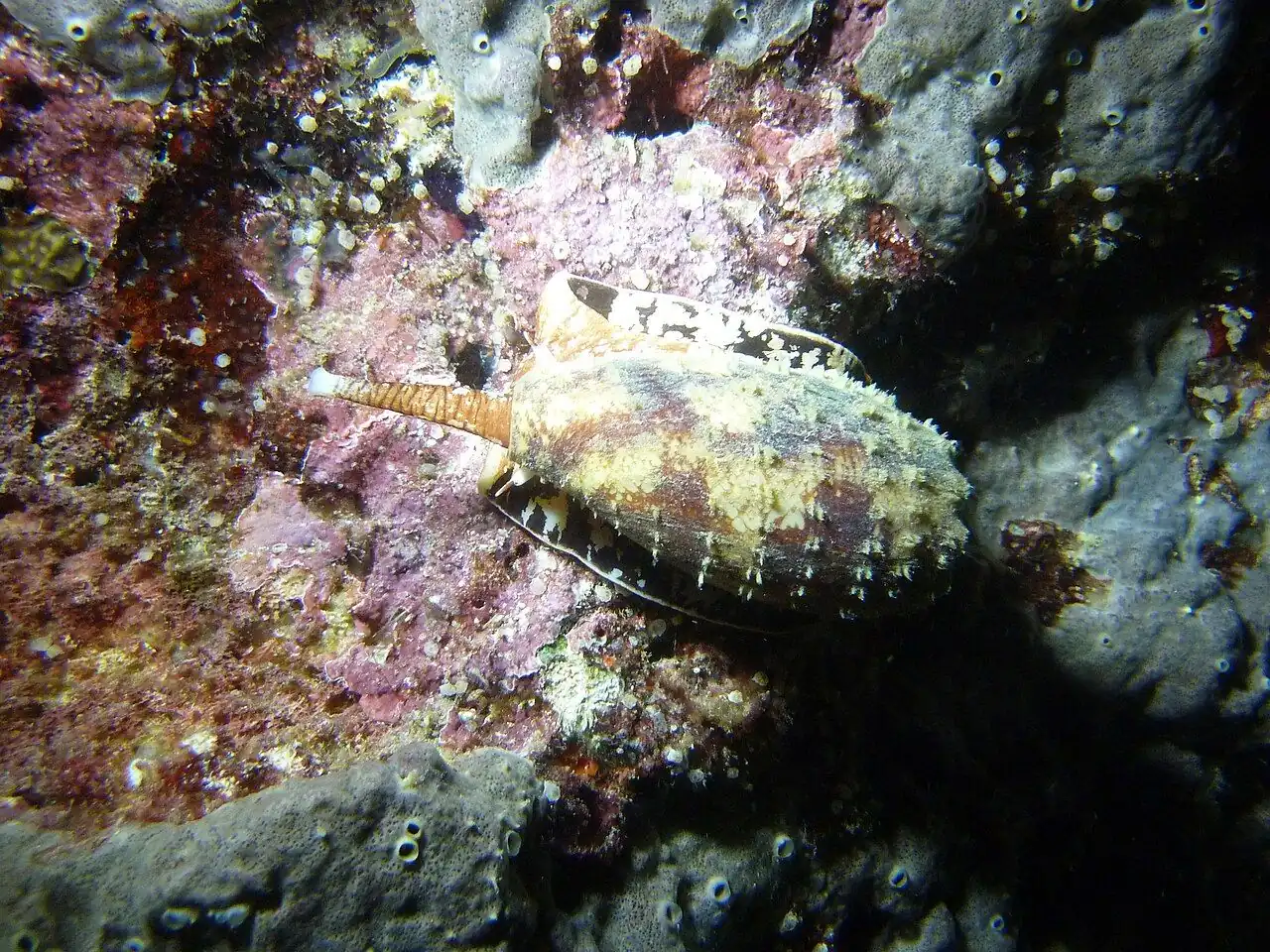
Geographic Cone Snail
Conus geographus
A fish-eating Indo-Pacific cone snail whose venom has killed more people than any other cone, and which drugs its prey with insulin.
Photo: Kai Squires / CC BY 4.0
3 things to know
- It is blamed for almost all known human deaths from cone snail stings.
- Its venom includes a fast-acting insulin that sends fish into hypoglycemic shock.
- It swallows small fish whole with a stretchy false mouth that works like a net.
- Scientific name
- Conus geographus
- Depth
- 1 m – 25 m
3 – 82 ft - Size
- Shell 4.3–16.6 cm (1.7–6.5 in) long
- Weight
- Unknown
- Lifespan
- Unknown
- Diet
- Small fish
- Where
- Shallow reefs of the tropical Indo-Pacific, from the Red Sea and East Africa east to French Polynesia
- IUCN status
- Least Concern
- Depth zones
- Sunlight
The geographic cone has a thin, broad shell, pink or violet-white and clouded with chestnut or chocolate brown in two irregular bands. Conus geographus grows to about 16.6 centimeters (6.5 inches) long, and its shell is lighter and more swollen in the middle than most cones of its size. It lives in the sediment of shallow reefs across the tropical Indo-Pacific, from the Red Sea and East Africa east to French Polynesia, from about 1 to 25 meters (3 to 82 feet) deep.
It is the cone snail most dangerous to people. In a 2016 review, Alan Kohn gathered 139 reliable reports of people stung by cone snails since the 17th century. Thirty-six of them died. C. geographus accounted for about half of all the stings and almost all of the deaths, and Kohn found that children died more often than adults and that stings from larger snails were more often fatal. He also noted that many stings have surely gone unreported.
All that venom is built for catching fish. In 2015, Helena Safavi-Hemami, Baldomero Olivera and colleagues at the University of Utah reported that C. geographus and its relative the tulip cone carry a specialized insulin as a major part of their venom. It resembles fish insulin more than the snail's own hormone, and when injected into fish it brought on hypoglycemic shock, a dangerous crash in blood sugar. The team proposed that the snail releases this insulin into the water as part of a toxin mix that disorients a whole school at once, and then engulfs the dazed fish with its stretched-open false mouth, which works like a net. Kohn describes the snail as a specialist that paralyzes fish with its venom and swallows them whole.
Shell collectors prize its pattern. The species is listed as Least Concern on the IUCN Red List (assessed in 2023), and its venom peptides, called conopeptides, are a subject of research into new drugs. How long it lives is unknown.



