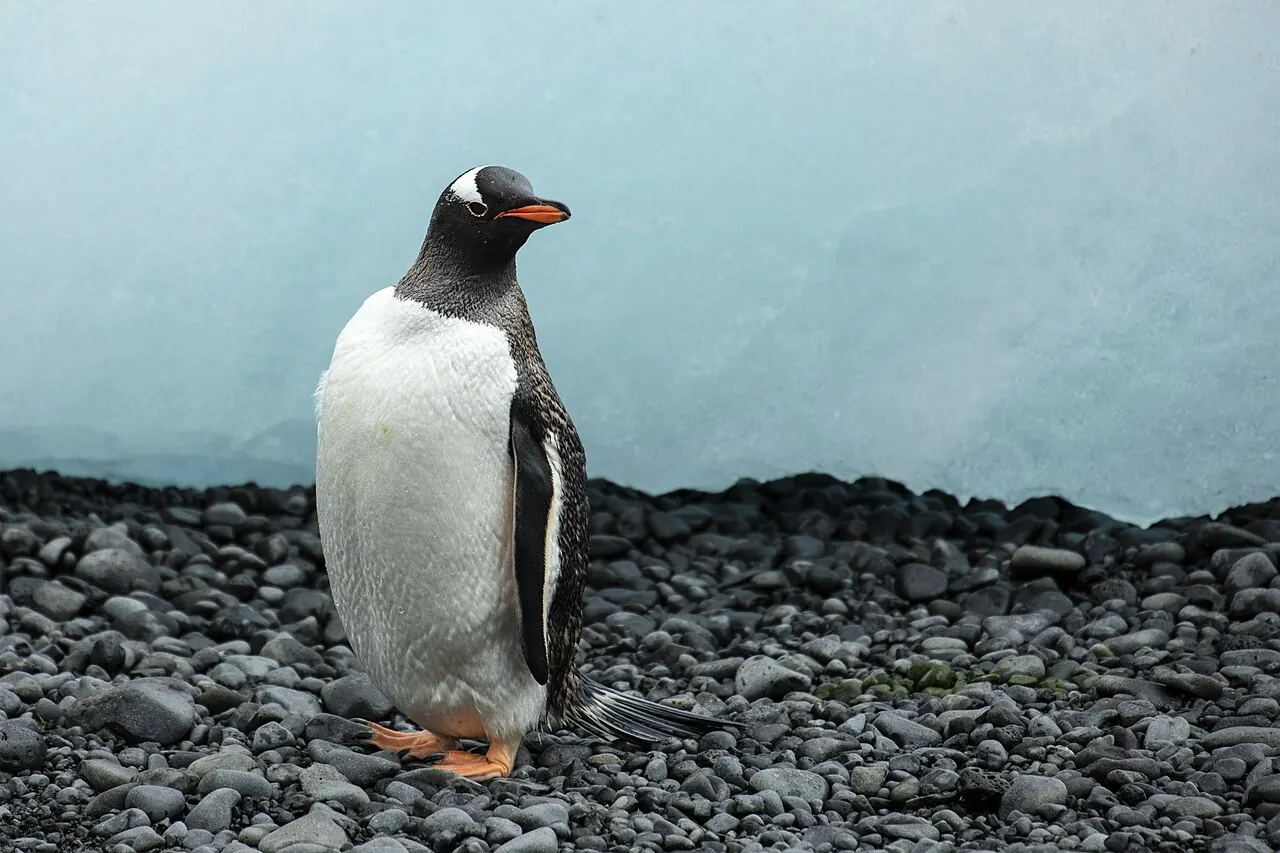
Gentoo Penguin
Pygoscelis papua
A red-billed penguin of the Antarctic Peninsula and sub-Antarctic islands that a 2026 genetic study proposes splitting into four species.
Photo: Godot13 / CC BY-SA 4.0
3 things to know
- It has a bright red-orange bill and white patches over the eyes.
- Its deep feeding dives average about 80 m (260 ft) and are deepest around midday.
- A 2026 genetic study found four distinct lineages and proposed treating them as four species.
- Scientific name
- Pygoscelis papua
- Depth
- 0 m – 90 m
0 – 295 ft - Size
- Stands about 76 cm (30 in) tall
- Weight
- About 5–8 kg (11–18 lb)
- Lifespan
- About 13 years on average, according to Animal Diversity Web
- Diet
- Crustaceans such as krill, small fish and squid
- Where
- Antarctic Peninsula and sub-Antarctic islands, roughly 45°S to 65°S
- IUCN status
- Least Concern
- Depth zones
- Sunlight
Look for the bill: a gentoo's is bright red-orange, and it has conspicuous white patches over the eyes. Adults stand roughly 76 centimeters (30 inches) tall and weigh 5 to 8 kilograms (11 to 18 pounds), heavier or lighter depending on the time of year.
Gentoos breed across a wide sweep of the Southern Hemisphere, from the Antarctic Peninsula to many sub-Antarctic islands between about 45 and 65 degrees south. They build nests on beaches or among tussock grass and defend their patch keenly. The female lays two eggs, which are incubated for 34 to 37 days. The Australian Antarctic Division puts the total breeding population at about 387,000 pairs. Animal Diversity Web gives an average lifespan of 13 years.
The diet is a mix of crustaceans, small fish and squid, often caught close to home. In a study published in 1992, T. D. Williams and colleagues fitted time-depth recorders to nine gentoos and followed 99 foraging trips. The dives fell into two clear groups. Shallow ones, under 21 meters (69 feet), averaged just 4 meters (13 feet) and looked like searching. Deep ones, over 30 meters (98 feet), averaged 80 meters (260 feet) and were probably where the feeding happened. The deep dives followed the sun, averaging about 40 meters (130 feet) at dawn and dusk and 80 to 90 meters (260 to 300 feet) at midday. Estimated foraging ranges were only 2.3 to 4.1 kilometers (1.4 to 2.5 miles) from the colony.
What counts as a gentoo may soon change. In 2026 Daly Noll and colleagues reported in Communications Biology that birds across the species' range form four divergent evolutionary lineages, northern, southern, southeastern and eastern, with signs of selection in genes tied to temperature control, oxygen transport and metabolism. They proposed recognizing four separate gentoo species, one newly named Pygoscelis kerguelensis. Their projections suggest three of the lineages face severe habitat loss, while the southern gentoo may expand its range.
For now the IUCN assesses the gentoo as a single species, listed as Least Concern.



