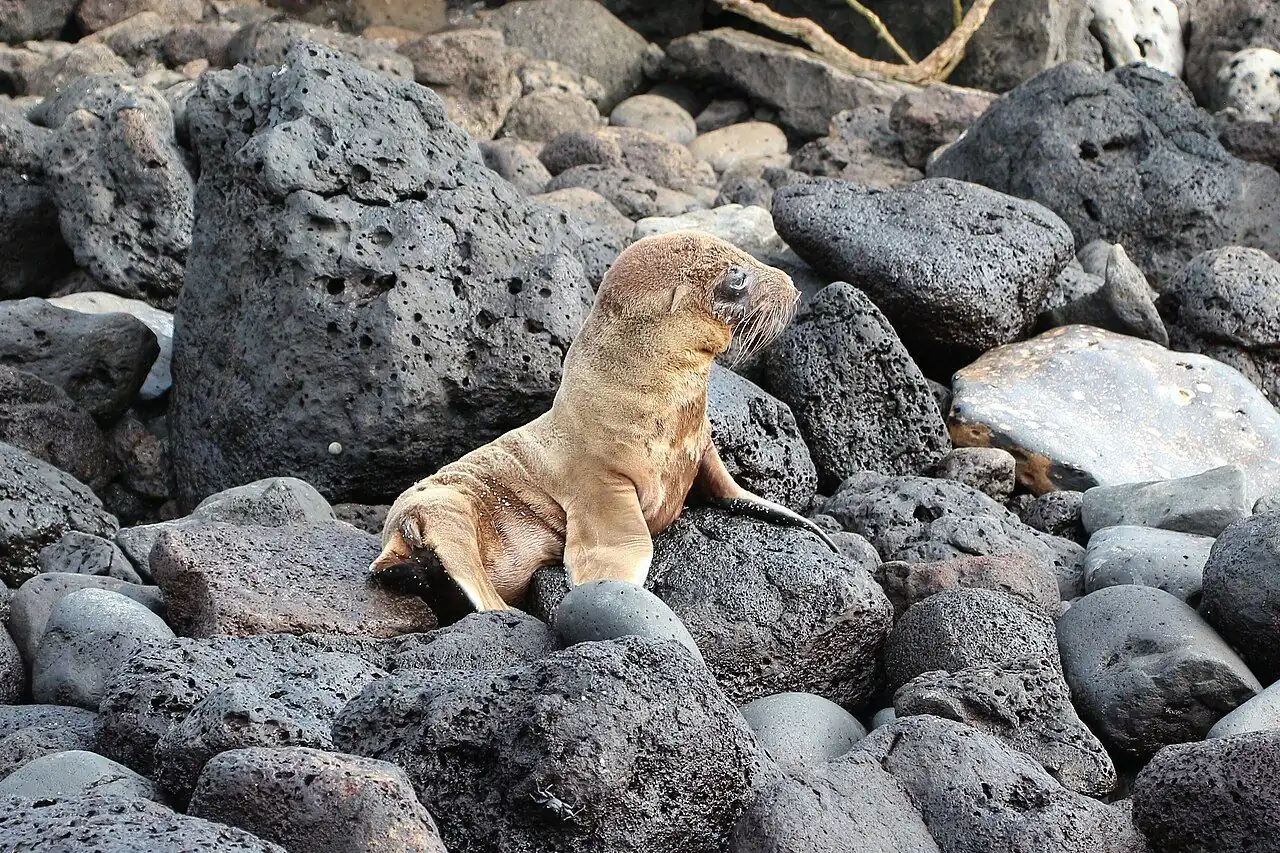
Galápagos Sea Lion
Zalophus wollebaeki
The Galápagos Islands' most common marine mammal, a sea lion that sometimes hunts in teams, herding fish into a cove and onto the beach.
Photo: Bernard Gagnon / CC BY-SA 4.0
3 things to know
- Groups of females have been watched herding schools of fish at least 600 to 800 m into a cove and onto the beach.
- One tagged mother dove to 568.5 m (1,865 ft), though most dives are far shallower.
- Pups nurse for about a year, and sometimes for up to three years.
- Scientific name
- Zalophus wollebaeki
- Depth
- 0 m – 165 m
0 – 541 ft - Size
- Males about 2–2.5 m (6.5–8 ft); females about 1.5–2 m (5–6.5 ft)
- Weight
- Males average about 250 kg (550 lb); females about 80 kg (175 lb)
- Lifespan
- About 15–24 years in the wild
- Diet
- Sardines and other fish, plus squid, octopus and crustaceans
- Where
- Galápagos Islands, with a few breeding colonies on Isla de la Plata, Ecuador
- IUCN status
- Endangered
- Depth zones
- Sunlight
Galápagos sea lions usually hunt alone, but some hunt as a team. Photographer Tui De Roy watched 40 hunts at Rocas Bainbridge, a cluster of islets east of Santiago Island, between 2016 and 2020. Groups of six to ten sea lions, usually all females, drove schools of amberstripe scad at least 600 to 800 meters (about 2,000 to 2,600 feet) from open water into a cove and up onto the beach, then grabbed the stranded fish, from fewer than 25 to about 300 at a time. These core hunters did not belong to the beach colony; they apparently arrived together for the hunt. Writing in Ecology and Evolution in 2021, De Roy, Eduardo Espinoza and Fritz Trillmich concluded that the animals must somehow communicate about a goal that is not yet in sight. An earlier report by Diego Páez-Rosas and colleagues in Marine Mammal Science described groups attacking large yellowfin tuna off northern Isabela.
The species lives and breeds in the Galápagos, with a few colonies on Isla de la Plata off mainland Ecuador, and stays year-round; it is the archipelago's most abundant marine mammal. Males reach about 2.5 meters (8 feet), can weigh up to four times as much as females, and carry a bump on the forehead. The fur is brown to gray, paler in females, and pups are chestnut. On rocky ground they can gallop faster than a person can run.
Sardines are the main food, along with other fish, squid, octopus and crustaceans. Nine nursing mothers tagged in 2012 at the El Malecón colony on San Cristóbal Island had average dive depths of 21 to 164 meters (69 to 538 feet), depending on the individual, and the deepest dive reached 568.5 meters (1,865 feet). Pups nurse for 11 to 12 months, and a mother that has no new pup may keep feeding one for up to three years.
The IUCN Red List rates the species Endangered (2014 assessment), with about 9,200 to 10,600 mature animals and a falling trend. El Niño years, when warm water collapses the fish they depend on, are the main threat. Diseases carried by domestic dogs and entanglement in plastic add to the losses.



