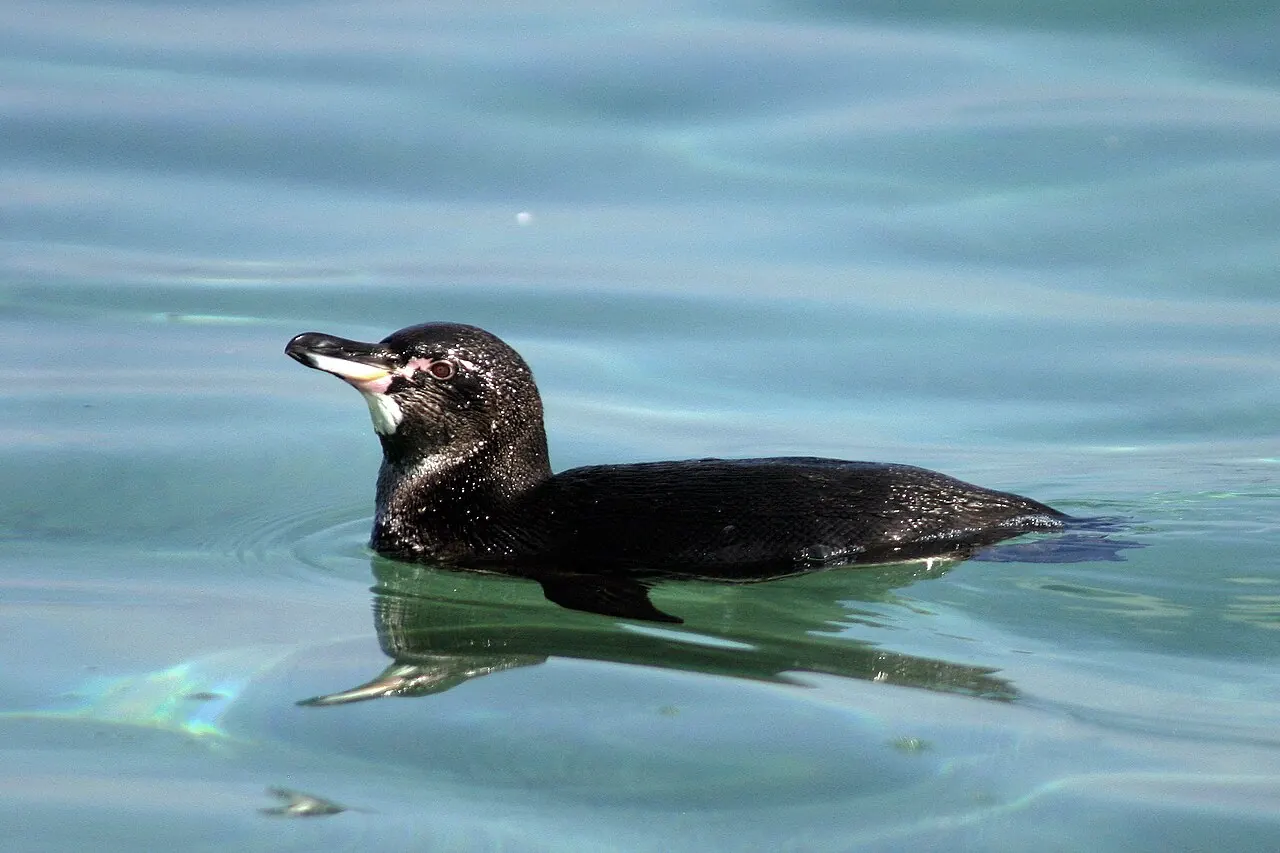
Galápagos Penguin
Spheniscus mendiculus
The rarest penguin and the only one living at the Equator, a small Galápagos bird whose numbers rise and fall with El Niño.
Photo: Charles J. Sharp / CC BY-SA 3.0
3 things to know
- It is the only penguin that lives at the Equator.
- Tagged birds spent 90 percent of their underwater time shallower than 6 m (20 ft).
- Biologist Dee Boersma estimates only about 2,000 are left.
- Scientific name
- Spheniscus mendiculus
- Depth
- 0 m – 6 m
0 – 20 ft - Size
- About 53 cm (21 in) long
- Weight
- About 1.7–2.6 kg (3.7–5.7 lb)
- Lifespan
- Up to about 15–20 years in the wild; most die younger
- Diet
- Small fish such as anchovies and sardines, plus crustaceans
- Where
- Galápagos Islands, Ecuador, mostly Fernandina and Isabela
- IUCN status
- Endangered
- Depth zones
- Sunlight
The Galápagos penguin is the only penguin that lives at the Equator, on volcanic islands under a hot sun. It is also the rarest penguin and one of the smallest, about 53 centimeters (21 inches) long and 1.7 to 2.6 kilograms (3.7 to 5.7 pounds), and adults have a white line around the cheek. Genetic studies suggest it descended from Humboldt penguins roughly two million years ago, when ancestors probably rode the cold, northbound Humboldt Current to the islands.
Most Galápagos penguins live on the two large western islands, Fernandina and Isabela, where the cold Cromwell Current brings food close to shore. They hunt small fish such as anchovies and sardines in coastal waters, and they stay shallow. Between 2004 and 2005, Antje Steinfurth and colleagues fitted 23 breeding adults on Isabela with GPS and depth recorders. The birds foraged mostly within 1 kilometer (0.6 mile) of shore; the deepest dive was 52.1 meters (171 feet), but on average they spent 90 percent of their underwater time shallower than 6 meters (20 feet).
Keeping cool matters as much as keeping warm. The birds nest in shady cracks and lava tunnels, pant like dogs, and hold their flippers out to shed heat. They have no fixed breeding season. They molt and breed when cool, food-rich water arrives, as often as two or three times a year, and simply wait when it does not.
That makes them hostage to El Niño, which pushes warm water over the islands and cuts off their food. Conservation biologist Dee Boersma of the University of Washington, who has studied them for about five decades, found their breeding tightly linked to El Niño and La Niña cycles; during a severe El Niño in the early 1980s the population fell by more than half. She estimates there are maybe 2,000 left, less than half as many as when she began. Introduced cats and rats raid nests, and in October 2023 the Galápagos National Park and the group Jocotoco began removing them from Floreana Island, where Boersma's team hopes artificial lava nests can help penguins return. Wild birds can live 15 to 20 years, though most die younger, and the IUCN lists the species as Endangered.



