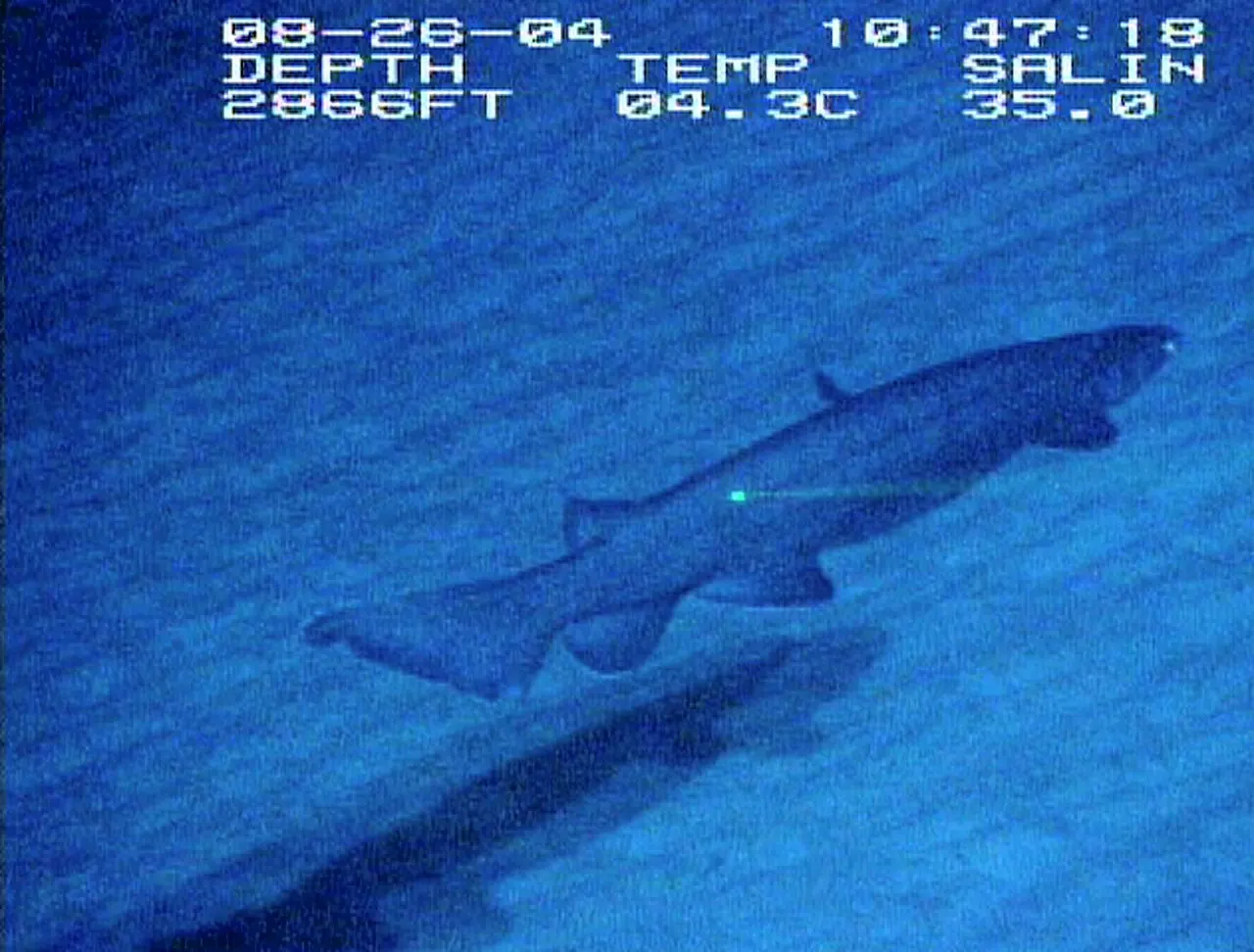
Frilled Shark
Chlamydoselachus anguineus
An eel-shaped deep-sea shark with six gill slits whose pregnancy is estimated to last at least three and a half years.
Photo: NOAA / Public domain
3 things to know
- It has six gill slits on each side, and the first pair meets across the throat.
- Its mouth sits at the very front of the head, lined with three-pointed teeth.
- Researchers in Japan estimated its pregnancy lasts at least three and a half years.
- Scientific name
- Chlamydoselachus anguineus
- Depth
- 120 m – 1,280 m
394 – 4,200 ft - Size
- Up to about 2 m (6.6 ft) long
- Weight
- Not well known; newborns weigh about 380 g (13 oz)
- Lifespan
- Unknown
- Diet
- Squid, bony fish and other sharks
- Where
- Patchy in deep water of the Atlantic, Pacific and western Indian oceans
- IUCN status
- Least Concern
- Depth zones
- Sunlight · Twilight · Midnight
Long, slender and dark brown or gray, the frilled shark looks more like an eel than most people's idea of a shark. It has six gill slits on each side, and the lower ends of the first pair meet across the throat. The mouth sits at the very front of the head rather than underneath, and both jaws carry rows of three-pointed teeth. FishBase notes they are sharp enough to cut the hands of a scientist who handles one carelessly.
Frilled sharks live on outer continental and island shelves and upper slopes, usually 120 to 1,280 meters (about 390 to 4,200 feet) down, though one is occasionally caught at the surface. Records are patchy but widespread: Japan to New Zealand, Southern California to northern Chile, northern Norway to Namibia, and a handful from the western Atlantic. The shark grows to about 2 meters (6.6 feet) and eats squid, bony fish and other sharks. It is an uncommon catch in bottom trawls and is sometimes used for fishmeal or food.
Most of what is known about its breeding comes from Japan's Suruga Bay. Sho Tanaka and colleagues at Tokai University examined 264 frilled sharks caught there and found that females have no fixed breeding season. Embryos grow inside the mother, live mainly on yolk and shed a thin capsule at 6 to 8 centimeters. Litters range from 2 to 10, and pups are born about 55 centimeters (22 inches) long, weighing about 380 grams (13 ounces).
Their 1990 report estimated the pregnancy lasts at least three and a half years, based partly on embryos that grew only 10 to 17 millimeters a month in tanks. No one has timed a full pregnancy, and FishBase gives a shorter estimate of one to two years.
The IUCN lists the frilled shark as Least Concern. Scientists long treated every frilled shark as one species, but in 2009 David Ebert and Leonard Compagno described a second, the southern African frilled shark (Chlamydoselachus africana), which looks almost identical from the outside and is told apart by its skull, backbone and fin supports.



