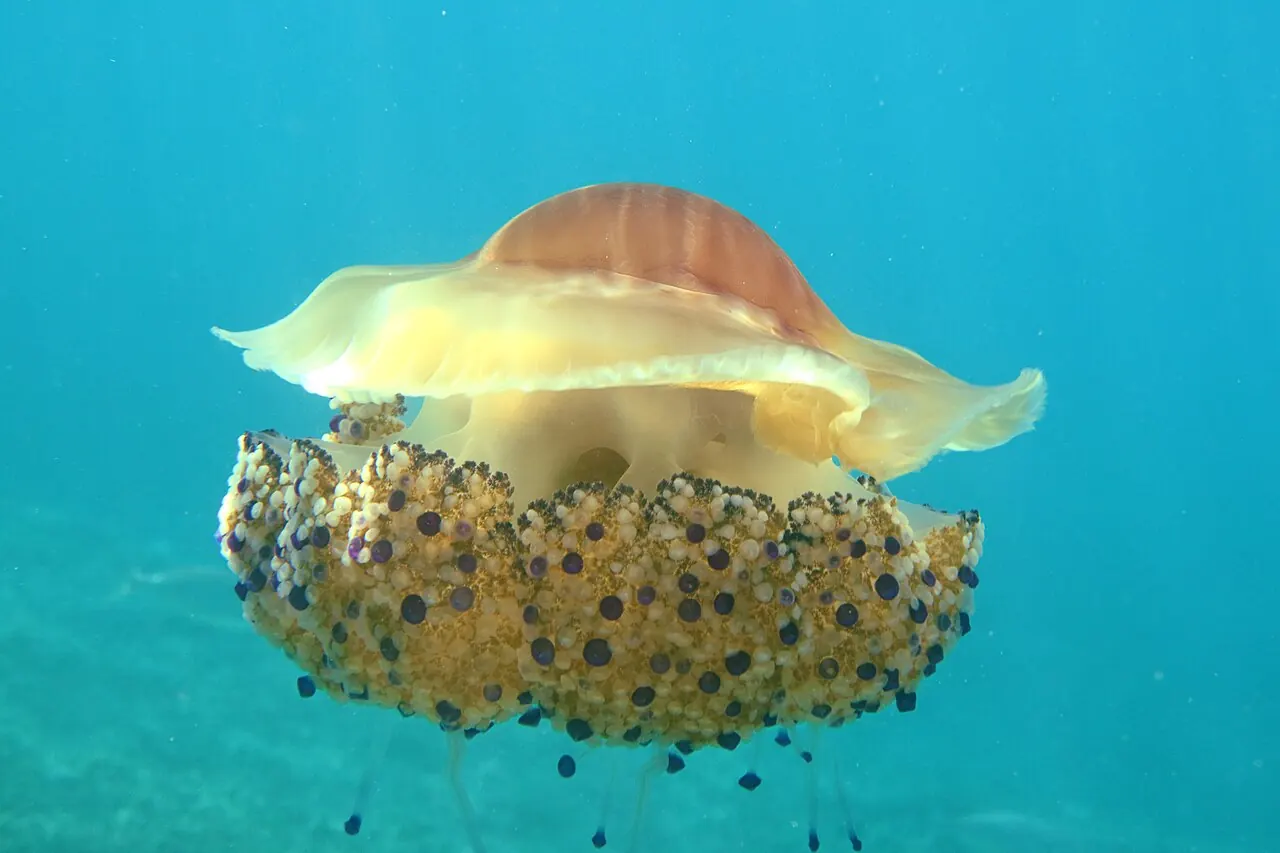
Fried Egg Jellyfish
Cotylorhiza tuberculata
A Mediterranean jellyfish shaped like an egg in a pan, fed partly by algae in its tissues, whose summer swarms fill a Spanish lagoon.
Photo: Holger Krisp / CC BY 3.0
3 things to know
- Algae living in its tissues, of the same family found in corals, help feed it.
- In Spain's Mar Menor lagoon, cleanup programs have removed more than 5,000 tons during its biggest summers.
- Lab work found that water temperature, acting on the polyps, is the critical factor in its blooms.
- Scientific name
- Cotylorhiza tuberculata
- Depth
- 0 m – 7 m
0 – 23 ft - Size
- Bell averages about 35 cm (14 in) across and reaches about 40 cm (16 in)
- Weight
- Not well known
- Lifespan
- Not well known; the medusae are seen mainly from July to November
- Diet
- Fine plankton caught by its oral arms, plus food made by algae living in its tissues
- Where
- Mediterranean Sea, including the Adriatic and Aegean
- IUCN status
- Not Evaluated
- Depth zones
- Sunlight
Seen from above, Cotylorhiza tuberculata looks like an egg in a pan: a raised golden dome in the middle of a flat, pale rim. Oceana gives an average bell width of about 35 centimeters (14 inches), and SeaLifeBase a maximum of 40 centimeters (16 inches). Short oral arms hang underneath, crinkled and studded with knobbed appendages tipped in violet or white. They carry stinging cells, but the sting is generally harmless to people.
It lives in the warm Mediterranean, including the Adriatic and Aegean seas, and swims close to the surface; SeaLifeBase gives a depth range of 0 to 7 meters (23 feet). The free-swimming jellyfish are met mainly from July to November, sometimes in swarms several kilometers long. Small polyps on the bottom bud off new jellyfish in spring.
Part of the golden color comes from lodgers. Single-celled algae of the family Symbiodiniaceae, the family of algae that also lives inside corals, fill its tissues, most densely in the oral arms. The algae pass on food they make by photosynthesis, and the jellyfish also strains fine plankton through its arms. In a 2022 study in Frontiers in Marine Science, Angélica Enrique-Navarro, Laura Prieto and colleagues at Andalusia's marine sciences institute in Spain found that the bell tissue absorbs ultraviolet light, which they suggested shields the algae from harmful rays.
The species is best known for its outbreaks in the Mar Menor, a shallow, salty lagoon on Spain's Mediterranean coast covering about 135 square kilometers (52 square miles). There is no record of it there before the lagoon's channel to the sea was deepened and widened in the 1970s. Since the early 1990s its summer swarms have been a problem for swimmers, and local authorities have used fishing boats and nets against them, removing more than 5,000 tons in the worst summers. In 2010, Prieto's team reported in PLoS ONE that temperature, through its effect on the polyps, is the critical factor: it controls both their survival and their release of young jellyfish.
The name is shared. SeaLifeBase also lists Phacellophora camtschatica as the fried egg jellyfish, a bigger jelly that the Monterey Bay Aquarium calls the egg-yolk jelly and counts among the bigger jellies common in Monterey Bay. Neither species has been assessed for the IUCN Red List.
Sources
- oceana.org
- sealifebase.se/summary/Cotylorhiza-tuberculata.html
- Study: doi:10.3389/fmars.2022.817312
- pmc.ncbi.nlm.nih.gov/articles/PMC2972201
- sealifebase.se/summary/Phacellophora-camtschatica.html
- montereybayaquarium.org/animals/animals-a-to-z/egg-yolk-jelly
- api.gbif.org/v1/species/2264578/iucnRedListCategory
- aquariumboka.ucg.ac.me/en/vrsta/fried-egg-jellyfish
- visitsealife.com/london/information/news/meet-our-very-own-fried-egg-jellyfish-sea-life…



