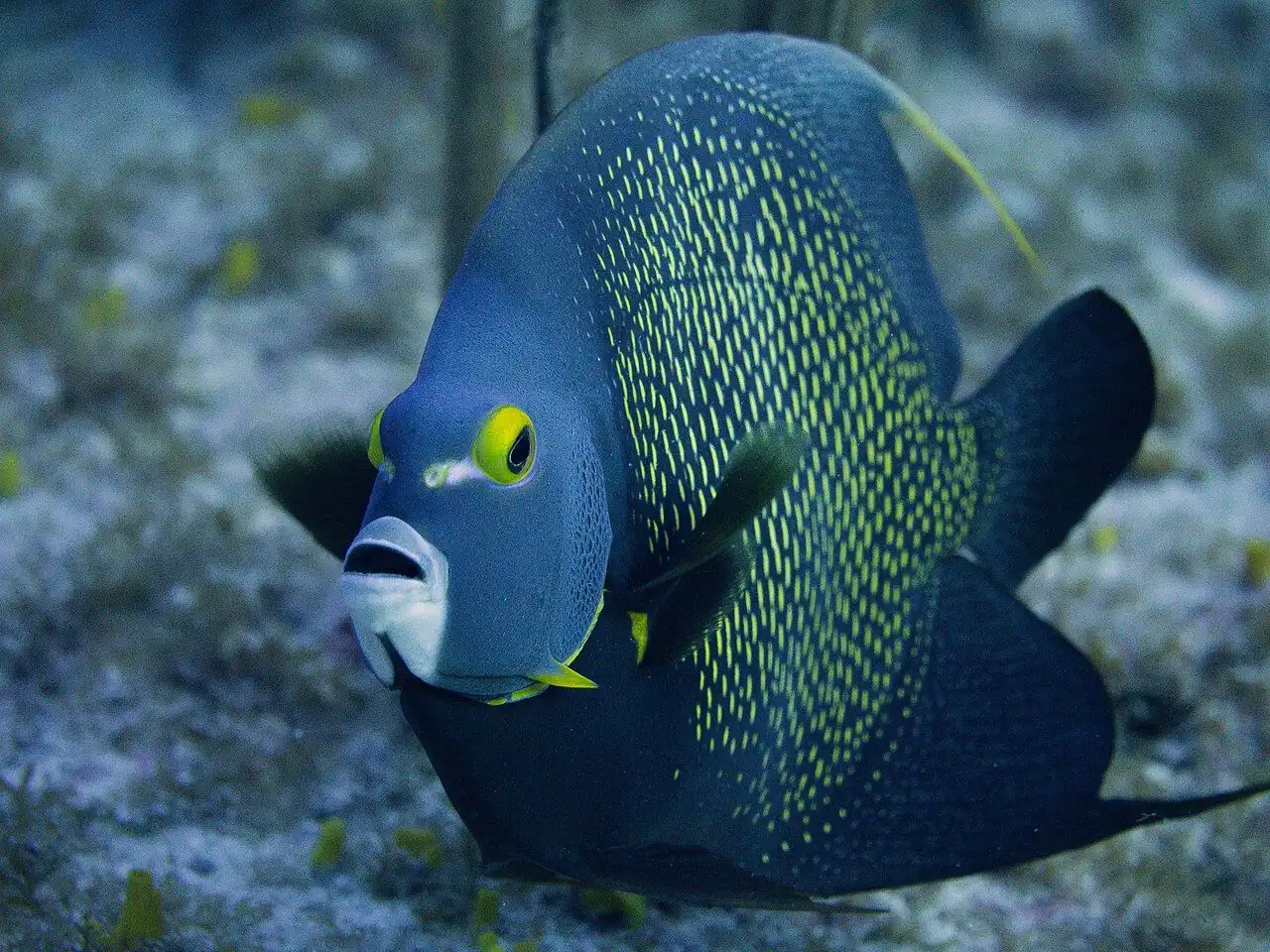
French Angelfish
Pomacanthus paru
A black-and-gold angelfish of Florida and Caribbean reefs that lives in faithful pairs, while its young run cleaning stations.
Photo: Dan Schofield / CC BY 4.0
3 things to know
- Adults live in what appear to be permanent pairs.
- Juveniles clean parasites off jacks, snappers, morays and other fish.
- The oldest French angelfish on record was 27 years old.
- Scientific name
- Pomacanthus paru
- Depth
- 3 m – 100 m
10 – 328 ft - Size
- Up to about 41 cm (16 in) long
- Weight
- Not well known
- Lifespan
- At least 27 years (oldest fish in an ear-stone ageing study)
- Diet
- Mostly sponges, plus algae, bryozoans, zoanthids, gorgonians and tunicates
- Where
- Western Atlantic from Florida and the Bahamas to Brazil, including the Gulf of Mexico and the Caribbean; also Ascension Island and St. Paul's Rocks
- IUCN status
- Least Concern
- Depth zones
- Sunlight
French angelfish are almost always seen two at a time. Adults are black, with every scale behind the head rimmed in golden yellow, a yellow streamer trailing from the dorsal fin, a whitish chin and a yellow ring in the eye. They grow to about 41 centimeters (16 inches); the Florida Museum gives a maximum of 61 centimeters (24 inches), larger than the FishBase figure. Divers know them as curious fish that swim right up to snorkelers.
The species lives in the western Atlantic, from Florida and the Bahamas to Brazil, including the Gulf of Mexico and the Caribbean, with outposts at Ascension Island and St. Paul's Rocks in the middle of the ocean. It is most often seen in shallow water on reefs, frequently near sea fans, though it has been recorded down to 100 meters (330 feet).
The pairs appear to be permanent. Researchers describe the species as monogamous, and spawning pairs hold territories, usually with both partners chasing off neighboring pairs. One field description, summarized in FishBase, follows a pair at spawning time. Shortly after sunset, the two fish rose off the bottom in a broad, shallow arc, covering 7 to 10 meters (23 to 33 feet) while climbing 2 to 3 meters, with their bellies close together or touching. Other pairs on the reef made the same arc at about the same time, without interfering with one another. The Florida Museum gives the spawning season as April through September.
Juveniles look nothing like their parents. They are dark brown to black with three thick yellow bars, and they run cleaning stations on the reef. Clients include jacks, snappers, morays, grunts, surgeonfishes and wrasses. The young cleaner flutters as it swims and touches its customers with its pelvic fins while picking off parasites.
Adults eat mostly sponges, along with algae, bryozoans, zoanthids, gorgonians and tunicates. A 2017 study that aged fish from the southwestern Atlantic by their ear stones found individuals up to 27 years old, far beyond the 10 years the Florida Museum gives. The fish is eaten in parts of its range and prized for public and home aquariums, and it has been reared in captivity. The IUCN lists the French angelfish as Least Concern, from a 2009 assessment.



