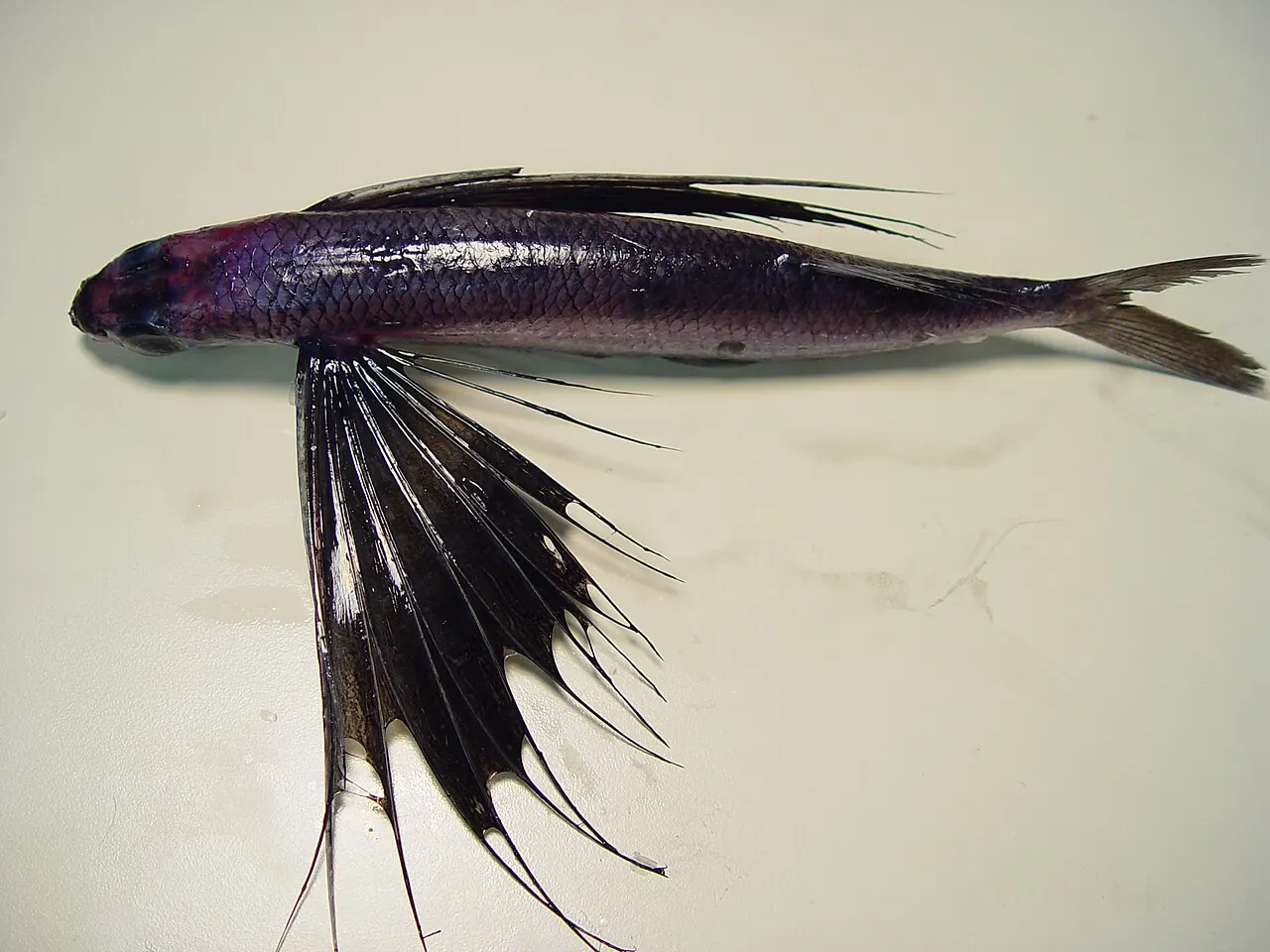
Flying Fish
Exocoetidae
Small ocean fish with wing-like fins that burst out of the water and glide over the waves, sometimes for hundreds of meters.
Photo: SEFSC Pascagoula Laboratory, NOAA/NMFS/SEFSC (Brandi Noble collection) / Public domain
3 things to know
- FishBase lists 75 species of flying fish.
- The longest flight on record, filmed off Japan in 2008, lasted 45 seconds.
- Their gliding performance compares with the wings of hawks and petrels.
- Scientific name
- Exocoetidae
- Depth
- 0 m – 20 m
0 – 66 ft - Size
- Up to about 45 cm (18 in); most species under 30 cm (12 in)
- Weight
- Varies by species; not well documented
- Lifespan
- Not well known; about one year in the fourwing flyingfish
- Diet
- Crustaceans and other plankton
- Where
- Warm surface waters of the Atlantic, Indian and Pacific oceans
- IUCN status
- Varies by species
- Depth zones
- Sunlight
Pectoral fins so long they spread like wings are the mark of a flying fish. In some species, called four-wingers, the pelvic fins farther back are enlarged too. The tail is deeply forked, with the lower lobe longer than the upper, and the body is often iridescent blue or green on top and silvery below. FishBase lists 75 species in seven genera, all in the family Exocoetidae. The largest reach about 45 centimeters (18 inches), and most stay under 30 centimeters (12 inches).
Flying fish live at the surface of warm seas in the Atlantic, Indian and Pacific oceans, including the Gulf of Mexico and the Caribbean, often in schools and both near shore and far out to sea. The tropical two-wing flyingfish, found in warm seas worldwide, keeps to the top 20 meters (66 feet). They eat crustaceans and other small plankton, and they are food for swordfish, tunas and many other large ocean fish.
A flying fish leaves the water at a steep angle, around 30 to 35 degrees, then spreads its fins and glides. Guinness World Records puts a typical glide at about 50 meters (160 feet), with reports of fish covering as much as 400 meters (1,300 feet) and leaping as high as 6 meters (20 feet). The longest timed flight, 45 seconds, was filmed by a crew from Japan's NHK from a ferry in 2008. Measuring the forces on models of the darkedged-wing flying fish, found off Japan and South Korea, Hyungmin Park and Haecheon Choi found gliding performance comparable to the wings of a hawk, petrel or wood duck, and less drag when the fish skimmed close to the sea surface.
The fourwing flyingfish of the Caribbean spawns from the surface down to about 20 meters, and deaths after spawning may explain why mature fish disappear at the end of the season. Its maximum reported age is one year. It is also the most important commercial fish in the eastern Caribbean. Eggs of the blackwing flyingfish carry tufts of filaments.
The IUCN lists some species, such as the tropical two-wing and fourwing flyingfish, as Least Concern, while others, including the darkedged-wing flying fish, have never been evaluated.



