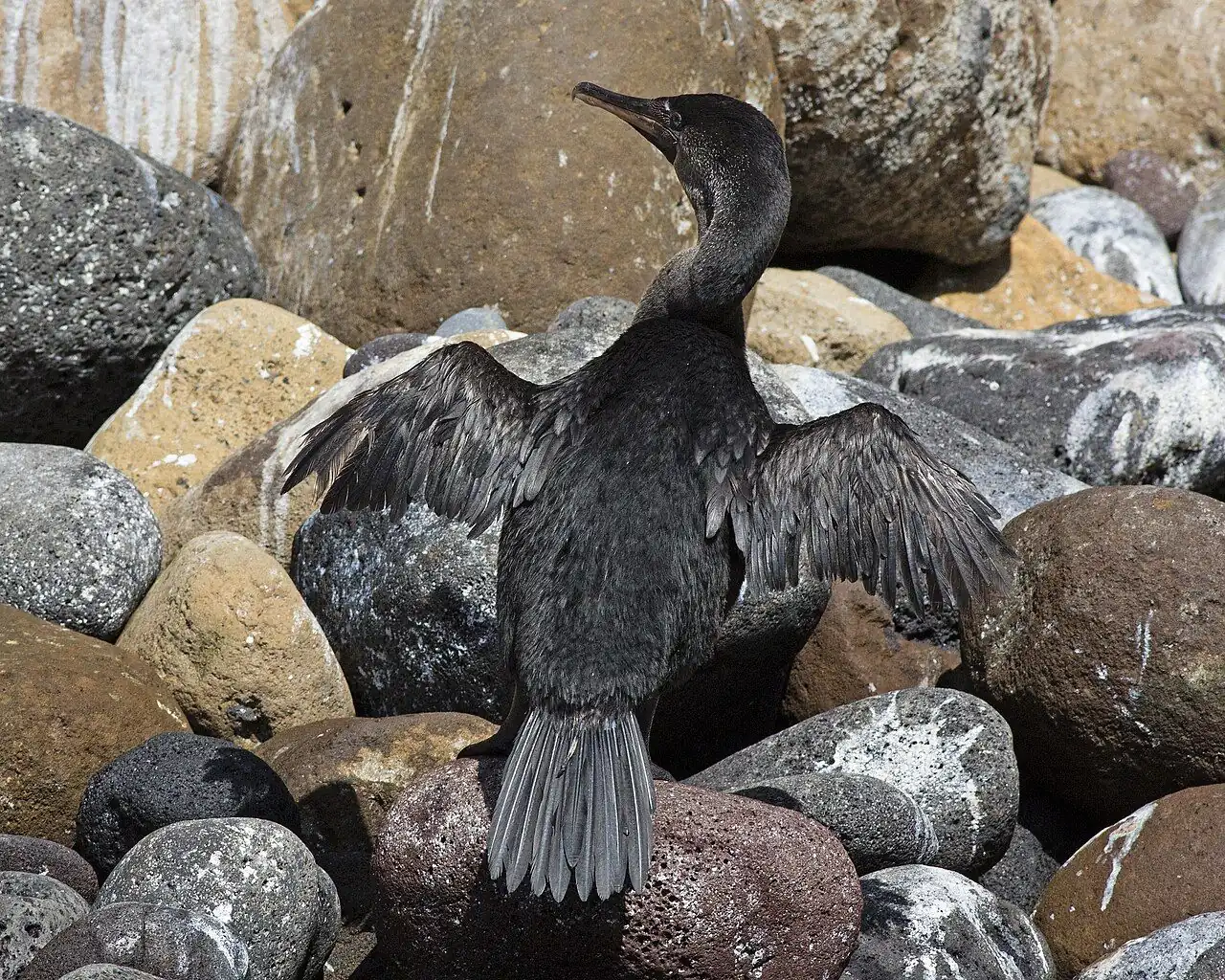
Flightless Cormorant
Nannopterum harrisi
The only cormorant that cannot fly, a Galápagos seabird with stubby wings that hunts eels and octopuses on the seabed close to shore.
Photo: Lip Kee / CC BY-SA 2.0
3 things to know
- Its wings are about a third of the size it would need to fly.
- In one study more than 90 percent of its dives were in water under 15 m (50 ft) deep, but one reached 73 m (240 ft).
- A 2020 census estimated 2,290 birds, the most since counts began in 1977.
- Scientific name
- Nannopterum harrisi
- Depth
- 0 m – 15 m
0 – 49 ft - Size
- About 90 cm (3 ft) long on average, up to about 1 m (3.3 ft)
- Weight
- About 3 kg (6.6 lb) on average, up to about 5 kg (11 lb)
- Lifespan
- Not well known
- Diet
- Eels, octopuses and fish caught on the seabed
- Where
- Galápagos Islands only: the coasts of Fernandina and of northern and western Isabela
- IUCN status
- Vulnerable
- Depth zones
- Sunlight
No other cormorant has given up flying. The Galápagos bird's wings are stubby and ragged, about a third of the size it would need to get airborne, and it is the heaviest of the cormorants: about 90 centimeters (3 feet) long and 3 kilograms (6.6 pounds) on average, up to about 5 kilograms (11 pounds). Adults are black above and dark brown below, with turquoise eyes. After a swim a bird often stands on the rocks holding its wings out to dry.
It lives nowhere but the western Galápagos, on the coasts of Fernandina and of northern and western Isabela, where it nests near the coldest, richest water. Birds stay close to home. Over three breeding seasons, Wilson and colleagues fitted depth recorders to 46 cormorants and GPS units to 30, and reported in 2008 that they fed a mean of 690 meters (about 2,260 feet) from the nest and only 230 meters from the coast. More than 90 percent of dives were in water less than 15 meters (50 feet) deep, though one reached 73 meters (240 feet). Underwater the bird tucks in its wings, kicks with its feet and pulls eels, octopuses and fish from holes in the rocks.
Pairs nest in small groups a few meters from the sea, mostly in the cooler months when food is richest. The Galápagos Conservation Trust says the female often leaves the male to finish raising the chick and starts another nesting attempt, up to three in a season.
In 2017 Alejandro Burga, Leonid Kruglyak and colleagues at UCLA compared its genome with those of three other cormorant species. The flightless bird had an unusually high number of mutations affecting cilia, tiny hair-like structures on cells that help control bone growth, and a mutation in a gene called CUX1 that the team had never seen in other animals. When the same genes go wrong in people, they cause skeletal ciliopathies, with shorter limbs and narrow chests.
The IUCN lists the species as Vulnerable because it lives in only two locations. El Niño years are the big danger: after the 1982–83 event the population fell to about 400 birds and its breeding failed completely, though it recovered. A 2020 census by the Charles Darwin Foundation and the national park estimated 2,290 flightless cormorants, the most since counts began in 1977.
Sources
- datazone.birdlife.org/species/factsheet/flightless-cormorant-nannopterum-harrisi/text
- iucnredlist.org/species/22696756/133546087
- galapagosconservation.org.uk/species/flightless-cormorant
- Study: doi:10.1890/07-0677.1
- Study: doi:10.1126/science.aal3345
- newsroom.ucla.edu/releases/how-the-galapagos-cormorant-lost-its-ability-to-fly
- darwinfoundation.org/en/news/newsroom/population-records-for-the-galapagos-penguin-and-…



