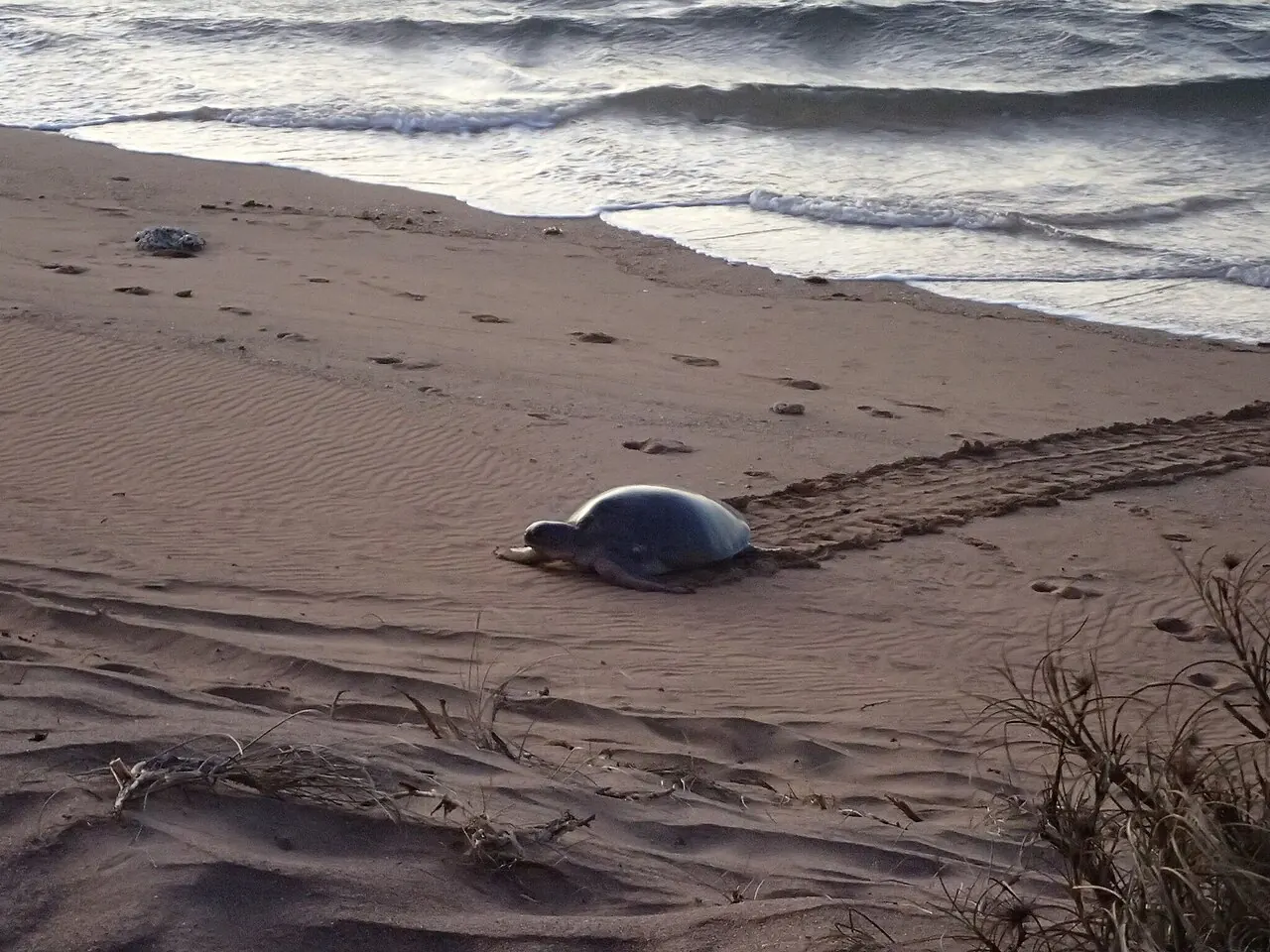
Flatback Sea Turtle
Natator depressus
Australia's own sea turtle, which nests only there, lays the fewest eggs of any sea turtle and skips the open-ocean stage.
Photo: Hugo Innes / CC BY 4.0
3 things to know
- It has the smallest range of the seven sea turtle species.
- Females lay about 50 eggs per nest, the fewest of any sea turtle.
- Its hatchlings stay on the continental shelf instead of heading out into the open ocean.
- Scientific name
- Natator depressus
- Depth
- 0 m – 60 m
0 – 197 ft - Size
- Shell up to about 1 m (3.3 ft) long
- Weight
- Usually about 70 kg (154 lb); SEE Turtles gives about 90 kg (200 lb)
- Lifespan
- Unknown
- Diet
- Soft-bodied animals such as sea cucumbers, soft corals and jellyfish
- Where
- Continental shelf of northern Australia, southern Indonesia and southern Papua New Guinea; nests only in Australia
- IUCN status
- Data Deficient
- Depth zones
- Sunlight
Australia has a sea turtle of its own. Every known breeding site of the flatback is in tropical Australia, and adults feed on the continental shelf across northern Australia and into southern Indonesia and southern Papua New Guinea. That is the smallest range of the seven sea turtle species. The name comes from the shell, which is smooth and flatter-domed than other sea turtles' shells, with upturned edges. An adult's shell can grow to about 1 meter (3.3 feet) long. Weights vary by source: Animal Diversity Web says adults usually weigh about 70 kilograms (154 pounds), and SEE Turtles gives about 90 kilograms (200 pounds). How long flatbacks live is not known.
Flatbacks prefer inshore waters where they can feed on shallow seabeds, and they are usually found in water less than 60 meters (200 feet) deep. They eat soft-bodied animals such as sea cucumbers, soft corals and jellyfish. In a 2025 study, Jenna Hounslow and colleagues tracked 42 adult flatbacks at a site in Western Australia with very large tides, using motion sensors, animal-borne video and GPS. The most suitable places for both feeding and resting were shallow, 10 to 15 meters (33 to 49 feet) deep, and 5 to 10 kilometers (3 to 6 miles) from the coast, with water closest to shore better suited to feeding than to resting.
Their breeding sets them apart from other sea turtles. A flatback lays about 50 eggs per nest, the fewest of any sea turtle, but its eggs and hatchlings are large for the species' size. The hatchlings also skip the open-ocean stage that most young sea turtles go through. In 1990 Terry Walker and John Parmenter reported that flatback hatchlings lack an oceanic dispersal phase altogether; they spread out through inshore waters and stay on the continental shelf.
On nesting beaches, feral pigs dig up and eat eggs, vehicles and coastal development disturb nests, and lights from houses and shops can lead hatchlings the wrong way. At sea, flatbacks drown in discarded fishing nets and get caught in trawls. Many nesting sites lie on Aboriginal or Torres Strait Islander land, and partnerships with those communities have been critical to what is known about the species. The IUCN lists the flatback as Data Deficient, from an assessment made in 1996, while it is listed as Vulnerable under Australia's national Environment Protection and Biodiversity Conservation Act.
Sources
- qld.gov.au/environment/plants-animals/animals/discovering-wildlife/turtles/species/flat…
- seeturtles.org/flatback-turtle
- animaldiversity.org/accounts/Natator_depressus
- environment.nsw.gov.au/sites/default/files/2024-09/assessment-vagrant-species-flatback-…
- seaturtlestatus.org/articles/2009/1/27/the-flatback-australias-own-sea-turtle
- Study: doi:10.2307/2845123
- Study: doi:10.1002/eap.70095
- en.wikipedia.org/wiki/Flatback_sea_turtle



